
How Agencies Win New Clients: From Free GEO Score to Branded Health Reports
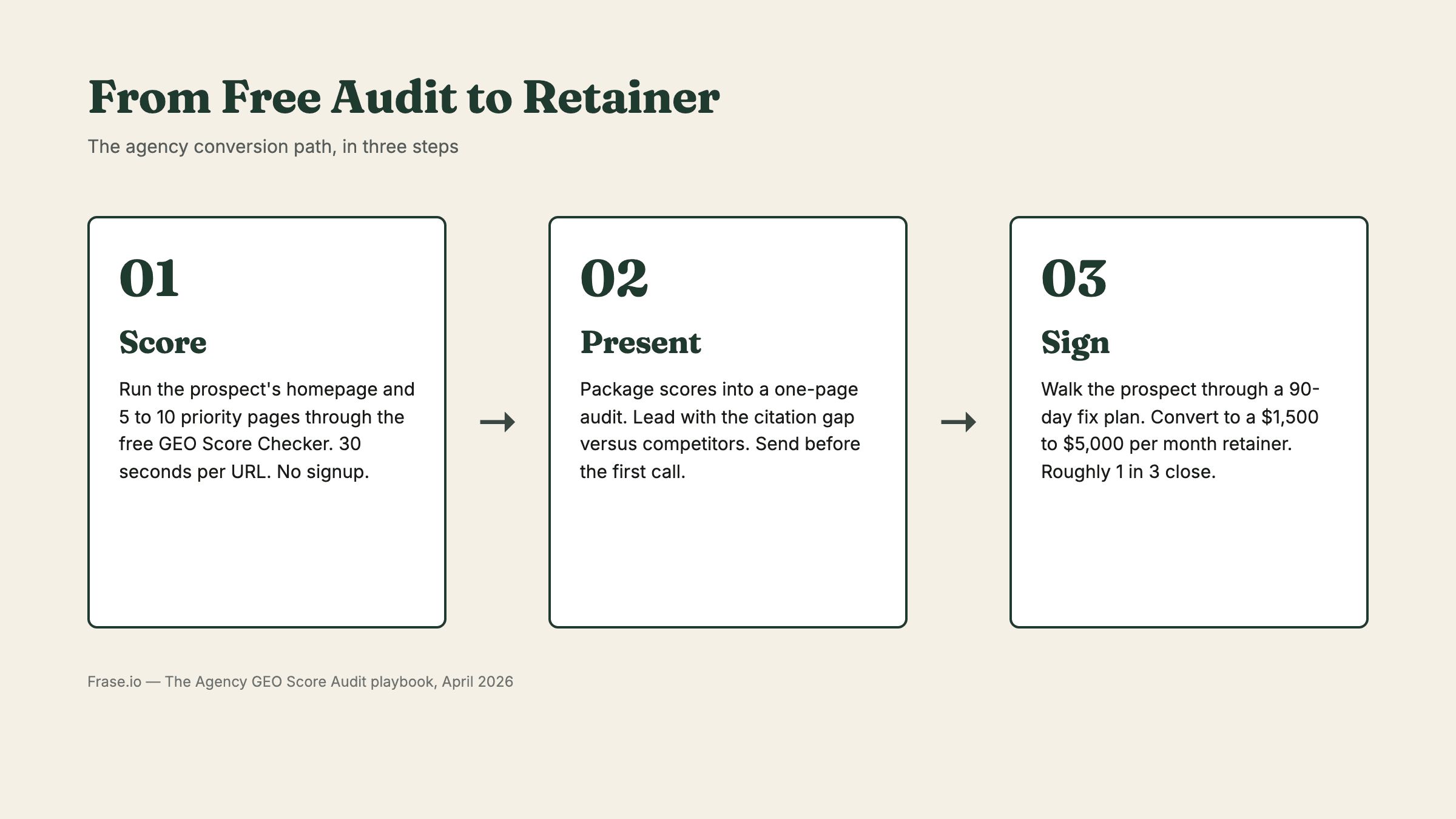
The agency playbook for AI search: free GEO Score audit, in-app diagnosis, branded Health Report PDF, retainer.
A free audit has been an agency's best sales weapon for two decades. The medium changes. The mechanic does not.
In 2007, HubSpot launched Website Grader. Type a URL, get a score, get a list of fixes. The tool produced more than 500,000 reports and Dharmesh Shah credited it as a load-bearing piece of HubSpot's path to a NASDAQ listing. Same playbook, updated for AI search, is what wins agencies their next retainer in 2026.
The free GEO Score Checker is the entry point. The Frase application is the playbook. This post walks through the full conversion ladder: how to use the free tool to start a conversation, how to diagnose the gap inside Frase, how to deliver a branded Health Report PDF that justifies a retainer, and how Content Guard keeps the engagement compounding without scaling agency headcount.
TL;DR
- Free GEO Score Checker scores one URL in 30 seconds. No login, no email gate to see a score. Use it to open the conversation, not to deliver the engagement.
- The honest gap of the free tool: it is stateless. No history, no client tagging, no rescore loop, no comparison view. It is a snapshot, not a system.
- The agency operating tier is Frase Scale at $299/mo: 10 client domains, 1,000 audit pages a month, 50 monitored articles, 12 months of historical data, interactive Audit Reports, exportable Health Report PDFs.
- The retainer-defender tier is Enterprise: white-label client portal with your logo, your colors, your custom domain (CNAME-verified), your email sender, unlimited domains, SSO. The "Generated by Frase" footer rewrites to "Generated by [Your Agency]" automatically.
- Content Guard closes the loop: weekly scans detect decay, suggestions auto-apply under the policy you set, the new draft is pushed back to WordPress, Sanity, Webflow, Wix, or FraseCMS without anyone opening the editor.
- Retainer math, segmented honestly: boutique/SMB $1,500–$5,000/mo, mid-market $5,000–$10,000/mo, enterprise $10,000–$50,000+/mo. Content-led retainers skew higher than pure SEO.
Why the Free Audit Still Wins (in 2026)
The mechanic that worked for HubSpot still works because the underlying psychology has not changed. A specific score on the prospect's site is more persuasive than any pitch deck. The only thing that has changed is what gets scored.
In January 2026, Google made Gemini 3 the default model for AI Overviews. Roughly 42% of previously cited domains were replaced according to a 100,000-keyword SE Ranking study. The overlap between top-10 organic ranking and AI Overview citation collapsed from 76% to between 17% and 38%, depending on dataset. The Gemini 3 reset playbook covers what changed and what to do about it.
Translation for an agency: prospects are watching their organic numbers move in ways their current SEO vendor cannot explain. The agency that walks in with a GEO Score audit is the one that gets the renewal call.
The market backdrop carries the rest of the case. The generative engine optimization services market was valued at roughly $1.01 billion in 2025 and is projected to reach $17.02 billion by 2034 at a 45.5% CAGR. LLM visitors convert at 4.4x the rate of average organic search visitors per Semrush's June 2025 study. Brands cited in AI Overviews earn 35% more organic clicks and 91% more paid clicks than non-cited brands on the same queries (Seer Interactive, 3,119-query study).
Demand is there. The agencies running a free audit in front of it convert disproportionately.
What the Free GEO Score Checker Actually Does (and What It Doesn't)
The free tool exists for one job. Score one URL. Show the score, show the five fixes. Get the prospect leaning in.
What it does, well:
- Returns a 0–100 GEO Score that summarizes how citation-ready the page is across the quality signals AI engines use to choose what to quote.
- Runs the same scoring engine the paid product uses inside Frase. Score parity is real.
- Works on any public URL. No login, no email required to see the result.
- Returns in roughly 30 seconds.
What it does not do, by design:
- No history. The score is not saved. Re-run tomorrow and yesterday's score is gone.
- No multi-page view. One URL per request. No site-wide rollup.
- No client tagging. You cannot label which prospect a score came from.
- No rescore loop. Edit the page, the free tool will not tell you whether the edit improved anything.
- No comparison. No competitor scoring side by side. No deltas over time.
This is the gap to be honest about. The free tool is the wedge. It opens the door. It is not the engagement.
The honest framing for the agency pitch: "I scored your homepage at 54. Your top two competitors are at 81 and 76. The free tool tells you the gap exists. To diagnose why, fix it, and prove the lift, you need the system that runs underneath." That system is Frase.
The Agency Operating Tier: Frase Scale ($299/mo)
Scale is the configuration that turns one URL of free signal into a multi-client production system.
What changes versus the free tool:
| Capability | Free Tool | Frase Scale ($299/mo) |
|---|---|---|
| Domains | 1 URL per request | 10 client domains |
| Audit pages | 1 at a time | 1,000 a month |
| Monitored articles | 0 | 50 |
| Historical data | None | 12 months |
| Score persistence | None | Every score saved per URL |
| Audit context | GEO only | GEO + SEO + AEO + E-E-A-T side by side |
| Rescore after edits | No | Automatic on every draft |
| Site-wide auditor | No | Yes, bulk |
| Auto internal-linking | No | Yes |
| Atomization (long-form → derivatives) | No | Yes |
| Health Report PDF export | No | Yes |
| Seats | n/a | Multi-seat with project-level visibility |
The two surfaces an agency strategist lives in on Scale:
The Audit Report (interactive, in-app). Lives at /auditor/[id]. Per-page diagnostic. GEO, SEO, AEO, and E-E-A-T scores on the same screen, severity-grouped issues, the specific fixes ranked. This is the screen the agency strategist works from. It is not designed for client delivery.
The Health Report (PDF, exportable). A token-gated executive summary suitable for the client. Site-level. Renders the headline numbers, the trend lines, the priority pages, and the next-quarter plan. This is what the agency hands to the client at month-end. Think of it this way: diagnose with the Audit Report, deliver with the Health Report PDF.
A working pattern on Scale: site = client domain. Project = engagement within that client. Folder = content batch within engagement. Project-level visibility settings keep the team member working on Client A from seeing Client B's drafts, even though both clients sit inside the same agency org. Multi-tenancy without the swivel-chair.
The Retainer-Defender: Enterprise
Once the engagement is real, the second-call objection is almost always the same. "We don't want to log our clients into a tool branded Frase." That is what Enterprise solves.
White-label, concretely (not a logo swap):
- Brand name that flows everywhere a client sees output.
- Logo and favicon uploaded once, applied across the portal and every PDF export.
- Primary and accent colors, hex-defined, applied to PDF headings, links, callouts.
- Custom domain for the client portal — verified by CNAME to portal.frase.io. The client logs in at
clients.youragency.com, not anywhere with "frase" in the URL. - Email sender white-labeled. Notifications come from your fromName + replyToEmail.
- Footer rewrite. The default "Generated by Frase" automatically becomes "Generated by [Your Agency]" on every export. No setting to remember. No string to find and replace.
- SSO for agency teams that need it.
- Unlimited domains. Twelve clients, eighty clients, no cap.
- Dedicated CSM.
The retainer math is what makes Enterprise work. Once an agency is at six or more active clients with a Health Report PDF deliverable going out monthly, the per-domain cost on Scale exceeds Enterprise floor. More importantly, the white-label is the asset. It is what keeps the client from wondering why they are paying for a layer between them and a tool.
Plan ladder for context: Pro $129/mo (5 domains, 250 audit pages, 15 monitored articles, 3-month history) for 1–3 client boutiques; Scale $299/mo as the default agency operating tier; Enterprise above that.
Closing the Loop: Content Guard (the Auto-Fix Layer)
Diagnosis is the first sale. Fix volume is the renewal.
Content Guard is the layer that makes a retainer scale without scaling agency headcount. It is a closed loop, not a monitoring tab.
The four phases, plain language:
- Monitor. The agency toggles
isMonitoredon an article (or the top 50 articles per client domain). Content Guard now watches them. - Diagnose. Weekly scans pull GSC clicks, impressions, position, plus the in-app GEO and SEO score deltas. Each guarded article gets a 0–100 health score and a status: healthy, monitor, refresh, or urgent.
- Apply. When decay is detected, Content Guard generates a fix. Low-risk fixes (meta improvements) auto-apply at the org's confidence threshold (default 80%). Medium-risk fixes (internal links, heading updates, FAQ additions) auto-apply only if the agency's policy allows. High-risk fixes (new sections, expansions) stay queued for human review.
- Re-publish. The new draft is pushed to the source CMS automatically. Supported providers: WordPress, Sanity, Webflow, Wix, and FraseCMS (Frase's own hosted blog). The agency's strategist reviews what was applied. Nobody opens the editor to push the change.
Plan caps on monitored articles (concurrent): Starter 3, Pro 15, Scale 50, Enterprise unlimited. Scale's 50 is enough for an agency running 6–10 active clients with the top 5–8 priority pages per client under guard.
The bigger picture for an agency that bills on retention rather than one-time audits: the work the agency was going to do manually still gets done. The strategist's job changes. Reviewing what auto-applied is faster than writing every update from scratch. The retainer that renews is the one where the client sees fewer regressions, faster fixes, and a Health Report PDF every month with the trend line going the right direction.
For the deeper how-to on guarded posts and decay detection, the AI search visibility tracking guide is the companion read.
Pricing the Engagement (Honestly)
Two anchors set the band: the one-time audit and the monthly retainer.
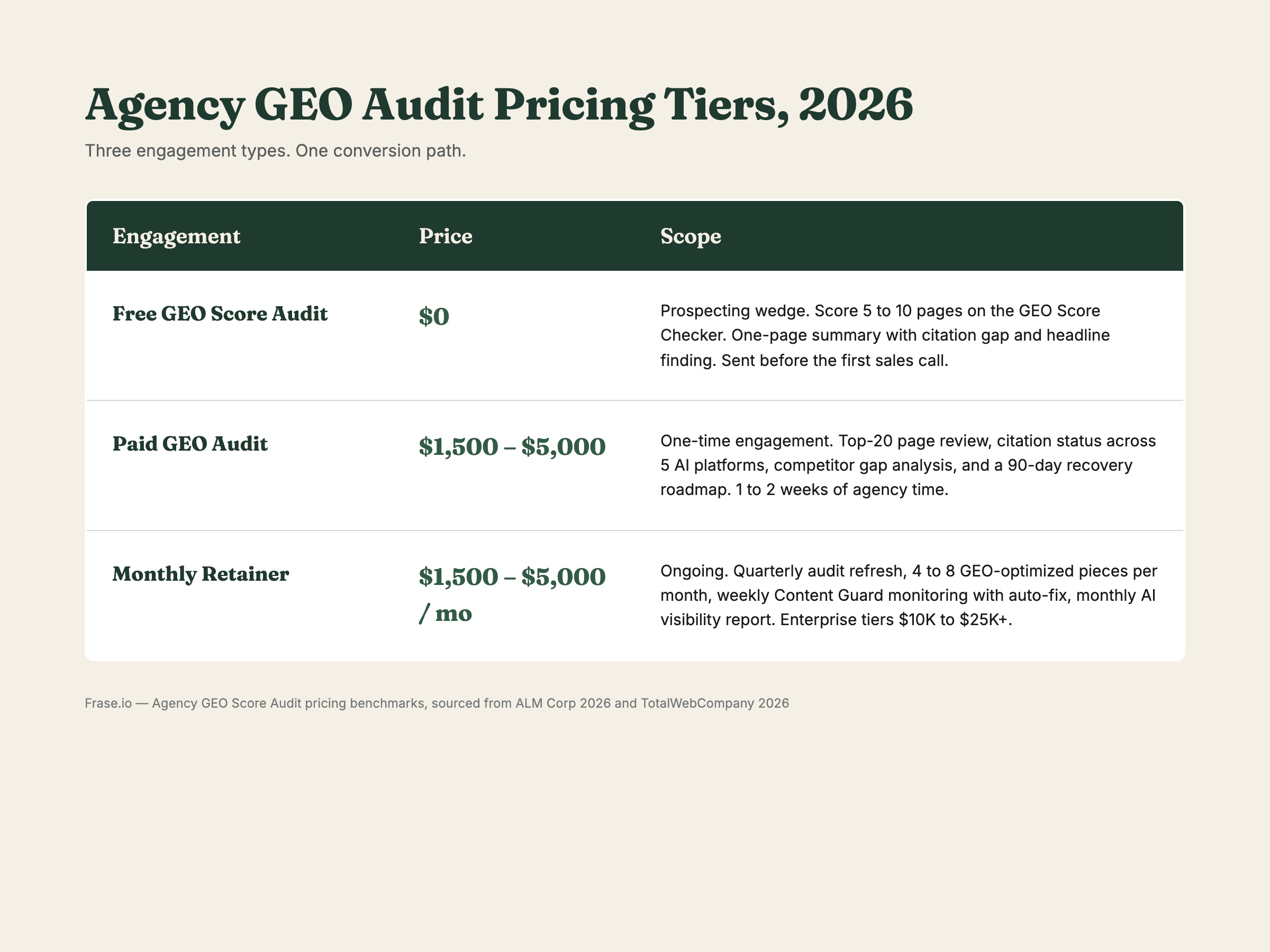
The one-time audit ($1,500 to $5,000). A foot-in-the-door product when the prospect is not ready to commit monthly. SEO audits price in the $500 to $15,000 range in 2026 per industry benchmarks (TotalWebCompany 2026), with most landing $1,500 to $3,500. GEO audits price toward the upper end because the analysis is broader: top-20 page GEO scoring, citation status across multiple AI platforms, competitor gap analysis, 90-day recovery roadmap. Roughly one in three paid audits convert to a retainer within 90 days when delivery is sharp.
The monthly retainer, segmented by client tier:
- Boutique / SMB: $1,500–$5,000/mo. (Search Logistics 2026, SE Ranking 2025 survey of 260 agencies). Weekly Content Guard monitoring, monthly Health Report, 4–8 long-form pieces, ad-hoc strategic recommendations.
- Mid-market: $5,000–$10,000/mo. (ALM Corp 2026 pricing guide, Content Matterz 2025). Quarterly GEO audit refresh per domain, 12–20 long-form pieces, custom reporting, 30-minute monthly review call.
- Enterprise: $10,000–$50,000+/mo. (ALM Corp 2026). Dedicated strategist, compliance review for regulated verticals, custom dashboards, white-label client portal as the artifact the client logs into.
- Content-specific retainers skew higher than pure SEO retainers — typical band $3,000–$12,000 (Content Matterz 2025) — because deliverables include monthly content production, not just analysis.
The fastest path to revenue, by the way, is not net-new logos. It is the upsell on the existing roster. Run the GEO audit on every current SEO client this month. Present the gap. Propose the upgrade. Average uplift across agencies that have shipped this conversion lands in the 20–30% range on existing MRR (ALM Corp benchmarks).
The quarterly review is where retainers renew or churn. Re-run the audit on the same priority pages, compare scores at month zero versus month three, cite the Health Report PDF trend lines, highlight one or two specific page-level wins. That review takes 2–3 hours to assemble inside Frase. The renewal conversation almost runs itself.
Win the Next Prospect This Week
Three actions, in order, for an agency that wants to ship a GEO audit prospecting motion in 14 days.
- Run a free [GEO Score Checker](/tools/geo-score) on three current prospects today. Pick three names from the LinkedIn pipeline or the lapsed-client list. Score one URL per prospect. Drop each result into a one-page summary (headline finding, three-bullet 90-day plan). Email each prospect with a single question: "Would it be useful if we ran the full top-20 audit?" Three cold starts becomes one or two qualified conversations within a week.
- Build the audit deliverable template once. A one-page PDF, branded for the agency. Top quarter: headline. Middle half: three-column table (URL / GEO Score / top recommendation). Bottom quarter: three-bullet 90-day plan (entity refresh on top decayed posts, FAQ schema deployment on conversion pages, Content Guard freshness loop on the top 20). The template is the asset. URL-specific scoring is the variable. The entity optimization guide and the FAQ schema for AI search post are the two reference docs to bookmark for the recommendations column.
- Start a Frase Scale trial and load the prospects on day one. Start a 7-day Scale trial and add three prospect domains the same afternoon. Run the bulk auditor. The first Audit Report rolls in within an hour. By day three, you have a Health Report PDF draft to walk a prospect through on the call.
The full delivery muscle takes 90 days to build. The first sale takes two weeks if the team treats this as a product launch, not a thoughtful pivot. The agencies that move first own the category in their region for the next 18 months. That window is open right now.
For the broader strategic context, How Agencies Sell AI Content Services covers the service-line structuring and the easiest verticals to enter. For the agency-tier solution overview, see /solutions/agencies.
FAQs
What is a GEO Score audit?
A GEO Score audit is an analysis of how citation-ready a webpage is for AI search engines like AI Overviews, ChatGPT, Perplexity, Claude, and Gemini. The score runs 0 to 100 and reflects the quality signals AI engines use to choose what to quote. The free GEO Score Checker returns a score for any URL in about 30 seconds with no signup required.
How is the free GEO Score Checker different from in-app Frase?
The free tool scores one URL at a time and returns a score. Nothing is saved, nothing is compared, nothing is tracked over time. Inside Frase, every score is persisted per URL with up to 12 months of history (Scale plan), every edit triggers an automatic rescore, GEO sits next to SEO and E-E-A-T scores in one Audit Report, and the bulk auditor scores hundreds of pages in one pass. The free tool opens the conversation. The paid product runs the engagement.
How much should an agency charge for a GEO audit and a retainer?
A one-time paid audit prices at $1,500 to $5,000 in 2026. Monthly retainers segment by client tier: boutique and SMB $1,500 to $5,000 a month, mid-market $5,000 to $10,000, enterprise $10,000 to $50,000 or more. Content-specific retainers tend to skew higher than pure SEO at $3,000 to $12,000.
What is the difference between an Audit Report and a Health Report?
The Audit Report is the per-page interactive diagnostic inside Frase. It shows GEO, SEO, AEO, and E-E-A-T scores side by side with severity-grouped issues. Agency strategists work from this screen. The Health Report is a token-gated PDF executive summary, site-level, suitable for client delivery. Diagnose with the Audit Report, deliver with the Health Report PDF.
Which CMS platforms does Content Guard auto-publish to?
Content Guard pushes optimized drafts back to WordPress, Sanity, Webflow, Wix, and FraseCMS (Frase's own hosted blog). Auto-fix policies are set per organization, with confidence thresholds and risk-tier gating so high-risk changes always queue for review.
Which Frase plan should an agency start on?
Pro at $129 a month works for boutiques running 1 to 3 active clients (5 domains, 250 audit pages a month, 15 monitored articles, 3 months of history). Scale at $299 is the default agency operating tier (10 domains, 1,000 audit pages, 50 monitored articles, 12 months of history). Enterprise unlocks the white-label client portal with custom domain, branded PDFs, unlimited domains, SSO, and a dedicated CSM.
What does the white-label client portal actually customize?
Brand name, logo, favicon, primary and accent colors, custom domain (verified by CNAME to portal.frase.io), white-labeled email sender (fromName and replyToEmail), and the report footer (the default "Generated by Frase" rewrites automatically to "Generated by [Your Agency]"). PDF exports use the configured colors. The client experience contains no Frase branding.
How does Frase keep client work isolated inside one agency org?
Three primitives. Sites are one per client domain. Projects sit inside a site for each engagement and carry their own visibility mode (org-wide or restricted). Folders sit inside projects for content batches. Project-level visibility means a team member working on Client A cannot see Client B's drafts, even though both live inside the same agency org. Multi-tenancy without separate logins.
Can the GEO Score Checker be used on any website?
Yes. The free tool accepts any public URL up to 2,048 characters or pasted content up to 500 KB. Agencies use it on prospect homepages, blog posts, product pages, and competitor pages. Rate limit is 60 requests per minute per IP. The honest gating is statelessness, not throughput — there is no dashboard, no history, no comparison.
How does Content Guard decide what to fix automatically?
Each organization sets a policy with a confidence threshold (default 80%) and a list of suggestion types it allows to auto-apply. Low-risk suggestions (meta improvements) auto-apply at threshold. Medium-risk suggestions (internal links, heading updates, FAQ additions) auto-apply only if the policy allows. High-risk suggestions (new sections, expansions) stay queued for human review. Update-stats suggestions are always blocked from auto-apply.
About the author
Frase Team
Content marketing and SEO experts helping teams create better content
Related articles

See Frase run on your own content.
Research your market, draft in your voice, and track where you show up across Google and AI search. Start free.
Start free trial7-day free trial. No credit card.