Gemini 3 Cut AI Overview Citations: The 4-Step Recovery Playbook
Gemini 3 replaced 42% of cited domains in AI Overviews on Jan 27. Here is the 4-step playbook to diagnose your decay and win back citations.
If your AI Overview citations dropped in February, you are not imagining it. On January 27, 2026, Google made Gemini 3 the default model for AI Overviews. The shift was not cosmetic. It was a citation reset.
We watched the reset play out across thousands of URLs run through the Frase GEO Score Checker starting that week. Pages that scored 70 or higher held their citation share. Pages under 70 lost ground fast. The pattern matched what the major SEO data houses began publishing weeks later, so this guide pairs what we are seeing inside Frase with what SE Ranking, Ahrefs, and BrightEdge have measured at scale.
Here is what a 100,000-keyword study from SE Ranking found: roughly 42% of previously cited domains were replaced. Each AI Overview now pulls 32% more sources per response. Different sites. More of them. Smaller share for everyone.
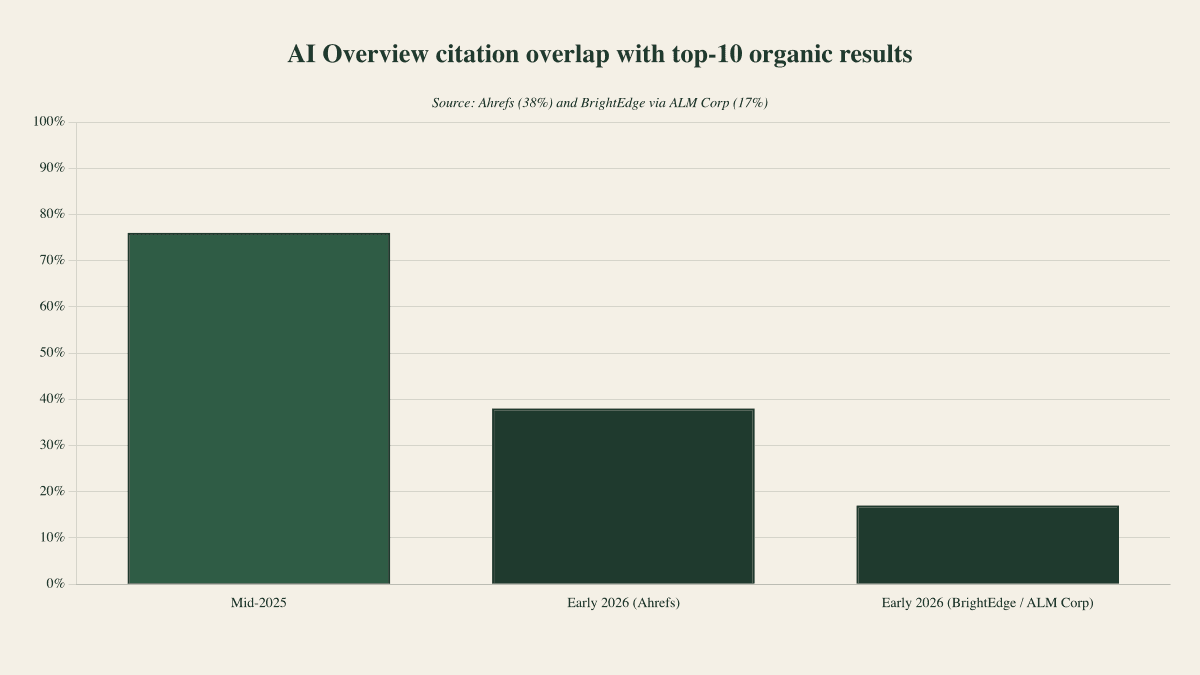
The harder number is what happened to ranking-driven citation logic. Ahrefs analyzed 863,000 keywords and 4 million AI Overview URLs and found that only 38% of cited pages also rank in the top 10 organic results. Seven months earlier, that figure was 76%. A separate BrightEdge analysis puts the overlap closer to 17%, depending on dataset.
This guide is the recovery playbook. Four steps, in order. Each one is something a content team can run this week, with a free tool to validate the work.
TL;DR
- Gemini 3 became the default AI Overviews model on Jan 27, 2026 and replaced ~42% of previously cited domains (SE Ranking, 100K-keyword study).
- Top-10 organic ranking and AI Overview citation overlap collapsed from 76% to 17–38% depending on methodology (Ahrefs / BrightEdge via ALM Corp).
- 88% of AI Overviews now cite three or more sources, and only 1% cite a single source (Heroic Rankings).
- Brands cited in AI Overviews earn 35% more organic clicks and 91% more paid clicks than non-cited brands on the same queries (Seer Interactive, 3,119 queries).
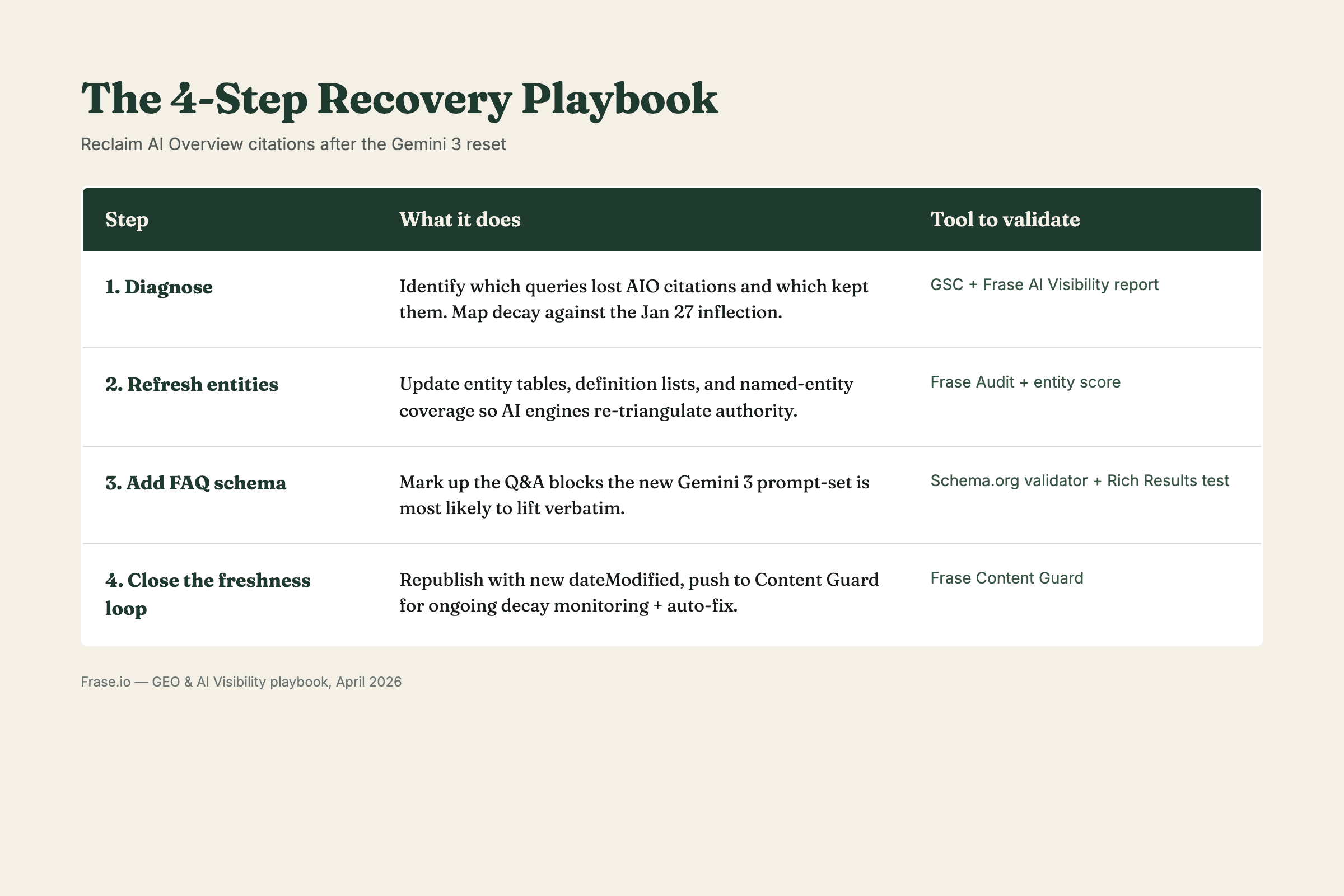
- The four-step recovery: diagnose the loss, refresh the entities, add FAQ schema, close the freshness loop. Validate every fix with the free GEO Score Checker.
What Actually Changed January 27, 2026
Gemini 3 became the AIO default
Google rolled Gemini 3 into AI Overviews and AI Mode globally starting January 27, 2026 (9to5Google, Google Blog). The new model is more selective on technical and fast-moving topics, more aggressive about pulling additional sources, and weighs freshness more heavily than Gemini 2 did.
For content teams, three things matter:
- The retrieval pipeline is different. Pages that used to slot in cleanly are being passed over for ones the model judges as more current or more entity-rich.
- The number of cited sources per AIO went up 32% on average (SE Ranking).
- Brand recognition matters more. Sites with thin entity coverage are losing share to YouTube, Reddit, and large editorial domains.
SE Ranking's methodology is worth understanding because it sets the upper bound on what your citation loss might look like. They tracked 100,000 keywords across 20 niches at three points in time: pre-Gemini 3, post-Gemini 3 with a known Google bug, and post-Gemini 3 after the bug was fixed. The replacement rate held at roughly 42% even after the bug was patched.
That is not a glitch. It is the new equilibrium.
The only caveat is that the global top 10 most-cited domains barely moved. YouTube still leads at 10.74% of citations, followed by Reddit at 4.01%, then Facebook, Indeed, and Quora (SE Ranking). Translation: if you are a major UGC platform, you are fine. If you are a B2B publisher or brand site, you got reshuffled.
More sources per AIO means smaller share for each
The other shift, less talked about, is volume. Gemini 3 cites 32% more sources per overview. So even if you keep your citation, the click share you draw from it is lower. 88% of AI Overviews now cite three or more sources. Only 1% cite a single source.
That changes the math on AIO traffic. Being cited is still valuable. Seer Interactive's 3,119-query study found cited brands earn 35% more organic clicks and 91% more paid clicks than non-cited competitors on the same queries. But the absolute click pool is smaller. The strategic implication: citation coverage breadth (how many AIOs cite you across your topic) matters more than citation depth (how prominently you appear in any single AIO).
Why Top-10 Organic No Longer Predicts AIO Citations
The 76% to 17–38% collapse
This is the data point that should reorient your content strategy.
In mid-2025, roughly three out of four pages cited in an AI Overview also ranked in the top 10 organic results for the same query. By early 2026, Ahrefs put that figure at 38%. BrightEdge put it at 17%. Whichever dataset you trust, the overlap broke.
Where are the rest of the citations coming from?
- Pages ranking positions 11–100: roughly 31.2%
- Pages not in the top 100 at all: roughly 31%
- YouTube alone: 18.2% of citations from outside the top 100
The model is not asking "what ranks well?" anymore. It is asking "what answers this best?" Those are different questions, and your content has to answer both.
What Gemini 3 weights instead
Three signals appear to drive citation under Gemini 3, based on the public studies and our own GEO Score data across thousands of user-submitted URLs:
- Entity authority. Pages that name and define the right entities, with internal and external connective tissue, win citations more often. This is the lever the Princeton GEO research quantified at up to 40% visibility lift when content adds statistics, quotations, and citations.
- Freshness. Recent content updates outperform stale ones, especially in fast-moving categories. Gemini 3 surfaces newer content earlier than Gemini 2 did.
- Multi-source corroboration. Pages whose claims are supported by multiple independent references get pulled into AIOs that cite three or more sources. If your post is a closed loop of internal references, the model has nothing to triangulate.
Why YouTube and Reddit gained share
YouTube now appears in roughly 16% of AI-generated answers, compared to Reddit's 10%. YouTube's share of social citations doubled from 18.9% to 39.2% between August and December 2025, while Reddit's share halved.
This is not a fluke. Video content carries signals AI engines value: visual demonstrations, original production quality, structured chapters, and timestamps that map cleanly to question-answer retrieval. Reddit holds onto its share inside Google AI Overviews specifically (about 21% of AIO responses cite Reddit) because of the AI search content licensing deal. Perplexity continues to favor Reddit user-generated content too.
For most B2B brands, the takeaway is not "go make TikToks." It is structural: the formats that look most like Q&A get cited most, regardless of medium.
The 4-Step Recovery Playbook
Step 1 — Diagnose your citation loss
Before you fix anything, build the list. You need to know which posts lost citations, which queries triggered the loss, and what the gap looks like.
The fast version, with Frase. Feed your top 20 organic-traffic URLs into the GEO Score Checker. Anything scoring under 70 is the model downgrading the page, not just demoting it in rank. Cross-check with the AI search visibility tracker to see which queries used to cite you and no longer do. Total time: about 30 minutes for a 20-post sweep.
The manual version, without Frase.
- Pull your top 20 posts by organic traffic from Q4 2025 (October to December).
- In Search Console, compare impressions and clicks for each URL across two windows: November 1 to January 26, 2026 (pre-Gemini-3) versus January 28 to today (post-Gemini-3).
- Flag any post with a drop greater than 25% on either metric. Those are your priority recovery targets.
- Spot-check the gap by searching the post's primary keyword and screenshotting which sources the AIO does cite.
Either way, the goal of Step 1 is a ranked list. Title, URL, score or decay percentage, citation status, priority. That is your work queue for the next 90 days.
Step 2 — Entity-refresh the top decayed posts
Once you have the list, treat the top 5 as priority. For each post:
- Add or expand the entity definition section. Name the topic clearly, name its parent category, and link to the GEO pillar guide or equivalent canonical source.
- Add at least three sourced statistics with hyperlinked citations from authoritative external sources published in the last 12 months.
- Add an entity table or definition list that maps related concepts. AI engines use these to triangulate topical authority.
- Update the schema. BlogPosting or Article schema should declare the entity relationship via
aboutandmentionsproperties. Organization schema for your brand should includesameAslinks to verified profiles.
Inside Frase, the audit surfaces the missing entities, suggests where to add them, and lines up sourced statistics from the SERP for the keyword you are targeting. The manual version of this work takes about an hour per post. The assisted version takes about 10 minutes.
Our Entity Optimization for GEO guide walks through the full six-signal model. The shortest version: specific, dated, sourced facts get retrieved. Vague generalities get skipped.
Step 3 — Add FAQ schema
FAQPage is the schema with the strongest signal for AI Overview citation. The reason is structural: Gemini 3 retrieves question-answer pairs more readily than it retrieves prose. Pages that already cover questions and answer them clearly should declare that structure explicitly.
The rules are tight:
- Six to ten questions per page is the right range. Twenty is overkill and looks gamed.
- Every question must be answered visibly on the page itself. Hidden FAQ schema is a manual action waiting to happen.
- Match the language searchers actually use. Use Search Console query data to source the question phrasing.
- Validate the schema in Google's Rich Results Test before deploying.
If you use Frase, the audit flags FAQ-schema gaps and surfaces the right questions from your Search Console query data, so you do not have to write them from scratch. The full implementation guide is in the FAQ schema for AI search post. One detail worth flagging: a clean FAQPage block does not just help AIOs. It helps every other AI search platform too, because they all parse structured data first.
Step 4 — Close the freshness loop
Steps 1 through 3 are one-time fixes. Step 4 is where you stop the next decay before it starts.
Gemini 3 weighs freshness. Pages that get updated regularly outperform pages that get rewritten once and abandoned. The operational pattern is a freshness loop:
- Monitor citation status weekly across AI Overviews, ChatGPT, Perplexity, Claude, Gemini, and Google AI Mode.
- Diagnose decay when impressions or citation rate drop below your threshold.
- Apply the fix: entity refresh, schema update, internal link injection, or republish with new data.
- Re-publish to the CMS automatically so the updated content actually reaches search.
- Verify the fix landed in the next index cycle.
This is what we built Frase Content Guard to do. It is the part most monitoring tools skip.
What makes the Frase loop different
Three things separate Frase Content Guard from monitoring-only tools:
- It actually fixes the content. The audit identifies the gap. Content Guard applies the fix per your policy. No writer in the loop unless you want one.
- It re-publishes to your CMS. WordPress, Sanity, Webflow, Wix, or Frase's own CMS — your choice. Updated content reaches search without anyone manually copying changes between systems.
- It runs on a cadence you set. Weekly scans for high-traffic posts, monthly for the long tail. The freshness loop runs without anyone owning a spreadsheet.
Most monitoring-only tools will tell you a citation dropped. They cannot fix the content and re-publish to your CMS in the same workflow. Detection without remediation is a dashboard. Detection plus remediation plus re-publication is a system. That gap is why the manual recovery loop dies inside most teams: somebody runs the audit, slacks the writer, the writer queues the work, the writer leaves, the queue dies. Closing the loop end-to-end is what makes the playbook stick.
If you do not use Frase, the fallback is a manual quarterly cadence with a project manager owning the spreadsheet. It works. It just does not scale past 50 posts.
Score Your Article Live
Before you commit to a recovery sprint, validate one URL.
Run any post through the free GEO Score Checker. The tool returns a 0–100 score reflecting how citation-ready the page is for AI engines, in about 30 seconds with no signup. It will tell you which of the four steps above is most urgent for that specific page.
The same tool is what we use internally to prioritize our own content backlog. The math is simple: a post scoring 60 is more likely to be a citation casualty than one scoring 85. Fix the 60s first.
Per-Platform Citation Differences After Gemini 3
The recovery playbook is tuned for AI Overviews because AIO is where the citation reset hit hardest. But Gemini 3 did not change every platform equally.
AI Overviews: top-10 organic now necessary but not sufficient
If you are not in the top 20 organic for a query, getting cited is unlikely. If you are in the top 10, you are eligible. The differentiator inside that pool is entity authority and freshness. Top-10 ranking is the floor, not the ceiling.
ChatGPT: less affected, different retrieval
ChatGPT uses a different retrieval pipeline. The Gemini 3 reset did not propagate. Citation rules there favor crawlable content with strong entity definitions and fewer ranking signals. Brand mentions across the open web matter more than they do for AIO. If your AIO citations dropped but your ChatGPT referrals held steady, that pattern is consistent with what we see across user data.
Perplexity: most freshness-weighted
Perplexity rewards recency aggressively. A post updated last month outranks a post last touched a year ago, even if the older post has stronger backlinks. For Perplexity recovery, the freshness loop in Step 4 is the single most important investment. Perplexity-cited pages also convert at notably higher rates than other AI sources, with some studies showing AI-referred traffic converts at roughly 14.2% versus 2.8% for traditional Google traffic. Smaller traffic, higher intent.
The point is to monitor all of them together. If you only watch AIO, you over-optimize for the platform that got hit and miss the platforms that compound your work.
What This Means for the Next 90 Days
Most content teams will spend the next quarter relearning what works. The teams that recover fastest will be the ones that stop treating GEO as an extension of SEO and start treating it as its own loop: monitor citations, diagnose decay, fix the entity and schema layer, close the freshness loop, repeat.
The four steps in this playbook are not novel ideas individually. Entity coverage, FAQ schema, freshness, multi-source corroboration. None of those are new. What is new is that the cost of skipping any of them just went up. Gemini 3 made the floor higher. Pages that used to coast on top-10 ranking are getting cycled out, and pages with deeper structural quality are taking their slots.
Start with one URL. Score it. Fix the biggest gap first. Then the next one. Ninety days from now, you will have a sharper view of which queries your brand owns inside AI Overviews and which ones you ceded. That clarity is worth more than the citation share itself.
Score your article free. No signup, no card. The 30-second version of Step 1 starts there.
FAQs
Why did my AI Overview citations drop in February 2026?
Google switched AI Overviews to Gemini 3 on January 27, 2026. According to a 100,000-keyword study by SE Ranking, the new model replaced roughly 42% of previously cited domains and pulls 32% more sources per response. If your citations dropped, the most likely cause is the model change, not a content quality decline.
Does ranking in the top 10 still get me cited in AI Overviews?
Not the way it used to. Ahrefs found that only 38% of pages cited in AI Overviews now also rank in the top 10 for the same query, down from 76% seven months earlier. BrightEdge data puts that overlap as low as 17%. Top-10 ranking is necessary but no longer sufficient for AI Overview citations.
What is the fastest way to diagnose AI Overview citation loss?
Start by listing your top 20 highest-traffic posts from Q4 2025. For each one, run the URL through Frase's free GEO Score Checker and compare the score against the post's pre-Gemini-3 citation snapshot in Search Console. Pages scoring under 70 with falling impressions are your priority recovery targets.
What schema types help most with AI Overview citations after Gemini 3?
FAQPage, HowTo, and Article schema have the strongest signal. FAQPage in particular maps to the question-answer structure Gemini 3 favors. Add it to any page that already covers a clear set of questions, and make sure your Organization schema includes sameAs links to verified profiles.
Should I focus on AI Overviews, ChatGPT, or Perplexity first?
Start with the platform driving the most referral traffic to your site today. For most B2B brands, AI Overviews drives the largest share of impressions, but Perplexity often delivers the highest conversion rate from a smaller traffic base. Track all three together so you do not over-optimize for one and lose ground on the others.
How often should I refresh content to defend AI Overview citations?
Quarterly for top-traffic posts, monthly for posts targeting fast-moving topics like AI search itself. Gemini 3 weighs freshness more than its predecessor, so a steady refresh cadence beats a single big rewrite. The goal is a closed loop: monitor, diagnose, fix, re-publish, monitor again.
About the author
Shegun Otulana
Founder & CEO
Shegun Otulana is CEO of Copysmith AI, parent company of Frase.io and Describely.ai. He's a serial entrepreneur with multiple exits and has been building companies at the intersection of search, marketing, SaaS, and artificial intelligence since 2013. Shegun writes about generative engine optimization, AI search, and the future of content marketing.
Related articles
See Frase run on your own content.
Research your market, draft in your voice, and track where you show up across Google and AI search. Start free.
Start free trial7-day free trial. No credit card.