The Agency Playbook for AI Content Services in 2026
The agency playbook for packaging GEO and AI visibility as a retainer service. What to sell, how to deliver it, and why now.
If you run a content or SEO agency, the question your prospects are asking right now is not "can you write us blog posts?" It is "why is our traffic dropping in AI search?"
That is a different sale. It pays better. And most agencies are not set up to deliver it.
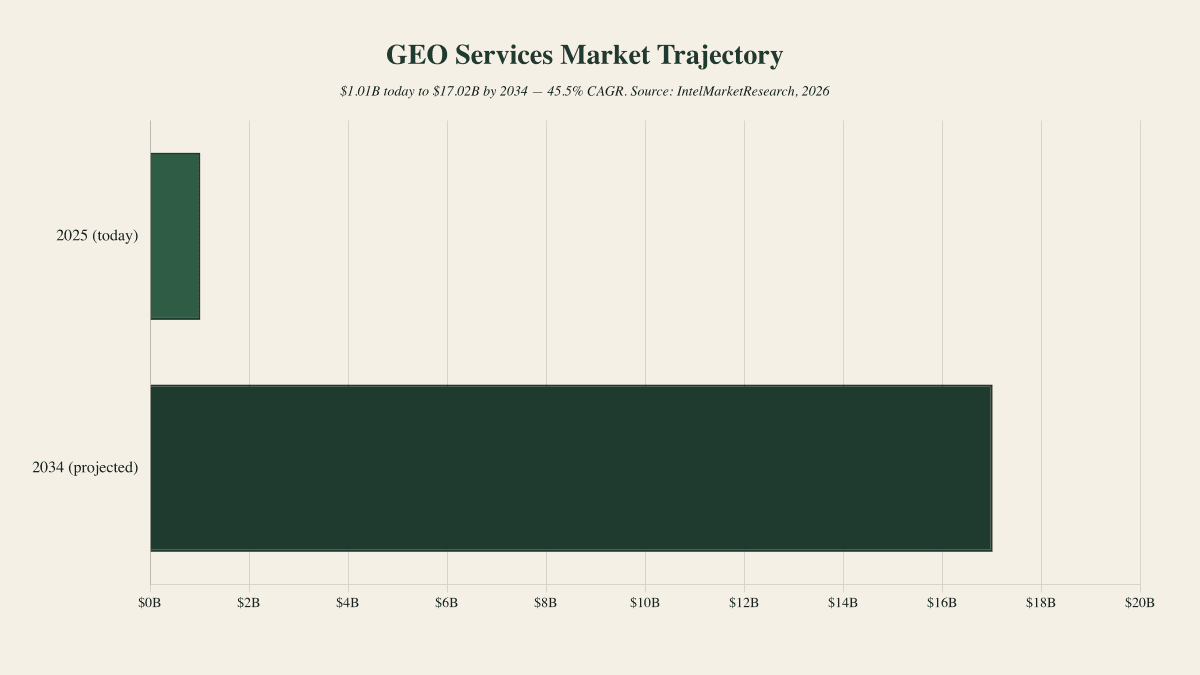
The market is moving fast. AI-sourced traffic surged 527% year over year between early 2025 and early 2026, according to Previsible's AI Traffic Report. Analyst estimates for the GEO services market in 2025 range from $848M (Market Intelo) to $1.01B (IntelMarketResearch), with projected CAGRs of 34–50% through 2031–2034. 86% of SEO teams have already adopted GEO in some form, but most clients have not. That gap is the opportunity.
This is the playbook for agencies that want to package AI content optimization as a named service line. What to sell. How to deliver it. How to price it. And how Frase fits into the workflow if you do not want to build the tooling stack from scratch.
TL;DR
- 2025 GEO services market estimates range from $848M (Market Intelo) to $1.01B (IntelMarketResearch), with projected CAGRs of 34–50%. Agencies are packaging GEO as $1,500–$5,000/mo for boutique/SMB, $5,000–$10,000/mo for mid-market, and $10,000–$50,000+/mo for enterprise.
- Clients are outsourcing because the talent does not exist in-house yet, regulated industries need compliance review, and the monitoring loop is operationally heavy.
- The agency service stack has four parts: AI visibility audit, GEO content optimization, content monitoring with auto-fix, and multi-platform reporting.
- Frase is built for agencies managing multiple client domains, and has an Enterprise plan that adds the white-label client portal for agencies that need full branding and approval workflows.
- Start with a free GEO Score audit on a prospect's site. The audit becomes the pitch. The retainer becomes the relationship.
Why AI Content Optimization Is Becoming an Agency Service
The AI search landscape shifted in 2025–2026
For most of the last 25 years, agencies sold "SEO" and clients understood roughly what that meant. That contract broke in 2025.
Two things happened. First, AI Overviews became the default surface for a meaningful share of Google searches. By late 2025, 44.1% of medical YMYL queries triggered an AI Overview, according to SE Ranking. Second, on January 27, 2026, Google switched AI Overviews to Gemini 3 and roughly 42% of previously cited domains were replaced. The overlap between top-10 organic ranking and AI Overview citation collapsed from 76% to somewhere between 17% and 38%, depending on the dataset (Ahrefs, BrightEdge via ALM Corp).
Translation: the rules a client's previous SEO agency optimized for stopped predicting visibility. Clients noticed. Their traffic dropped. Now they want to know what to do about it.
The agencies that have an answer are getting the calls. The agencies that do not are losing the renewals.
Why most companies are outsourcing AI content strategy
Three reasons clients give when they hire an agency instead of building in-house.
The first is talent. GEO as a named discipline is barely two years old. The skills required are SEO-adjacent but not identical: entity optimization, schema design, citation analysis, multi-platform tracking, and prompt engineering for AI search engines. Most in-house marketing teams do not have anyone who has shipped this work yet. Hiring takes six months. Hiring a competent agency takes a phone call.
The second is compliance. Regulated industries such as healthcare, financial services, legal, and government carry YMYL exposure that makes in-house generative AI usage risky. FINRA's 2026 Regulatory Oversight Report dedicated a full section to GenAI, classifying AI-generated content as "firm communications" subject to supervision, recordkeeping, and fair dealing rules. Healthcare faces parallel exposure under HIPAA and Google's heightened YMYL standards. Agencies that institutionalize compliance review across multiple clients amortize that cost; in-house teams cannot.
The third is operational load. Monitoring AI citation share across five or six platforms, diagnosing decay, fixing the underlying content, and re-publishing to the CMS is a weekly workflow that breaks down inside most marketing teams. The work falls between SEO and content, owned by no one, and dies. Agencies survive because the workflow is the product, not a side task.
The revenue opportunity for agencies
Three numbers worth holding side by side.
Healthcare digital marketing outsourcing alone is projected to grow from $8.9 billion in 2024 to $16.3 billion by 2031, a 9% CAGR (Persistence Market Research). That is one vertical. The broader GEO services market will more than triple in three years if any of the published CAGRs hold.
The unit economics work too. AI search visitors convert at meaningfully higher rates than traditional Google organic. Semrush's June 2025 study found LLM visitors convert at 4.4x the rate of average organic search visitors. A separate study of B2B technology firms found AI traffic converts at 14.2% versus Google's 2.8%. The traffic volume is still small at most sites, but the conversion premium is what makes AI-cited content disproportionately valuable to clients. That premium is what justifies the agency retainer.
Per-engagement pricing is already being set in the market. A defensible 2026 rate card looks like this:
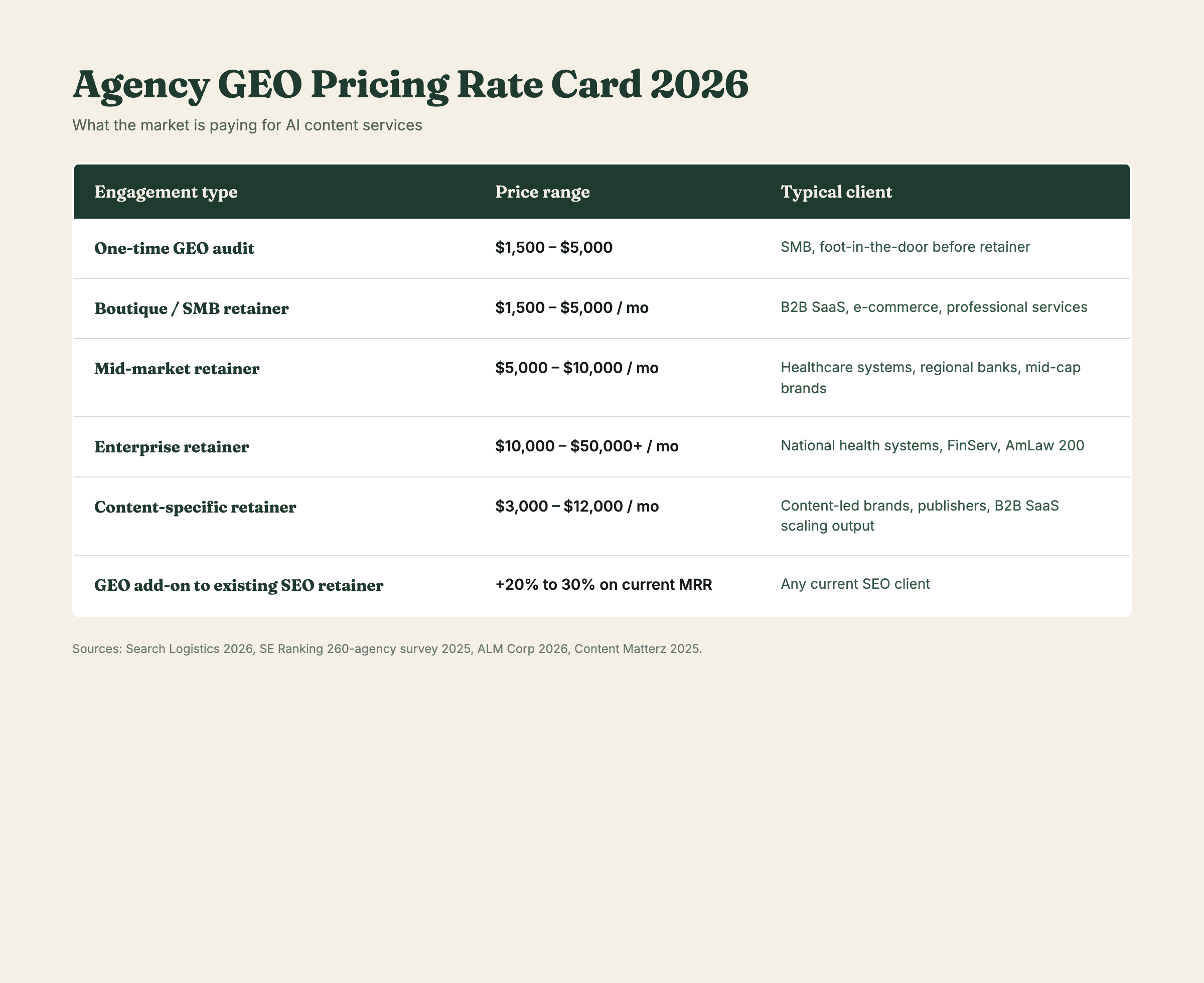
Retainers segment cleanly by client size, with content-specific work skewing higher than generalist SEO retainers:
- Boutique/SMB retainers: $1,500–$5,000/mo (Search Logistics 2026; SE Ranking 260-agency survey 2025)
- Mid-market retainers: $5,000–$10,000/mo (ALM Corp 2026; Content Matterz 2025)
- Enterprise retainers: $10,000–$50,000+/mo (ALM Corp 2026)
- Content-specific retainers skew higher: $3,000–$12,000/mo typical (Content Matterz 2025)
- One-time GEO audits: $1,500–$5,000 (SMB, used as foot-in-the-door before retainer)
- GEO add-on to existing SEO retainer: +20–30% on current MRR (any current SEO client)
The simplest move for most agencies is the last row: a 20% to 30% uplift on every existing SEO retainer, sold as "we are now optimizing for AI search too." It is the easiest "yes" the client will say all year.
The Agency AI Content Service Stack
A defensible AI content service has four layers. Skip any of them and the offering looks like commodity SEO with new vocabulary, which is what most clients are now actively avoiding.
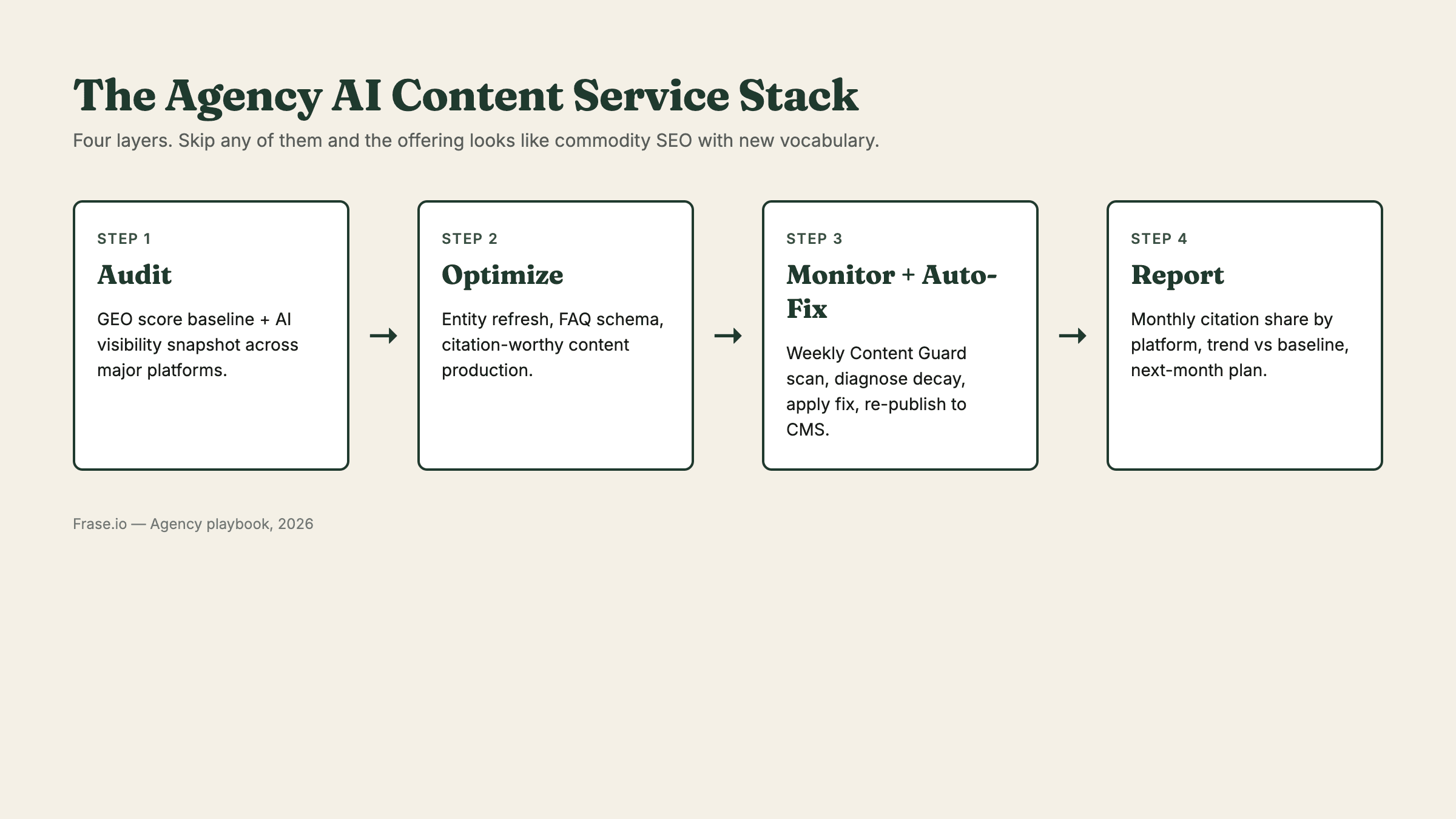
1. AI visibility auditing — where clients stand today
The audit is the first deliverable. It is also the prospecting tool, the renewal anchor, and the quarterly reset. Run it well and it is the most valuable single artifact in the relationship.
A good audit answers four questions per client:
- What is the client's current GEO score, broken out by their top 20 highest-traffic pages?
- Which AI platforms cite the client today, and at what rate per relevant query?
- Where are the gaps: which competitor sites are taking the citations the client should own?
- What is the recovery plan, with priority and effort estimates per page?
Frase's free GEO Score Checker gives an agency the answer to question one in under 30 seconds per URL. Use it as a sales tool: run it on a prospect's homepage and a few priority pages, send them a one-page summary, and lead the next call with the gap. We cover the full prospecting workflow in The Agency GEO Score Audit.
2. GEO content optimization — making content AI-citable
Optimization is where the work lives. Three deliverables run weekly or monthly per client:
- Entity refresh on top decayed posts. Add specific, dated, sourced facts. AI engines retrieve content with strong entity coverage more readily than vague prose. Our Entity Optimization for GEO guide walks through the six-signal model.
- FAQ schema deployment. FAQPage is the schema type with the strongest signal for AI Overview citation, because Gemini retrieves question-answer pairs more readily than narrative content. Six to ten questions per page is the band that performs without looking gamed. Implementation details are in our FAQ schema for AI search post.
- New citation-worthy content production. Pillar posts and answer-style content engineered for the queries the client wants to own. Frase's content brief and audit workflow handles the production heavy-lift; the agency adds the editorial layer and client voice.
The unifying principle: every page the agency touches gets engineered for citation, not just for ranking. Citation and ranking are correlated but no longer the same job. The GEO pillar guide covers the full conceptual model.
3. Content monitoring and auto-recovery — protecting client rankings
This is the layer most agencies skip and most lose retainers over.
Monitoring is straightforward. Track citation status weekly across AI Overviews, ChatGPT, Perplexity, Claude, and Gemini. Set thresholds. Alert when a page drops out of citations or below an impression threshold.
Auto-recovery is harder. Most monitoring tools tell the agency a citation dropped and stop there. They report the decay; they do not fix the content and re-publish it to the client's CMS. The result is a familiar pattern: monitoring tool flags an issue, project manager logs it, writer queues the work, the writer leaves, the queue dies, the citation does not come back, the client churns at renewal.
Frase's Content Guard is the closed-loop layer for this exact problem. It scans content weekly, diagnoses decay, applies a fix per the agency's policy (entity refresh, schema update, internal link injection, freshness republish), and re-publishes to the client's CMS — WordPress, Sanity, Webflow, Wix, or Frase's own CMS, your choice. The work the agency was going to do manually still gets done, just without the project manager bottleneck. Agencies that bill on retention rather than one-time audits need this loop because every recovered citation is the proof point that justifies the next renewal.
4. Multi-platform tracking — reporting across AI engines
The fourth layer is what the client sees. A monthly report. The right format is one page per client domain, with three things on it:
- Citation share by platform: AI Overviews, ChatGPT, Perplexity, Claude, Gemini, in absolute count and as a percentage of relevant queries.
- Trend versus baseline: month-one snapshot versus current.
- Top three actions taken this month, with the page-level impact.
Volume metrics matter less than coverage. A client cited in 40% of their relevant AI Overviews is a stronger result than one cited prominently in 5%. The report exists to make that point legible to a CMO who is not going to read prose.
Frase's AI search visibility tracking feeds the data. The agency adds the narrative layer and the client-specific interpretation.
How to Deliver AI Content Services with Frase
The hard part of operationalizing this service is not the strategy. It is the workflow. Eight clients, five platforms tracked per client, weekly monitoring, monthly reporting, quarterly audits, ad hoc fixes — the math gets ugly fast without a tooling stack designed for multi-client work.
Frase's Scale plan is the configuration most agencies start on. Below is what it includes, mapped to the service stack above.
Setting up multi-client workflows on Scale
Scale at $299 per month gives an agency:
| Capability | Scale plan |
|---|---|
| Client domains | 10 |
| Seats | 5 |
| Articles per month | 100 |
| AI visibility tracking | Across all major AI search platforms |
| Content Guard | Included (monitoring + auto-fix + CMS re-publish) |
| API access | Full |
| Brand voice profiles | Per client |
| Content briefs and audits | Unlimited |
That is the configuration for an agency running 6 to 10 active client retainers. Each domain has its own content library, audit history, AI visibility dashboard, and Content Guard policy. Five seats covers an agency with a strategist, two writers, an editor, and an account manager.
When an agency outgrows 10 client slots — typically around the $50K to $80K per month MRR mark — Enterprise adds unlimited domains, single sign-on, the white-label client portal, custom branding on email and reports, and approval workflows for client review.
Using Content Guard to protect client rankings automatically
Content Guard is a four-phase loop:
- Scan. Weekly crawl of every page in every client domain to assess GEO score, citation status, freshness, and schema health.
- Diagnose. When a page falls below threshold, identify the most likely cause: entity gap, schema missing, freshness lapsed, internal linking broken, or competitor displacement.
- Fix. Apply the remediation per the policy the agency set for that client. Some clients want every fix run through the writer; others approve auto-fix for low-risk changes (schema updates, freshness republish) and gate auto-fix for substantive content changes.
- Re-publish. Push the change live to the client's CMS without manual handoff. WordPress, Sanity, Webflow, Wix, or Frase's own CMS are all supported natively — your choice.
The configuration that works for most agencies: auto-fix on for schema, freshness, and internal linking; manual approval for entity refresh and rewrites. That balance keeps the writer in the loop on judgment calls and removes them from the maintenance grind.
Building AI visibility reports clients understand
Frase exports raw citation data. The agency builds the narrative. A monthly report template that consistently lands well with clients:
- One page summary at the top: citation share trend, top win, top concern.
- Per-platform breakdown next: AI Overviews, ChatGPT, Perplexity, Claude, Gemini.
- Page-level action log: what we touched, why, what changed.
- Next month's priorities, ranked.
Send it on the first business day of the month. Walk the client through the one-page summary live in a 30-minute call. Leave the rest as appendix.
The Frase Agent for agency-scale content production
Production volume is the other constraint that breaks agencies running multiple clients. The Frase Agent handles the repeating work: research, brief generation, draft scoring, schema validation, internal link suggestions, and citation-density checks. The agency owns voice, judgment, and the client relationship; the agent owns the parts of the workflow that scale linearly with client count.
Our AI Agents for SEO post covers the conceptual model. The shortest version: agents do not replace the strategist; they remove the bottleneck that prevented one strategist from supporting more than two or three clients well.
Packaging and Pricing Your AI Content Service
A service line is only as defensible as its packaging. Three packaging models work in 2026, and most successful agencies layer all three.
Retainer models for GEO/AEO services
The default model. Recurring monthly fee, defined deliverables, three-month minimum.
A typical SMB or mid-market package at $2,500 to $5,000 per month:
- Quarterly GEO audit per client domain
- Monthly content production: 4 to 8 long-form pieces, GEO-optimized
- Weekly Content Guard monitoring with auto-fix on schema and freshness
- Monthly AI visibility report and review call
- Ad hoc strategic recommendations as platforms shift
Larger retainers in the $10,000 to $25,000 range scale article volume, add custom dashboards, dedicate a strategist, and include compliance review for regulated clients. Pricing maps to client size and content volume more than to feature count.
Project-based engagements
Two project types worth selling alongside the retainer.
One-time GEO audit ($1,500–$5,000). A 90-minute scoped engagement plus a written report. Most agencies use this as a foot-in-the-door product; about a third of audits convert to retainers within 90 days when the audit is delivered well.
Optimization sprints ($5,000–$15,000). A two- to four-week engagement to fix a defined batch of pages. Common trigger: client lost AIO citations after Gemini 3 and wants a single-quarter recovery push before deciding on a long-term retainer. The Gemini 3 recovery playbook is the public version of this engagement.
Upselling existing SEO clients into AI optimization
The fastest path to revenue is the existing book. For every active SEO client, the conversion script is roughly:
- "Your traffic is shifting. Here is the data on AI Overviews and the citation reset."
- "We ran your top 10 pages through a GEO audit. Here is the score gap." (Use the free GEO Score Checker.)
- "We are adding GEO optimization as a service. The retainer goes from $X to $Y, and here is what changes in the deliverable."
Average uplift across agencies that have shipped this conversion: 20% to 30% on existing MRR. No new logos required. The math beats almost any other growth lever an agency has access to.
Show Your Clients: The Monthly AI Visibility Report
The single asset that holds a retainer together is the monthly report. Here is the structure that consistently retains clients past the first 90 days.
Month 1 — Audit and baseline
- Run a GEO Score audit on the client's top 20 pages.
- Snapshot AI visibility across all major platforms (AI Overviews, ChatGPT, Perplexity, Claude, Gemini).
- Identify the top three pages with the highest decay risk and the top three pages with the highest citation upside.
- Deliver a one-page baseline report. Walk through it in a 30-minute kickoff call.
Month 2 — Optimize and monitor
- Execute the priority fix list from month one: entity refresh, FAQ schema, freshness updates.
- Activate Content Guard with the agreed auto-fix policy.
- Track citation share daily, report weekly, summarize monthly.
Month 3 — Report and expand
- Show the citation share trend versus baseline.
- Identify two to three new content opportunities based on competitor citation gaps.
- Propose the month four to twelve roadmap, including any retainer adjustments tied to expanded scope.
By month three, the client has a measurable change in their AI visibility, a clear next-quarter plan, and a working monthly cadence. The retainer renews because the report makes the value obvious without the agency having to argue for it.
Why the Bundle Matters for Agency Margin
The reason this playbook works on Frase Scale is the bundle. AI visibility tracking, Content Guard with auto-fix, multi-domain workspaces, API access, and brand voice profiles are all included at $299 per month with no add-ons. Most competing platforms break this bundle apart, charging separately for AI tracking, agency-tier pricing, or sunsetting agency-specific features that send teams hunting for replacements. Semrush, for example, sunsetted its Agency Growth Kit on October 13, 2026, retiring the Client Portal and CRM components.
The agencies that consolidate their stack instead of stitching together five vendors get the operational margin back. That margin is what funds the second strategist or the third client-facing AM. We cover the broader landscape in Best AI SEO Agents 2026.
What to Do This Week
Three concrete actions, in order, for an agency that wants to ship an AI content service line in 14 days:
- Run a free GEO Score audit on three prospective clients. Score one URL per prospect. Send each prospect a short summary of their score, the top decay risk, and one question: "Would it be useful if we ran the full top-20 audit?" Three cold starts becomes one or two qualified conversations within a week.
- Pick the package. Choose one default retainer (the $2,500/mo SMB tier is the easiest to sell) and one upsell path (the +20–30% uplift on existing SEO retainers). Write the deliverable list on a single page. Send to your team.
- Set up Frase Scale and load three client domains. Start the 7-day Scale trial. Add the three prospects from step one. Run the Content Guard scan on day one so you have data to walk a prospect through on day three.
The full delivery muscle takes 90 days to build out. The first sale takes two weeks if the team treats AI content services as a product launch instead of a slow strategic pivot. Most agencies are still treating it as the latter, which is why the window is open.
One last piece of context worth holding onto. The agencies winning early in this market are not the ones with the deepest GEO research or the most polished decks. They are the ones who decided that AI search was the product, picked one tooling stack, and shipped the first audit by Friday. The rest of the playbook (vertical specialization, white-label reporting, multi-domain dashboards, Content Guard policy tuning) is the second-quarter project. Sequencing matters. Sell the audit, sign the retainer, then build the operations.
FAQs
What is an AI content service for agencies?
An AI content service is a packaged retainer where an agency owns generative engine optimization (GEO), AI visibility monitoring, and AI-citable content production for a client. The deliverable is not a content calendar; it is a measurable share of citations across AI Overviews, ChatGPT, Perplexity, Claude, and Gemini, plus a closed-loop process to recover citations when they decay.
How much can agencies charge for GEO and AI content services?
One-time GEO audits range from $1,500 to $5,000. Monthly retainers segment by client size: $1,500–$5,000 for boutique/SMB, $5,000–$10,000 for mid-market, and $10,000–$50,000+ for enterprise. Content-specific retainers skew higher than generalist SEO, typically $3,000–$12,000/mo. Agencies adding GEO to existing SEO retainers report a 20% to 30% pricing uplift on the same client.
Why are clients outsourcing AI content optimization instead of building in-house?
Three reasons. First, the talent does not exist in-house at most companies; GEO is two years old as a named discipline. Second, regulated verticals such as healthcare, financial services, and legal need specialized compliance review that outsourced agencies institutionalize faster. Third, the tooling, monitoring, and recovery workflow is operationally heavy, and agencies amortize that cost across multiple clients.
Which Frase plan is built for agencies?
Scale at $299 per month is the agency plan: 10 client domains, 5 seats, 100 articles per month, plus AI visibility tracking, Content Guard for monitoring and auto-fix, and full API access. Larger agencies graduate to Enterprise for the white-label client portal, single sign-on, and unlimited seats and domains.
Do clients understand the difference between SEO and GEO?
Most do not, and that is the agency's wedge. Clients see traffic dropping in Google Search Console, ask why, and the agency that can explain the AI Overviews citation reset and show a recovery plan wins the retainer. The educational sale is what differentiates GEO services from commodity SEO.
How do agencies prove AI visibility results to clients?
Monthly reports that show citation share across each AI platform, broken out by client domain. The report should include baseline at month one, optimization actions taken, and citation share trend at month three. Volume metrics matter less than coverage; a client cited in 40% of relevant AI Overviews is a stronger result than one cited prominently in 5%.
What types of clients buy AI content services?
Heaviest demand is in regulated verticals: healthcare systems, financial services firms, law firms, higher education institutions, and government contractors. These clients have YMYL content exposure, compliance requirements, and budgets large enough to justify a $5,000 to $25,000 monthly retainer. SaaS and B2B tech are the second wave.
What is the Frase Content Guard and why does it matter for agencies?
Content Guard is the closed-loop monitoring and auto-fix layer in Frase. It scans content weekly for citation decay, diagnoses the cause, applies the fix per the agency's policy, and re-publishes to the client's CMS. Agencies that bill on retention rather than one-time audits need this loop because every recovered citation is recurring revenue justification.
How long does it take to launch an AI content service line?
Two weeks to a working pilot. Week one: pick the tooling (Frase Scale gives you 10 client slots from day one), define the package, and run a free GEO Score audit on three prospective clients. Week two: pitch the audit results, sign the first retainer, and build the monthly report template. The 90-day version of the program is mature; the two-week version is the wedge.
Can agencies use Frase to manage multiple client sites?
Yes. The Scale plan supports 10 client domains in a single workspace with 5 seats. Each domain has separate content libraries, AI visibility tracking, and Content Guard monitoring. Agencies running more than 10 clients move to Enterprise, which includes the white-label client portal for client-facing approval workflows and branded reporting.
About the author
Georgina D'Souza
Marketing Manager
Georgina D'Souza is a Marketing Manager at Frase and Copysmith AI, the company behind Frase.io and Describely.ai. She brings ten years of marketing experience — spanning early-stage startups to multinational enterprise — specializing in content marketing, SEO, and generative engine optimization, helping SaaS brands adapt their content strategies for AI-powered search. Georgina writes about generative engine optimization, AI search visibility, and content marketing for the AI era.
Related articles
See Frase run on your own content.
Research your market, draft in your voice, and track where you show up across Google and AI search. Start free.
Start free trial7-day free trial. No credit card.