Entity Optimization for GEO: The Practitioner's Guide to Getting Cited by AI Search
Entity optimization is how you get AI search engines to recognize, trust, and cite your brand. Six steps, one self-diagnostic, zero fluff.
Entity optimization is how you make AI search engines recognize, trust, and cite your brand. It is the practitioner's lever for generative engine optimization (GEO). The brands showing up in ChatGPT, Perplexity, Claude, Gemini, and Google AI Overviews answers are not the ones stuffing keywords. They are the ones whose entity is so cleanly defined that an AI retrieval system can pull a passage, attribute it correctly, and fit it into a generated answer.
The shift is already quantifiable. The Princeton and IIT Delhi research team behind the original GEO paper found that entity-rich, fact-dense content can improve AI citation visibility by up to 40% across a wide range of queries. Semrush's AI Search Traffic Study reported that AI-sourced visitors convert at roughly 4.4 times the rate of traditional organic traffic. That is not a rounding error. That is a channel.
And yet most content teams still optimize the way they did in 2019: one keyword, one page, hope for the best. The AI engines are not reading keywords. They are reading entities: the recognized things your content describes and how those things relate to each other.
This guide is the operational playbook. You will get the six signals AI engines use to resolve an entity, the six-step workflow to make your content entity-rich, a self-diagnostic you can run in under a minute, and the monitoring loop that keeps your citations from rotting. No theory. No fluff. Every step ships with a check you can run today.
Here is what you will walk away with:
- A working definition of entity optimization that your whole content team can use
- The six AI-entity recognition signals that decide who gets cited
- A step-by-step workflow to build an entity-rich content architecture
- How to score your entity coverage before you publish
- Platform-specific tactics for each major AI engine
- The monitoring loop that catches citation decay before it hurts
What is entity optimization for GEO?
Entity optimization for GEO is the practice of structuring content around recognized, disambiguated things (brands, people, products, concepts) so AI search engines can pull your passages into generated answers. It is the bridge between traditional SEO, which targets keyword strings, and AI search, which targets meaning.
An entity is a thing with an identity. "Frase" is an entity. "The Professional plan on Frase" is an entity. "Generative engine optimization" is an entity. Each one has attributes, relationships, and a canonical identifier: a Wikidata Q-ID, a Google Knowledge Graph MID, or a schema @id you define yourself. Keywords are strings of characters. Entities are the things those strings refer to.
The difference matters because AI retrieval systems do not match queries to documents. They match queries to passages grounded in entities. When a user asks Perplexity about content optimization tools, the engine fans the query into dozens of sub-questions, pulls passages where the relevant entities co-occur, and synthesizes an answer. Perplexity had grown to roughly 30 million monthly active users by April 2025, and each of those answers is an opportunity to be cited or skipped. If your page is about "content optimization" but the entity "your brand" never surfaces cleanly in the right context, you do not get cited. You are invisible in the exact moment the user is asking a buying question.
Entity optimization for GEO has three jobs:
- Clarity: Make sure every page has one canonical entity and a definitional opening sentence the AI can lift verbatim.
- Coverage: Surface the adjacent entities in your category (the people, tools, methods, and concepts that your entity relates to).
- Connectivity: Tie your entity to the public knowledge graph via structured data so AI engines can resolve it to a stable identity.
A page that does all three is the one that gets quoted. A page that does none of them is a keyword artifact from the old web. GEO is the new scoreboard, and entity optimization is how you put points on it.
Why AI engines cite entities, not keywords
AI search does not rank pages. It retrieves passages, grounds them in entities, and generates an answer. That single sentence is why every SEO tactic built around keyword density is losing ground.
Here is what actually happens when someone asks ChatGPT or Perplexity a question:
- Query fan-out. The engine decomposes the user's question into sub-questions. A query like "best SEO tools for agencies" becomes "what is an SEO tool," "which SEO tools target agencies," "which SEO tools support multi-client workflows," and dozens more.
- Passage retrieval. Each sub-question hits an index of passages, not pages. The engine scores passages on entity clarity, fact density, freshness, and authority.
- Grounded generation. Selected passages feed a language model, which assembles an answer. Passages that are ambiguous, entity-poor, or contradict other sources get filtered out.
- Citation selection. The engine exposes a small number of sources to the user. These are the passages the model leaned on most. These are the pages that get the click.
Keywords barely factor into this flow. What the engine is really scoring is whether the passage unambiguously references the entities in the user's question. A 2,000-word page full of the keyword "content optimization" loses to a 400-word passage that cleanly says "Frase is a content optimization platform that scores content against SERP competitors and AI citations."
LLM-based engines retrieve passages, not pages, and select them based on entity grounding rather than static ranking scores. This is why two otherwise identical pages can produce wildly different citation volumes. The one with cleaner entity signals wins.
Different AI search engines weight entities differently, and that matters for where you invest:
- ChatGPT leans on Bing's live index and its own training data. It favors entities that appear consistently in training-weight sources: Wikipedia, major publications, and your own well-established content.
- Perplexity crawls the live web continuously and cites far more sources per answer than ChatGPT. A 118,000-answer analysis from Qwairy in Q3 2025 measured an average of 21.87 citations per Perplexity answer against 7.92 for ChatGPT. Freshness matters here as well: the same dataset showed Perplexity citing content updated within 30 days at an 82% rate, dropping to 37% for content older than 12 months.
- Claude relies on training data with a known cutoff. The entity has to exist in that training window, cleanly defined, across multiple corroborating sources.
- Gemini and Google AI Overviews draw from Google's Knowledge Graph. If your entity does not have a canonical ID (a Wikidata Q-ID or a
sameAslink in your schema), you are invisible to this retrieval path. - Copilot and Grok cite fewer sources per answer on average, so entity clarity is the deciding factor between being the one source quoted and being none.
The tactical implication is clear. You cannot optimize for all engines the same way. But there is a shared foundation: resolve your entity, define it clearly, surface it in the right passages, and tie it to the public knowledge graph. Do that, and you are competing on every platform at once.
The 6 signals AI engines use to recognize your entity
AI retrieval systems decide which pages get cited by scoring a small set of entity signals. The pages that win on most of these signals win the citation. Here are the six that matter.
Signal 1: Canonical identifiers
Your entity needs a stable ID that AI engines can resolve without ambiguity. That means a Wikidata Q-ID where possible, a Google Knowledge Graph MID, or a well-formed schema @id on your own pages. The sameAs property in your Organization schema lets you explicitly link your brand to its Wikipedia page, LinkedIn company page, Crunchbase profile, and other authoritative sources. Without these links, AI engines cannot be certain which "Apple" or "Surfer" or "Frase" your page is referring to. Google's Knowledge Graph contains over 500 billion facts about 5 billion entities, and canonical IDs are how you connect your page to that graph.
Signal 2: Definitional opening sentences
AI retrieval systems favor passages that open with a clear definition. The pattern is consistent: "[Entity] is a [category] that [differentiator]." A page that opens with "Frase is an agentic SEO and GEO platform that helps content teams research, write, and optimize content that ranks on Google and gets cited by AI search engines" scores better than one that opens with a paragraph of setup. The engine can lift that sentence verbatim into an answer.
Signal 3: Fact density with inline citations
The Princeton GEO paper quantified this directly: adding statistics, quotations, and citations to a page lifted visibility in generative engines by up to 40%. Vague claims get filtered out. Specific, dated, sourced facts get retrieved. A sentence like "AI-referred sessions jumped 527% between January and May 2025 (Previsible 2025 AI Traffic Report)" is a gift to an AI engine looking for a citable passage.
Signal 4: Entity co-occurrence
AI engines build a picture of your entity's category by noting which other entities appear around it. A page about "content optimization tools" that never mentions Google, search engines, SERPs, ranking, or AI citations does not look like a content optimization page to the retrieval system. A page that discusses your entity alongside its adjacent entities (the people, methods, categories, and competitors that naturally surround it) signals topical authority.
Signal 5: Structured data tying entity to content
The BlogPosting, Article, Organization, and Product schema types carry explicit entity relationships. author links to a Person entity. mentions links to related Things. mainEntityOfPage tells engines which entity the page is primarily about. FAQ schema on the right pages further improves retrieval for question-shaped queries. According to Semrush's AI Search Visibility Study, only 6-27% of the most-mentioned brands also rank as top sources AI models cite, depending on industry and platform: the gap is almost always structured-data connectivity. Without schema, the engine has to infer. Inference is where citations get lost.
Signal 6: Freshness and corroboration
AI engines favor content that is recent and that agrees with other authoritative sources. On Perplexity, content older than 12 months drops to a 37% citation rate versus 82% for content updated within the last 30 days. On Claude, the entity needs to exist in the training window with consistent descriptions across sources. A page that is fresh, fact-dense, and matches how other authoritative sources describe the entity gets picked. A page that contradicts the consensus gets filtered out.
A table summarizing the signals helps when you audit a page:
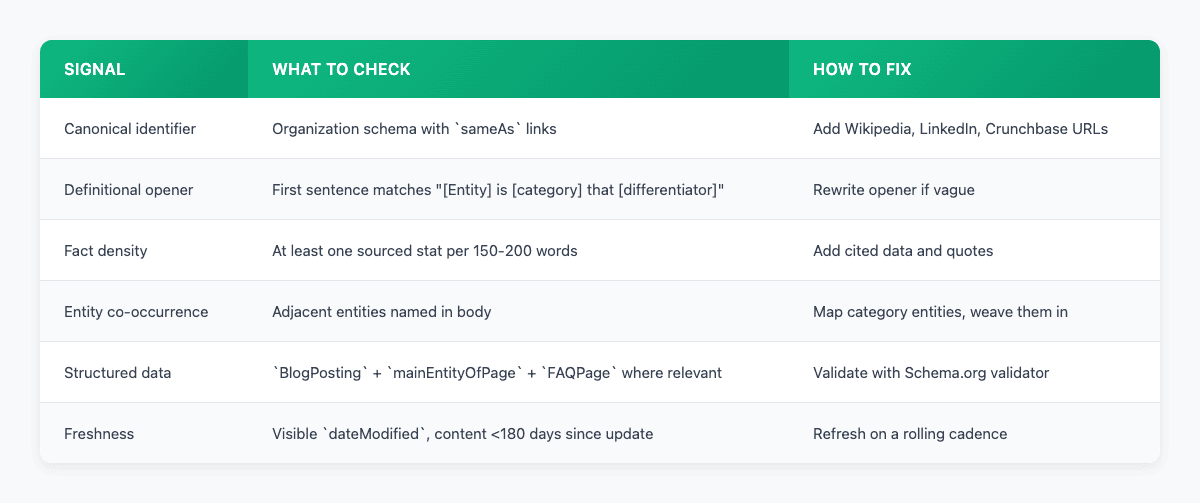
| Signal | What to check | How to fix |
|---|---|---|
| Canonical identifier | Organization schema with `sameAs` links | Add Wikipedia, LinkedIn, Crunchbase URLs |
| Definitional opener | First sentence matches "[Entity] is [category] that [differentiator]" | Rewrite opener if vague |
| Fact density | At least one sourced stat per 150-200 words | Add cited data and quotes |
| Entity co-occurrence | Adjacent entities named in body | Map category entities, weave them in |
| Structured data | `BlogPosting` + `mainEntityOfPage` + `FAQPage` where relevant | Validate with Schema.org validator |
| Freshness | Visible `dateModified`, content <180 days since update | Refresh on a rolling cadence |
Pages that earn all six signals are pages AI engines trust. Pages that earn one or two are roulette.
The 6-step entity optimization workflow
Entity optimization is a process, not a checklist. Here is the six-step workflow Frase teams use on content intended to earn AI citations. Each step produces an artifact. If the artifact is missing, the step is not done.
Step 1: Pick one canonical entity per page
The most common entity optimization failure is a page that tries to cover five things. Pick the single entity the page is about. A page on "content briefs" is about content briefs. Not briefs, audits, topic clusters, and AI writing in one document. Write the canonical entity at the top of your brief before you write anything else.
Step 2: Write the definitional opener
Before you draft the intro, write one sentence in the format "[Entity] is a [category] that [differentiator]." Stress-test it. Can an AI engine lift this verbatim and use it to answer a generic question about the entity? If yes, keep it. If no, rewrite. This single sentence often accounts for a disproportionate share of your citations because it is the passage retrieval engines reach for first.
Step 3: Map adjacent entities
List every entity that naturally belongs in your canonical entity's category. For a page on content optimization, that includes SERP analysis, topic clusters, on-page SEO, content briefs, Google, ranking, audits, and each major AI search engine. These become the internal linking targets, the phrases to weave into body copy, and the signals that tell the retrieval engine your page is part of a coherent topic.
Step 4: Add structured data that connects entity to identity
Implement BlogPosting or Article schema for the page, Organization schema for your brand, and sameAs links to every authoritative external profile of the entity. Add mainEntityOfPage and author properties. Where the page has question-shaped content, add FAQPage schema. Validate with the Schema.org validator before publish. Schema without validation is liability, not an asset.
Run these checks on every Organization schema block before publish:
nameandurlfields present and consistent with your canonical domainsameAsarray includes Wikipedia, LinkedIn, Crunchbase, X/Twitter, and YouTube where the entity has a profilelogoreferences a real ImageObject with dimensions@iduses a stable, canonical URL that matches across all pages- Validation runs without warnings in the Schema.org validator
Step 5: Build entity hubs (pillar plus spokes)
One page cannot carry an entity. The topic cluster model uses a pillar page on the canonical entity with multiple supporting spoke pages on narrower sub-entities. That structure signals to AI engines that your site is the authoritative home for this entity. Each spoke links back to the pillar with descriptive anchor text that names the entity. The GEO strategy workbook covers the cluster architecture in depth.
Step 6: Monitor citation coverage across AI platforms
Entity optimization is not a publish-and-forget discipline. Check monthly whether ChatGPT, Perplexity, Claude, Gemini, Copilot, Grok, Google AI Overviews, and DeepSeek cite your entity for the prompts your customers actually ask. AI visibility tracking automates this monitoring so you see citation gains and losses per platform without manual querying. When a platform stops citing you, you know where to intervene.
Every step has a test. The canonical entity test: can a stranger read your page and tell you the one entity it is about? The opener test: can an AI lift the first sentence as a standalone answer? The adjacency test: are the adjacent entities in the body? The schema test: does it validate? The hub test: are spokes linking to pillar? The monitoring test: do you know your citation share this week? If any answer is no, fix it before you move on.
How to score your entity coverage
You do not need to guess whether a page is entity-optimized. You can score it. The GEO Score Checker at frase.io/tools/geo-score runs a page through the same signals above and returns a 0-100 score with a sub-score for entity coverage specifically. Under the hood, Frase's GEO content optimization scores live drafts against the same model so you catch entity gaps before publish, not after.
A healthy page scores above 70 on entity coverage. Pages that score below 50 usually fail on two or three of these patterns:
- Generic openers that do not name the canonical entity in the first sentence
- Missing schema or schema without
sameAslinks - No adjacent entities named in the body
- Fact-thin passages with zero inline citations
- A single orphan page with no pillar or spokes around it
The score is diagnostic. The fix is prescriptive. Run a page, see the gaps, close them, re-run. Teams that integrate the scoring loop into their brief and editor workflow catch entity problems before they ship, which is cheaper than fixing them after three months of lost citations.
If you want the fastest way to experience the workflow, check your own site's GEO Score in under a minute: frase.io/tools/geo-score. Paste a URL, get the entity coverage breakdown, and you will see what an AI retrieval system sees when it reads your page.
Entity optimization for each AI platform
The foundation is shared across engines. The tactics differ. Here is where the platform-specific tuning pays off after the fundamentals are in place.
ChatGPT. ChatGPT pulls from OpenAI's training data and from Bing's live index via the SearchGPT pipeline. It favors entities that appear consistently in high-weight training sources: Wikipedia, major publications, Reddit and Stack Overflow discussions, and widely-indexed sites. Sam Altman announced at OpenAI's October 2025 Dev Day that ChatGPT had reached 800 million weekly active users, which means the training-weight sources ChatGPT reaches are the ones that scale. Priority: get your entity on Wikipedia or Wikidata if it qualifies. Build citations across authoritative third-party sources. Keep your site well-indexed in Bing.
Perplexity. Perplexity crawls the live web and cites many more sources per answer than ChatGPT. Freshness is the biggest lever. Visible dateModified, rolling content refresh, and consistent publishing cadence all lift Perplexity citation rates. Half of all top-cited content in AI search is less than 13 weeks old, per an analysis of 250 million AI search responses — and freshness analyses consistently find recently updated content earns roughly 3x more AI citations than stale equivalents across Perplexity, ChatGPT, and Google AI Overviews.
Claude. Claude relies on training-data snapshots with a known cutoff. The entity has to exist in that training window, described consistently across multiple sources. Analysis of AI citation patterns found that ChatGPT ties every claim to a specific source in 62% of complex research questions, compared to Perplexity's 78%. That gap widens on training-data-dependent engines like Claude. Priority: presence on high-authority domains and consistent entity description. One Wikipedia page plus consistent about-page language across your domains does more for Claude citations than any amount of on-page optimization.
Gemini and Google AI Overviews. Both retrieval paths lean on Google's Knowledge Graph. If your entity does not have a Knowledge Panel and a stable connection to the Knowledge Graph, you are invisible here. Priority: claim your Knowledge Panel, implement Organization schema with sameAs linking to Wikipedia and official social profiles, and earn authoritative third-party mentions that Google uses to seed the panel.
Copilot, Grok, and DeepSeek. These engines cite fewer sources per answer on average, so entity clarity is the deciding factor between being the one source quoted and being none. Priority: the definitional opener and fact-dense body. If your page cannot be summarized into a three-sentence answer that quotes your entity cleanly, these engines will skip you.
Each platform rewards the same fundamentals (clear canonical entity, connected schema, corroborated description, fresh updates), weighted differently. Optimize the fundamentals first. Tune the weights second.
Common entity optimization mistakes
The patterns that kill entity optimization are predictable. If you are not getting cited, one of these is almost certainly the reason.
One page, five entities. Coverage without clarity. An AI engine cannot tell what the page is about, so it cannot retrieve a clean passage for a specific query. Fix: split the page, or pick one canonical entity and cut the rest to supporting context.
Keywords dressed up as entities. Optimizing for "best content optimization software" when the canonical entity is your product. Keywords describe what users type. Entities are the things they mean. Fix: rewrite the page around the entity and let the keyword coverage follow.
Schema without `sameAs`. Half-implemented structured data. The schema validates but carries no links back to the public knowledge graph. Fix: add sameAs to Wikipedia, LinkedIn, Crunchbase, YouTube, X/Twitter, and any other authoritative entity profile.
Keyword-driven internal linking. Linking pages together by keyword match instead of entity relationship. This dilutes entity signals because pages that are not actually related end up cross-linked. Fix: build your internal linking map around entity hubs. Pillar on the canonical entity, spokes on sub-entities, cross-links only where the entities actually relate.
Publish and forget. Ignoring citation decay. Content that earned citations nine months ago may be invisible today as fresher competitors and retrained models move on. Rank.bot research found that sites refreshing content every two weeks capture 4-10x more AI citations than sites refreshing annually. Fix: a rolling refresh cadence tied to citation monitoring. When a page loses citation share, update it before the decay compounds.
The common thread: entity optimization is active, not passive. The pages that keep earning citations are the ones that get re-scored, re-refreshed, and re-hubbed on a schedule.
What a full entity optimization stack looks like
A complete entity optimization workflow covers four capabilities: research, optimization, monitoring, and fix. Most teams have one or two. Very few have all four connected.
Research. You need to discover the entity landscape for your category: the canonical entity, the adjacent entities, the questions real users ask around them, and how AI engines are currently describing the category. SEO and SERP research in Frase surfaces the questions and adjacent entities your category commands.
Optimization. Drafts need entity scoring while they are being written, not after they ship. Frase's GEO content optimization grades live drafts on entity coverage, fact density, and structure so writers see gaps in real time. The live score in the editor is the difference between shipping entity-rich content by default and shipping keyword-rich content by habit.
Monitoring. Published pages need citation tracking across the eight AI engines. AI visibility tracking runs the queries your customers actually ask on ChatGPT, Perplexity, Claude, Gemini, Copilot, Grok, Google AI Overviews, and DeepSeek, then reports per-platform citation share over time. This is how you catch a Perplexity citation loss before it becomes a three-month traffic drop.
Fix. When monitoring flags a citation loss, something has to close the loop. Content Guard watches flagged pages, diagnoses why they are losing citations, applies the fix per your policy, and re-publishes to your CMS. The result: the gap between detecting decay and repairing it collapses from weeks to hours.
Plenty of tools do one of these four. The differentiator is the connected loop. Research feeds optimization, optimization ships, monitoring watches, fixes get applied, monitoring re-checks. That loop is what converts entity optimization from a one-time project into a compounding asset. Run it end-to-end with the Frase Agent. See Frase pricing for what's included at each tier.
Entity optimization is a living process
The single biggest mistake content teams make with GEO is treating entity optimization as a launch activity. It is not. It is a maintenance discipline.
AI models retrain. Crawlers re-crawl. Competitors publish fresher versions of your content. The passage that got cited last quarter may be invisible next quarter even if nothing on your page changed, because the retrieval context around it changed. The pages that keep earning citations are the ones that get re-scored, re-refreshed, and re-hubbed on a schedule.
This is where the monitoring-to-fix loop matters most. You monitor citation share by platform. When a page loses share, you diagnose the cause: stale stat, missing entity, schema drift, or a competitor with fresher content. You apply the fix. You verify the citation recovers. And you do it at a cadence: weekly for high-value pages, monthly for the rest.
The teams winning GEO in 2026 are not the teams that published the most entity-rich content last year. They are the teams that published entity-rich content and kept it entity-rich. Entity optimization compounds when you treat it as a loop. It decays when you treat it as a project.
Frequently Asked Questions
What is entity optimization for GEO?
Entity optimization for GEO is the practice of structuring content around recognized, disambiguated things (brands, people, products, and concepts) so AI search engines can reliably pull passages from your pages into generated answers. It differs from keyword SEO by targeting the meaning behind search queries rather than the strings users type.
How is entity optimization different from keyword SEO?
Keyword SEO targets character strings in a query. Entity optimization targets the things those strings refer to. A keyword-optimized page may rank on Google, but if AI engines cannot resolve the canonical entity on the page, it will not get cited. Entity optimization fills the gap that keyword optimization leaves in AI retrieval systems.
Which AI search engines should I optimize for?
Cover ChatGPT, Perplexity, Claude, Gemini, Google AI Overviews, Copilot, Grok, and DeepSeek. The fundamentals (clear canonical entity, connected schema, corroborated description, fresh updates) apply to all eight. The platform-specific tuning matters only after you have the fundamentals in place.
How do I know if my entity optimization is working?
Measure citation share per platform on the prompts your customers actually ask, and track it over time. A single-point measurement does not tell you whether you are winning. Running the same prompts weekly or monthly and watching the trend does. AI visibility tracking automates this so the measurement does not depend on manual querying.
How long does entity optimization take to show results?
Expect a 60 to 120 day window before citation share moves meaningfully across the full set of AI engines. Perplexity and AI Overviews respond faster because they crawl live. Claude and parts of ChatGPT respond more slowly because they depend on retraining cycles. Consistent cadence beats single-shot optimization.
Conclusion
Entity optimization is the practitioner's job for GEO. Not the theory. Not the vendor pitch. The actual work of picking the canonical entity, writing the definitional opener, mapping the adjacent entities, wiring up the schema, building the hub-and-spoke cluster, and monitoring citations across every AI engine your customers use.
The shift from keyword-string optimization to entity optimization is the single biggest change in content marketing since the Panda update. Gartner has projected that traditional organic search traffic to commercial sites will decline by 25% by 2026 as users shift to AI answer engines. Teams that make the shift compound citations. Teams that hold onto 2019 playbooks watch their traffic share migrate to AI answer boxes that do not cite them.
You do not have to rebuild your content program overnight. Start with one page. Pick the canonical entity. Rewrite the opener in the definitional format. Add or repair the schema. Weave in the adjacent entities. Then check your GEO Score and see the entity coverage sub-score for yourself. From there, scale the workflow across your highest-value pages.
The content that earns AI citations in 2026 is the content whose entity is cleanly defined, connected to the public knowledge graph, and kept fresh on a schedule. That is the work. The tools make it faster, but the discipline is what wins. Entity optimization for GEO is not a one-quarter project. It is the new default for how content gets made.
Check your GEO Score free and see where your entity coverage stands today.
About the author
Georgina D'Souza
Marketing Manager
Georgina D'Souza is a Marketing Manager at Frase and Copysmith AI, the company behind Frase.io and Describely.ai. She brings ten years of marketing experience — spanning early-stage startups to multinational enterprise — specializing in content marketing, SEO, and generative engine optimization, helping SaaS brands adapt their content strategies for AI-powered search. Georgina writes about generative engine optimization, AI search visibility, and content marketing for the AI era.
See Frase run on your own content.
Research your market, draft in your voice, and track where you show up across Google and AI search. Start free.
Start free trial7-day free trial. No credit card.