Mastering AI Citations: The Ultimate GEO Playbook
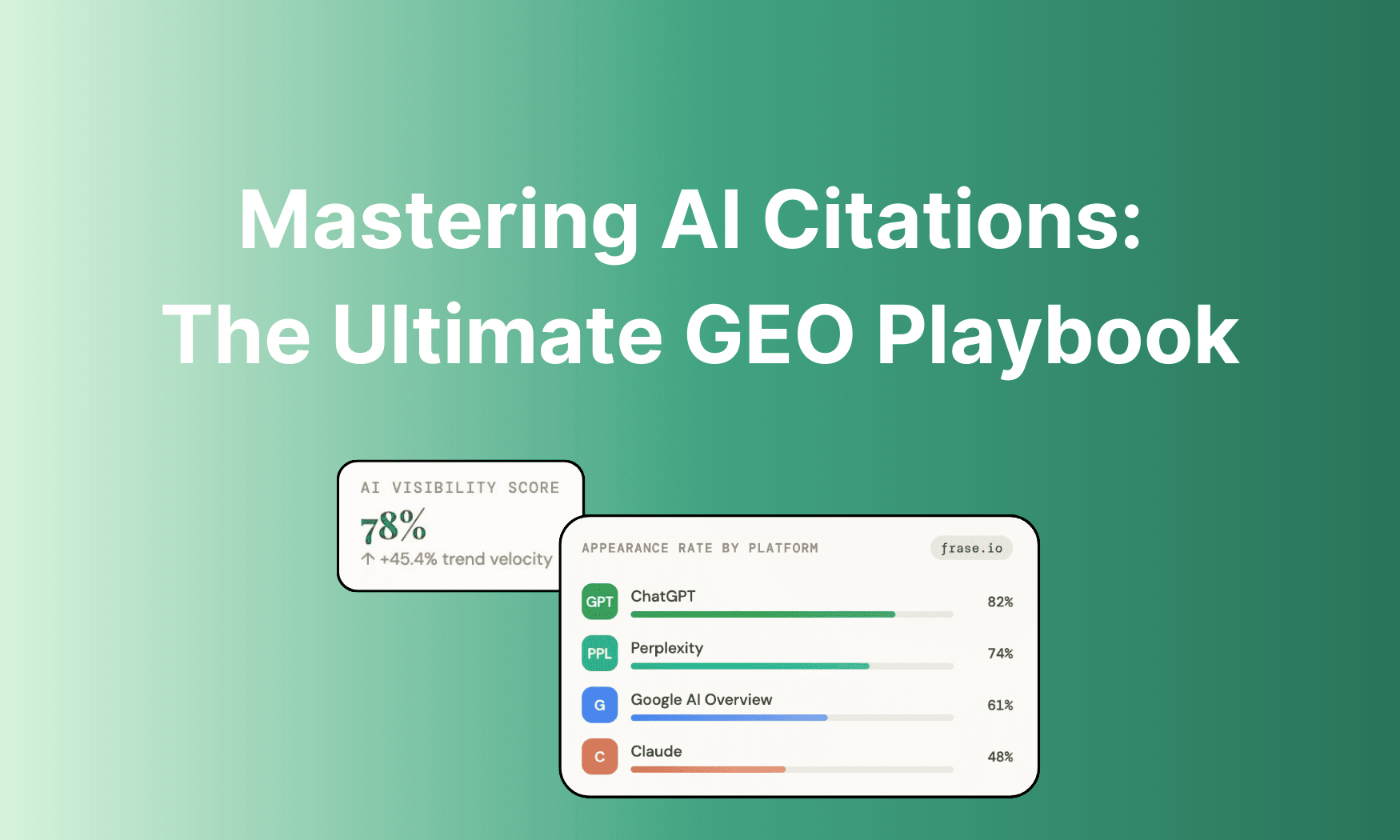
Unlock the secrets of AI search optimization. Discover strategies for gaining visibility, citation tracking, and mastering generative engine optimization.
Getting cited by AI search engines is no longer a nice-to-have. It's becoming the difference between growing organic traffic and watching it disappear.
Here's the reality: organic CTR has dropped 61% for queries where a Google AI Overview appears. But when your brand is cited inside that AI Overview, CTR is 35% higher than traditional organic results. The brands winning in AI search aren't just surviving the shift — they're compounding their advantage with every citation they earn.
This guide is your complete, platform-specific playbook for Generative Engine Optimization (GEO) — the practice of optimizing your content to get cited by ChatGPT, Perplexity, Google AI Overviews, and Claude. You'll find a 7-step framework, platform-specific tactics, and a practical workflow you can start using today. New to GEO? See where to start when you are handed GEO.
→ Check your GEO Score for free to see where you stand right now before diving in.
New: Entity Optimization for GEO — The Practitioner’s Guide to Getting Cited by AI Search. Six signals AI engines use to resolve, trust, and cite your brand, plus a live self-diagnostic with the free GEO Score tool.
The AI Citation Landscape in 2026 (Data Overview)
Before optimizing for AI citations, you need to understand what's actually happening in AI search—and the numbers are more consequential than most marketers realize.
In 2026, platforms like ChatGPT, Perplexity, and Google's AI Overviews handle billions of queries monthly, fundamentally changing the relationship between content and discovery. Traditional SEO metrics only tell half the story now.
The shift is dramatic: 62% of users now start their search journey with AI tools rather than traditional search engines. AI-referred sessions jumped 527% between January and May 2025. AI platforms generated 1.13 billion referral visits in June 2025 alone, representing a 357% increase year-over-year. ChatGPT now processes an estimated 1.6 billion search queries daily and is the fourth most visited website globally. However, citation patterns show extreme concentration: the top 20% of cited domains capture 80% of all AI references.
And yet more than 50% of brands still have no GEO strategy.
Understanding how to optimize for these platforms isn't optional anymore—it's the difference between being discovered and being invisible.
How AI Search Engines Decide What to Cite
AI platforms don't rank pages like Google does. They use Retrieval-Augmented Generation (RAG) — a process where the model pulls the most relevant external documents in real-time, synthesizes an answer, and cites the sources it drew from. This means citation decisions happen at the passage level, not the page level. The good news is, AI search engines don't pick sources randomly—they follow patterns we can reverse-engineer.
What RAG systems prioritize:
- Semantic clarity: Can the passage be extracted and understood standalone? The AI assesses whether your content directly addresses the user's question.
- Factual density: Does the content contain verifiable statistics, data points, and cited research with relevant links?
- Structural organization: Are headings, lists, and logical flow used consistently? Well-organized information with clear hierarchies gets parsed more effectively than dense, unstructured text.
- Authority signals: Is the source trusted by other trusted sources? Indicators like domain reputation, citation networks, and content freshness influence trust scores.
Critically, LLMs only cite 2–7 domains per response on average—far fewer than Google's ten blue links. Getting into that set requires deliberate optimization, not just good writing.
Platform Differences: Perplexity vs. ChatGPT vs. Google AI Overviews
Each major AI platform has distinct citation behaviors, and a one-size-fits-all approach leaves visibility on the table.
ChatGPT citation behavior reflects two layers—its training data favored high-authority, encyclopedic sources (hence Wikipedia's dominance as one of its most-cited sources), but its live web retrieval uses different signals. Content structure, comprehensiveness, and semantic relevance matter more than traditional authority metrics for earning citations in live responses, which is why 90% of ChatGPT citations come from outside Google's top 20 (meaning ChatGPT uses fundamentally different relevance signals than traditional search).
Perplexity prioritizes recency and community-validated content. According to industry analysis, Perplexity consistently favors content published within the past 12 months. Reddit accounts for 46.5% of Perplexity's citations which demonstrates that the platform clearly weights authentic, conversational content over brand-owned material. Perplexity shows only 25.11% duplication across sources (compared to Google's tendency to favor established domains), which creates genuine opportunity for newer, fresher content to get cited. Users who choose Perplexity tend to click cited links at higher rates, making it a quality traffic source.
Google AI Overviews favor content that already ranks well in traditional search. Reddit (21%) and YouTube (18.8%) are its most-cited sources. Google AI Overviews frequently cite sources already ranking in the top 10 organic results, making traditional search optimization tactics still relevant alongside newer GEO strategies. AI Overviews now appear in 50% of US searches and reach 1.5 billion users monthly. The CTR impact is severe — when an AI Overview appears, only 8% of users click a traditional result, down from 15%.
Claude prioritizes structured, substantive content with clear sourcing and demonstrated expertise. It tends to be more conservative in citation volume but highly selective about quality. The user base skews heavily toward professionals, consultants, and enterprise decision-makers — making it disproportionately valuable for B2B brands despite smaller referral volume. Claude uses Brave Search for web retrieval rather than Bing or Google, so ranking well in traditional search won't automatically surface you here; it cross-verifies sources heavily before citing them, meaning third-party mentions on G2, Wikipedia, and editorial coverage carry extra weight; and Claude won't cite your summary of a study if it can access the original. The most counterintuitive tactic: content that explicitly acknowledges limitations or trade-offs receives a 1.7x citation boost because it signals the intellectual honesty Claude is specifically trained to reward.
Understanding these platform-specific nuances shapes how you'll implement each optimization tactic—which is exactly what the framework ahead addresses.
The 7-Step GEO Optimization Framework
AI search optimization isn't about tweaking a few meta tags—it requires a systematic approach that addresses how LLMs evaluate and cite content. The framework below provides a sequential roadmap that builds from visibility assessment through citation optimization.
Think of this framework as a diagnostic tool followed by targeted interventions. Each step addresses a specific failure point in the AI citation pipeline, from being discovered in the first place to earning the final citation link. Skip a step, and you'll likely waste effort optimizing content that AI models never see or can't properly parse.
The seven steps work together as an interconnected system:
- Audit Your Current AI Visibility – Establish baseline citation rates across platforms
- Fix Technical Barriers – Ensure AI crawlers can access and process your content
- Optimize Content Structure – Format pages for LLM comprehension and extraction
- Build Semantic Authority – Strengthen topical signals that models recognize
- Create Citation-Worthy Assets – Develop content types that AI platforms preferentially cite
- Earn External Validation – Accumulate trust signals from authoritative sources
- Monitor and Iterate – Track citation performance and refine based on results
This framework differs from traditional SEO approaches because it prioritizes machine comprehension over human readability, citation probability over rankings, and semantic relationships over keyword density. Research shows that content optimized specifically for AI citations sees 3-4x higher mention rates than pages using conventional SEO tactics alone.
Ready to start? Let's begin by establishing your current baseline so you know exactly where you stand today.
Step 1: Audit Your Current AI Visibility
You can't optimize what you don't measure. Before making any content changes, establish your baseline AI visibility across platforms.
Manual testing: Query ChatGPT, Perplexity, Google AI Overviews, and Claude with 15–20 prompts that represent the questions your target customers are asking. Document whether your brand is cited, mentioned, or absent.
Categorize your prompts by type:
- Commercial (e.g., "best [category] tools")
- Comparison (e.g., "[your brand] vs [competitor]")
- Problem-solving (e.g., "how to [solve problem you address]")
- Category definition (e.g., "what is [your category]")
What to record for each prompt: Your visibility status, which competitors appear, how your brand is described when mentioned, and what page (if any) gets cited.
Use Frase's AI Visibility tracker to automate this process at scale. Rather than manually checking prompts, Frase monitors your brand's appearance across ChatGPT, Perplexity, Claude, Gemini, and Google AI daily — tracking your share of voice, citation sentiment, and the specific gaps where competitors are winning. You can test it out with a free 7-day trial.
The audit will reveal three types of opportunities: prompts where you're not visible but competitors are (priority targets), prompts where you're mentioned but not cited (optimization targets), and prompts where you're winning (content to protect and replicate).
Step 2: Identify High-Potential Query Targets
Not all AI citations are worth pursuing equally. The highest-value targets share three characteristics: high commercial intent, reasonable competition level, and strong alignment with content you can credibly own.
Prioritize prompts by:
- Commercial value: Comparison and recommendation queries drive conversion. "Best content optimization tools for SEO agencies" is more valuable than "what is content marketing."
- Citation gap size: Prompts where competitors are consistently cited but you're absent represent the clearest opportunity.
- Your authority zone: Queries where you have genuine expertise, data, or differentiated perspective will yield better and more durable citations than topics where you're a generalist.
Map query types to content formats. Frase's AI Visibility platform shows "Head-to-Head" comparisons with competitors by prompt category — this is your prioritization map. Prompts categorized as "problem" and "recommendation" types tend to have lower competition and high conversion intent.
Use Frase's Opportunities tab to surface the specific queries where competitors are winning that you could realistically target with new or optimized content.
Step 3: Structure Content for AI Extraction
This is the single highest-leverage change most brands can make. It is also the same discipline behind classic on-page work — the 12 content optimization strategies guide covers the foundational layer this step builds on. AI systems parse content at the passage level, which means your content needs to be extractable in chunks — not just readable as a whole.
Traditional AI SEO focused on keyword density and meta tags. Modern optimization prioritizes information architecture that LLMs can confidently extract and attribute. This means organizing content into discrete, citable units that answer specific questions without requiring context from surrounding paragraphs. According to research on AI search optimization, structured data formats receive 3x more citations than paragraph-only content.
The core structural principles:
Lead with the direct answer. Put your clearest, most complete answer to the page's main question in the first 40–60 words. Research shows that 44.2% of all LLM citations come from the first 30% of text. Your introduction isn't preamble — it's prime citation real estate.
Use a clean heading hierarchy. Every H2 and H3 should clearly signal the topic of that section. AI systems use headings to understand passage context. Vague headings ("Key Considerations") lose to specific ones ("How ChatGPT Decides What to Cite").
Write standalone sections. Each major section should be understandable without reading the rest of the piece. Add a brief TL;DR or summary sentence at the start or end of key sections so they can be extracted cleanly.
Include FAQ sections. AI engines rely heavily on clear question-and-answer pairs. A well-structured FAQ section with proper schema markup (more on that in Step 5) is one of the most reliably cited content formats.
Maintain fact density. Include statistics, data points, and specific examples every 150–200 words. AI systems favor content with verifiable claims over opinion-heavy prose. Always cite your sources — this signals credibility to RAG systems looking for trustworthy passages.
Use lists and structured formatting. Bulleted and numbered lists are consistently among the most-cited content formats. Comparison articles lead AI citations at 32.5% — structure comparative content clearly.
Content to avoid for GEO:
- Long walls of text without visual breaks
- Vague claims without supporting data
- Excessive hedging and qualifications
- Thin introductions that bury the answer
Step 4: Optimize for E-E-A-T Signals
Experience, Expertise, Authoritativeness, and Trustworthiness (E-E-A-T) isn't just a Google concept. AI platforms use similar signals to evaluate whether a source is worth citing. A Princeton study on citation bias in AI search confirmed that AI engines strongly favor earned, authoritative content over brand-owned material.
Demonstrate Experience:
A generic article about "marketing strategies" gets ignored; the same content authored by a CMO with case study data becomes citation-worthy.
- Include real examples, case studies, and first-hand observations
- Reference specific data from your own platform or customers (with permission)
- Document the methodology behind any claims
Establish Expertise:
Establishing author credentials prominently. Include bylines with professional titles, LinkedIn profiles, and relevant certifications near the top of each article. AI search algorithms scan for these trust indicators within the first 200 words to assess source reliability.
- Author bylines with credentials and relevant background
- Link to supporting research and industry sources
- Use domain-specific terminology accurately (but not to the point of obscuring meaning)
Build Authoritativeness:
Incorporate cited statistics and original research throughout your content. Generative Engine Optimization rewards specificity over vague claims—"conversion rates improved 47% after implementing personalization" beats "personalization works well" every time. Link to primary sources using inline hyperlinks rather than bare citation numbers.
- Earn citations from established industry publications
- Get listed on relevant comparison and review sites (G2 is the most cited software review platform across ChatGPT, Perplexity, and Google AI Overviews)
- Maintain consistent, accurate entity information about your brand across the web
Signal Trustworthiness:
Display publication dates and regular content updates prominently. AI models favor fresh information, especially for time-sensitive queries. A "Last Updated: March 2025" timestamp signals ongoing maintenance and accuracy commitment, increasing your content's trustworthiness score during the extraction process.
- Keep content updated with accurate, current information
- Maintain publication and "last updated" dates
- Cite your own sources explicitly with links
Step 5: Implement Schema Markup for AI Crawlers
Research indicates that structured data markup increases AI citation likelihood by making content boundaries explicit—AI models can confidently identify where claims begin, who authored them, and what context surrounds them.
Schema markup is the technical layer that tells AI crawlers exactly what your content means and how to classify it. Pages with proper schema markup are 30–40% more likely to be cited in AI-generated answers. This is one of the clearest technical improvements you can make with a measurable payoff.
Essential schema types for GEO:
Article schema — For all editorial content. Include author, datePublished, dateModified, and description properties. Keep dateModified current as you update content.
json
{ "@context": "https://schema.org", "@type": "Article", "headline": "Your Article Title", "author": { "@type": "Person", "name": "Author Name" }, "datePublished": "2026-01-15", "dateModified": "2026-03-01", "description": "Brief description of the article content" }
FAQPage schema — Add to any page containing question-and-answer content. This is the highest-impact schema for GEO because AI systems specifically favor FAQ-formatted content for response synthesis.
json
{ "@context": "https://schema.org", "@type": "FAQPage", "mainEntity": [{ "@type": "Question", "name": "What is GEO optimization?", "acceptedAnswer": { "@type": "Answer", "text": "GEO (Generative Engine Optimization) is the practice of optimizing content to be cited by AI search engines like ChatGPT, Perplexity, and Google AI Overviews." } }] }
HowTo schema — For instructional content and step-by-step guides. Clearly signals process-oriented content that AI systems frequently cite for "how to" queries.
Product schema — For product and feature pages. Include name, description, aggregateRating, and pricing information. AI systems use Product schema to populate comparison and recommendation responses.
Organization schema — Define your brand entity clearly with your name, URL, logo, social profiles, and description. Consistent entity information across the web improves how accurately AI platforms represent you.
Validate all schema using Google's Rich Results Test before publishing. Monitor for schema errors in Google Search Console regularly.
Step 6: Build Third-Party Citation Sources
AI search engines don't just crawl your website—they cross-reference your claims against third-party sources to validate credibility. This is the most powerful and most underutilized GEO tactic. AI engines are fundamentally more likely to cite a source that other trusted sources have cited first.
According to SEO leaders tracking AI search evolution, brands with "multi-source validation"—their claims appearing across 5+ external domains—see citation rates improve by 67% in AI overviews.
High-impact third-party citation sources:
Review platforms: G2, Capterra, and Trustpilot reviews are cited regularly across all major AI platforms. An active G2 profile with recent, detailed reviews signals trust to AI engines. Encourage customers to leave substantive reviews that describe specific use cases — these surface in recommendation queries.
Industry media and publications: Getting mentioned in TechCrunch, Search Engine Land, MarTech, or other relevant industry publications creates the kind of third-party validation that AI engines weight heavily. Guest articles on relevant publications are particularly effective because they include a byline link back to your site.
Reddit and community platforms: Reddit is one of the most-cited sources across all major AI platforms — 21% of Google AI Overview citations, 46.5% of Perplexity citations. Participating authentically in relevant subreddits (r/SEO, r/content_marketing, r/bigseo) and contributing genuinely helpful content creates citations from one of the most trusted sources in the AI citation ecosystem.
LinkedIn content: LinkedIn was among the top-cited sources by major LLMs in late 2025. Long-form LinkedIn articles and thought leadership posts are indexed and cited by AI platforms, especially for professional queries.
Podcast and interview features: When you're quoted or interviewed as an expert, those transcripts and show notes create diverse citation sources that signal expertise to AI engines.
Digital PR and research publication: Original research that others cite is GEO gold. Benchmark studies, industry surveys, and data analyses give other publications a reason to link to you — and give AI engines a reason to cite you as the primary source. If you publish something no one else has, AI engines have no choice but to cite you.
A practical starting point: ensure your product is listed and actively managed on G2, then identify three industry publications where you can contribute expert commentary or guest articles in the next 90 days.
Step 7: Monitor and Iterate
GEO is not a one-time optimization. Between 40–60% of cited sources change from month to month as AI models update, citation patterns shift, and competitors adapt. The brands that sustain AI visibility treat monitoring as an ongoing discipline, not a quarterly check-in.
What to track:
- Citation frequency: How often does your brand appear across tracked prompts?
- Share of voice: Your AI citations versus competitors across your priority query set
- Citation sentiment and accuracy: Is AI describing your brand correctly and positively?
- Appearance rate by platform: Which AI engines are citing you, and for what query types?
- AI-referred traffic and conversions: In GA4, set up source/medium tracking for
chatgpt.com,perplexity.ai, andclaude.aito measure actual business impact
The Frase monitoring workflow: Frase's AI Visibility tracker runs daily checks across your tracked prompts, surfacing wins, losses, and opportunities automatically. When competitors gain citations you're missing (the Opportunities tab), Frase provides the specific "what is working for them" analysis and actionable recommendations — whether that's content to create, schema to add, or entities to mention. The "Create Content" button takes you directly from the insight to the optimization workflow.
Review cadence recommendations:
- Weekly: Check for significant citation changes and new opportunities
- Monthly: Analyze share of voice trends and competitor movements
- Quarterly: Assess overall GEO strategy and refresh priority prompt list
However, don't just track—test variables systematically. If a competitor consistently beats you for a query cluster, reverse-engineer their approach: Do they use more structured data? More third-party backlinks? Deeper topical coverage? Then iterate one variable at a time to isolate what drives citation wins. For example, if adding FAQ schema doesn't improve visibility within 30 days, test expanding your "People also ask" coverage instead.
The reality is that AI search is still evolving, and what works today may need adjustment as platforms refine their algorithms. Continuous iteration separates brands that maintain GEO visibility from those that fade into obscurity.
Platform-Specific Optimization Tactics
The 7-step framework works universally, but each platform has distinct citation behaviors that reward specific approaches.
Google AI Overviews
Google AI Overviews draw heavily from existing top-ranked content, but they don't exclusively cite #1 results. The key is creating content that Google's systems can extract clearly for the AI Overview while also maintaining strong traditional SEO fundamentals.
Tactics that work:
- Target "featured snippet" style formatting: AI Overviews and featured snippets share structural preferences — clear definitions, step-by-step lists, and direct answers. If you're already optimizing for featured snippets, you're ahead.
- Keep your top-ranking pages updated: Google favors freshness in AI Overviews. Add a "Last Updated" date and refresh statistics and examples regularly. When a core update moves your rankings, diagnose before you react — what actually moved in the May 2026 core update and how to recover walks through the week-one workflow.
- Answer the question in the first paragraph: AI Overviews extract opening content heavily. Your intro needs to be answer-dense, not just engaging.
- Use structured headings for subtopics: When AI Overviews cover multiple aspects of a topic, they often pull from different sections of different pages. Well-organized subheadings increase the probability of being cited for specific subtopics even if you don't own the entire response.
- Prioritize informational and comparison queries: 99.2% of queries triggering AI Overviews have informational intent. Commercial comparison content (e.g., "Frase vs. Surfer") performs particularly well.
ChatGPT
ChatGPT has different authority signals than Google — domain authority matters, but content quality and comprehensiveness matter more. The platform favors content that reads like a definitive resource.
Tactics that work:
- Create comprehensive, encyclopedic guides: ChatGPT's preference for Wikipedia-style content signals that depth and completeness outperform focused, brief content. Pillar pages covering a topic thoroughly are ideal.
- Include specific, verifiable statistics: ChatGPT responds well to content with precise data points and clear attribution. Vague generalities are less likely to be cited.
- Build domain authority through backlinks: Unlike Perplexity, ChatGPT still weights traditional authority signals. High-quality backlinks from relevant domains improve your citation probability.
- Optimize your About page and company description: ChatGPT pulls entity information for recommendation queries. Ensure your site clearly describes what your product does and who it's for.
- Be present on high-authority platforms: ChatGPT's top citation sources include Wikipedia, Reddit, and Forbes. Building presence through guest posts, Wikipedia mentions (where accurate and appropriate), and industry media coverage directly improves ChatGPT visibility.
Perplexity
Perplexity is the most citation-transparent platform — it shows users exactly what it cited, which means users are more likely to click through. Perplexity's reliance on Reddit (46.5% of citations) and its preference for recency and diversity make it distinctively different to optimize for.
Tactics that work:
- Prioritize freshness: Perplexity leans into recently published content. Maintain a consistent publishing cadence and update existing content with current data.
- Engage in Reddit and community forums authentically: Given how heavily Perplexity sources Reddit, participating in relevant subreddit conversations where you can genuinely add value is one of the highest-ROI GEO activities specifically for Perplexity.
- Target niche, specific queries: Perplexity users tend to ask more specific, research-oriented questions. Content that goes deep on a specific topic outperforms broad overviews.
- Create content with multiple credible sources cited: Perplexity's algorithm appears to favor content that itself cites multiple trustworthy sources — demonstrating that you're doing the synthesis work already.
- Maintain a Perplexity Pages presence: Perplexity now allows brands to create Pages that can appear as cited sources. This is an underutilized direct presence opportunity.
Claude
Claude (Anthropic's AI) is more selective and conservative in citations than ChatGPT or Perplexity. It tends to favor content that is structurally clear, well-sourced, and authoritative without being promotional.
Tactics that work:
- Write with authoritative neutrality: Claude is more likely to cite content that reads like expert analysis rather than marketing copy. Tone matters — be informative and balanced.
- Cite your sources inline: Claude tends to favor content that demonstrates its own epistemic rigor — citing research, linking to data sources, and acknowledging complexity.
- Use precise, specific language: Vague claims and superlatives ("the best," "revolutionary") are likely to be filtered out. Specific, verifiable claims ("reduces research time by 40%") are more likely to be cited.
- Create comparison content: Claude handles comparison queries extensively. Well-structured head-to-head comparisons with objective criteria tend to get cited for these query types.
Measuring GEO Success: KPIs That Matter
Traditional SEO metrics don't capture AI citation performance. Here's what to track and how.
Primary GEO KPIs:
Citation frequency and share of voice: How often does your brand appear across your tracked prompts versus competitors? This is your GEO equivalent of keyword rankings. Track this weekly via Frase's AI Visibility dashboard or manual testing across platforms.
Appearance rate: The percentage of tracked prompts where you're cited at least once. Frase's platform shows this metric clearly — the "Appearance Rate" metric on the Overview dashboard.
Trend velocity: Is your citation rate accelerating, stable, or declining? Growth direction matters as much as current position.
Authority rate: Are you being cited as a primary/authoritative source, or as a secondary mention? Frase tracks "prominence score" for individual citations — whether your brand is mentioned early and prominently (which signals authority) versus buried later in a response.
Secondary GEO KPIs:
AI-referred traffic: Set up GA4 to track sessions from chatgpt.com, perplexity.ai, claude.ai, and gemini.google.com. Given that LLM-referred traffic converts at 14.2% versus Google organic's 2.8%, even modest AI traffic volumes can have meaningful business impact.
Brand search volume: Brands mentioned in AI responses often see branded search spikes as users turn to Google to learn more. Monitor this in Google Search Console as a secondary indicator of AI citation influence.
Citation sentiment: Are AI platforms describing your brand accurately and positively? Negative or inaccurate descriptions — even with citations — can damage conversion. Frase's sentiment tracking flags these automatically.
What not to track (yet): Don't obsess over AI-referred traffic in absolute terms. Google still sends significantly more traffic than ChatGPT, Gemini, and Perplexity combined. The case for GEO is about brand authority, citation quality, and positioning for a channel growing at 165x the rate of organic search — not replacing your current traffic reporting with AI-only metrics.
The practical workflow: Use Frase's GEO Score to establish your baseline, implement optimizations from the 7-step framework, and monitor your score weekly. The GEO Score synthesizes your content optimization level, AI visibility tracking data, and citation performance into a single benchmark that makes progress measurable.
Turn the framework into your own baseline
The seven steps pay off when they run against your own domain, not a hypothetical one. In a Frase trial, you can set up AI Visibility tracking for your brand and your competitors, pull your first share-of-voice read across ChatGPT, Perplexity, Claude, Gemini, and Google AI, and open the Opportunities tab to see which prompts competitors win that you could take. That is Step 1 and Step 2 of this playbook done with data instead of guesswork, inside a week.
Start your 7-day free trial → No credit card required.
Frequently Asked Questions
How long does it take to get cited by AI search engines after optimization?
Most brands see initial citation improvements within 4–8 weeks of implementing structural content changes and schema markup. Perplexity tends to respond fastest due to its recency bias. ChatGPT and Google AI Overviews take longer because they weight established authority signals that build over months. Third-party citation building (Step 6) has the highest impact but the longest lead time.
Do I need to optimize differently for each AI platform?
The core framework (Steps 1–7) applies universally. Platform-specific tactics amplify results for individual platforms. Start with universal optimization, then layer in platform-specific approaches based on where your target audience is most active and where citation data shows the biggest gaps.
Does GEO optimization hurt my traditional SEO?
No. The structural improvements GEO requires — clear headings, factual density, schema markup, E-E-A-T signals, and third-party citations — are the same foundations of strong traditional SEO. GEO and SEO are complementary, not competing.
What's the difference between a citation and a mention in AI responses?
A citation typically means the AI platform explicitly links to your content as a source. A mention means your brand or product is referenced without a direct link. Both have value, but citations are stronger signals of authority and more likely to drive direct traffic. Frase's AI Visibility tracker distinguishes between the two.
How do I get my brand cited in comparison queries ("X vs. Y")?
Comparison queries are among the most commercially valuable in AI search. The most effective tactic is creating your own well-structured comparison content (including comparisons against competitors) with clear, objective criteria. Getting reviewed on G2 and Capterra is also highly effective, as these platforms are frequently cited by AI engines for comparison queries. Frase's AI Visibility shows you specifically which competitor comparisons are being won by others, so you can prioritize.
My brand is being described inaccurately by AI engines. What do I do?
This is an authority gap issue. When AI platforms lack clear, authoritative information about your brand, they fill the gap with whatever signals they can find — which may be outdated or inaccurate. Fix this by: (1) improving your About page and product descriptions, (2) ensuring consistent entity information across all platforms, (3) creating content that explicitly defines your category and positioning, and (4) earning more third-party coverage that accurately describes what you do. Frase's AI Visibility Insight feature identifies exactly this type of authority gap and provides specific recommendations.
Is GEO just for large brands with big budgets?
No. The core tactics — content restructuring, schema markup, FAQ optimization, and Reddit participation — cost primarily time, not money. With 47% of brands having no GEO strategy, the competitive window for early movers is still wide open. The brands that build AI citation authority now will be significantly harder to displace as competition increases.
Your GEO Optimization Workflow in Frase
The challenge with GEO is that most platforms require you to stitch together separate tools for tracking, optimization, and content creation. Frase brings all three into one workflow: tracking, optimization, and content creation in the same place.
Here's how it works in practice:
- Check your GEO Score at /tools/geo-score to benchmark how well a typical piece of your content is currently optimized for GEO.
- Set up AI Visibility tracking for your brand and priority competitors. Frase monitors your citations across ChatGPT, Perplexity, Claude, Gemini, and Google AI daily.
- Use the Opportunities tab to identify prompts where competitors are winning but you're absent. Each opportunity comes with a "What is working for them" analysis looking at the content types and approaches that are earning citations.
- Create optimized content directly from each insight using the "Create Content" button. Frase's editor gives you both an SEO Score and a GEO Score in real-time, so you can optimize for both traditional rankings and AI citations simultaneously.
- Monitor and iterate. Your AI Visibility dashboard shows trend velocity, share of voice shifts, and new opportunities as they emerge.
The insight-to-action workflow — from identifying a gap to publishing content that addresses it — happens in one platform, not across four separate tools.
The Bottom Line
Getting cited by AI search engines requires a different approach than ranking in Google — but it's achievable and measurable. The brands winning in AI search have structured their content for extraction, built third-party authority, and implemented the technical foundations that help AI systems trust and cite them.
The 7-step framework in this guide gives you everything you need to start:
- Audit your current AI visibility
- Identify high-potential query targets
- Structure content for AI extraction
- Optimize for E-E-A-T signals
- Implement schema markup
- Build third-party citation sources
- Monitor and iterate
The window for early movers is still open. With 47% of brands lacking any GEO strategy, acting now means building citation authority before your competitors do.
→ Check your GEO Score for free — see your baseline across all major AI platforms in minutes.
→ Run the playbook on your own site — start a free 7-day trial — GEO Score, AI Visibility tracking, content optimization, and publishing in one workflow.
Related reading: What is Generative Engine Optimization (GEO)? | GEO Scoring in Frase | AI Visibility Tracking | GEO Content Optimization
About the author
Georgina D'Souza
Marketing Manager
Georgina D'Souza is a Marketing Manager at Frase and Copysmith AI, the company behind Frase.io and Describely.ai. She brings ten years of marketing experience — spanning early-stage startups to multinational enterprise — specializing in content marketing, SEO, and generative engine optimization, helping SaaS brands adapt their content strategies for AI-powered search. Georgina writes about generative engine optimization, AI search visibility, and content marketing for the AI era.
See Frase run on your own content.
Research your market, draft in your voice, and track where you show up across Google and AI search. Start free.
Start free trial7-day free trial. No credit card.