Why Your Page Ranks But Doesn't Get Cited by AI (And How to Fix It)
Many AI-cited URLs don't rank in Google's top ten. Learn the 4-job operating loop that closes the gap and keeps your pages cited.
Your page sits on Google page one. ChatGPT still ignores it. That gap is the new shape of search. Just been handed that problem? Start with the first three things to do.
A 15,000-prompt analysis from Ahrefs in September 2025 found that only 12% of URLs cited by ChatGPT, Gemini, and Copilot rank in Google's top 10 for the same prompt. Top-10 rank is no longer enough. AI engines pick sources on their own terms.
This guide breaks the problem into a 4-job operating loop that audits, diagnoses, fixes, and publishes. It is the workflow Frase customers run weekly to keep pages cited across several AI engines. The approach also aligns with Google's official AI search guidance on what actually earns AI citations.
What you will learn:
- Why ranking and getting cited are now two different jobs
- The four mechanics AI engines use to pick sources
- A 4-job loop you can run weekly across your CMS
The Citation Gap: Why Top-10 Ranking Stopped Being Enough
Search behavior split in two during 2025. Google AI Overviews now appear in a growing share of result pages, and when they do, click-through rates fall by roughly 58% according to Ahrefs' December 2025 update. AI referral traffic from ChatGPT, Perplexity, Claude, and Gemini accounts for about 1.08% of total web traffic and is growing roughly 1% month over month, per Search Engine Land's analysis of 3.3 billion sessions across 13,770 domains. A separate Ahrefs AI traffic study of 3,000 sites found 63% of websites now receive measurable AI referral traffic.
Pages holding position 3 on Google can lose half their clicks to an AI Overview while never appearing in the AI Overview citation list. Two surfaces. Two selection systems.
Twelve percent overlap, per the same Ahrefs analysis, means 88% of AI citations go to URLs that are not in Google's top 10 for the same prompt. Some rank deeper. Some are not even optimized for the query. Ranking is now one input among several, and no longer the dominant one. A separate Semrush study found that when ChatGPT cites a page, that page ranks in traditional position 21 or lower almost 90% of the time. The exception is Google AI Overviews, which still pull from the organic top 10 about 38% of the time, per Ahrefs, so rank matters most on the surface Google itself controls and least on the standalone assistants.
The cost of inaction is measurable. SparkToro's 2024 zero-click study found only 37.4% of US Google searches now generate any click to the open web. AI Overviews compound that compression by another 58 percent on the queries they appear in. Without a citation strategy, the brand attached to your category gets quieter every quarter.
Why Ranking Doesn't Mean Getting Cited
AI engines do not consult Google's ranking algorithm before picking sources. They run their own retrieval and synthesis pipeline, and that pipeline rewards different signals.
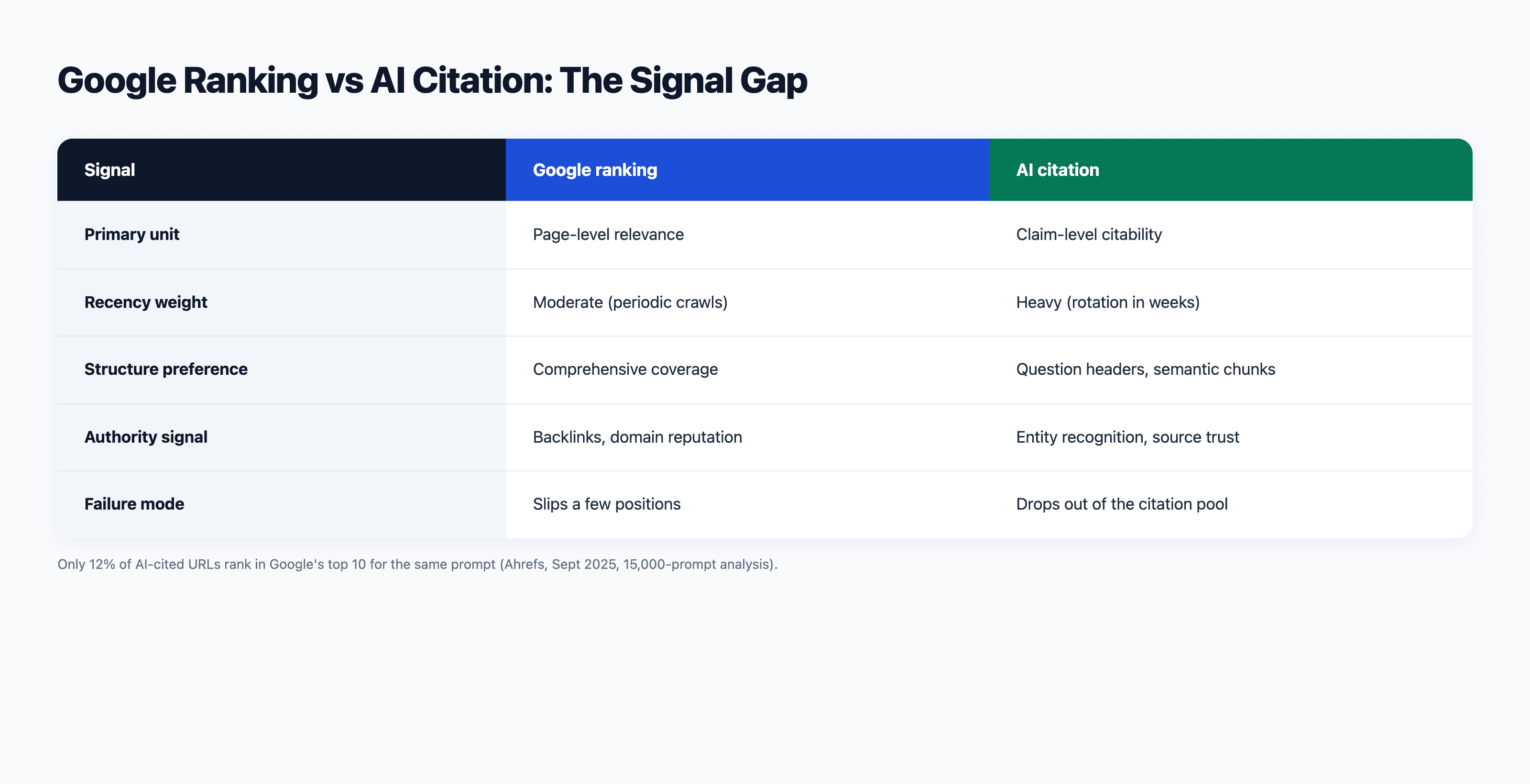
The signal gap is the entire problem in one table.
| Signal | Google ranking | AI citation |
|---|---|---|
| Primary unit | Page-level relevance | Claim-level citability |
| Recency weight | Moderate (periodic crawls) | Heavy (rotation in weeks) |
| Structure preference | Comprehensive coverage | Question headers, semantic chunks |
| Authority signal | Backlinks, domain reputation | Entity recognition, source trust |
| Failure mode | Slips a few positions | Drops out of the citation pool |
Four mechanics decide whether a page gets cited.
Entity recognition over keyword density
AI engines parse pages as collections of entities: products, people, places, concepts, and the relationships between them. A page that mentions a topic without clearly defining the entities, their attributes, and how they relate to each other will lose to a page that does. Keyword density without entity coverage is invisible to the retrieval layer. This is the foundation of Generative Engine Optimization (GEO) and the reason traditional on-page SEO is not sufficient.
Freshness as a primary signal
AI engines weight recency far more aggressively than Google does. A study of 17 million AI citations found that AI-surfaced URLs are 25.7% fresher on average than Google's organic results for the same queries. A page published 18 months ago can hold its Google rank for years while quietly disappearing from AI answers as new entrants publish on the same topic. This is the mechanism behind AI citation decay.
Structural clarity
Answer engines extract claims, not paragraphs. Pages that bury insights inside long, unbroken text lose to pages that surface the same insights in question headers, semantic chunks of 200 to 400 words, and labeled lists. Structural clarity does not change the meaning of the content. It changes whether the retrieval layer can find it.
Citability of the claim itself
When an AI engine generates an answer, it picks specific facts to cite. A claim with a number, date, definition, or source link is easier to attribute than a vague observation. Pages built from citable claims accumulate citations the way pages built for backlinks accumulate links.
A page can rank number two on Google and be invisible to ChatGPT because it fails three of those four tests. The fix is not "more SEO." The fix is a different workflow.
The 4-Job AI Citation Operating Loop
Most teams treat AI visibility as a quarterly audit. Teams winning the citation game run it as a weekly loop.
The loop has four jobs. Each one feeds the next.
- Audit: measure your citation share across the AI engines that matter to your category
- Diagnose: identify which pages are decaying and why
- Fix: apply the page-level changes that close the gap
- Publish: push the fix to your live URL through your CMS
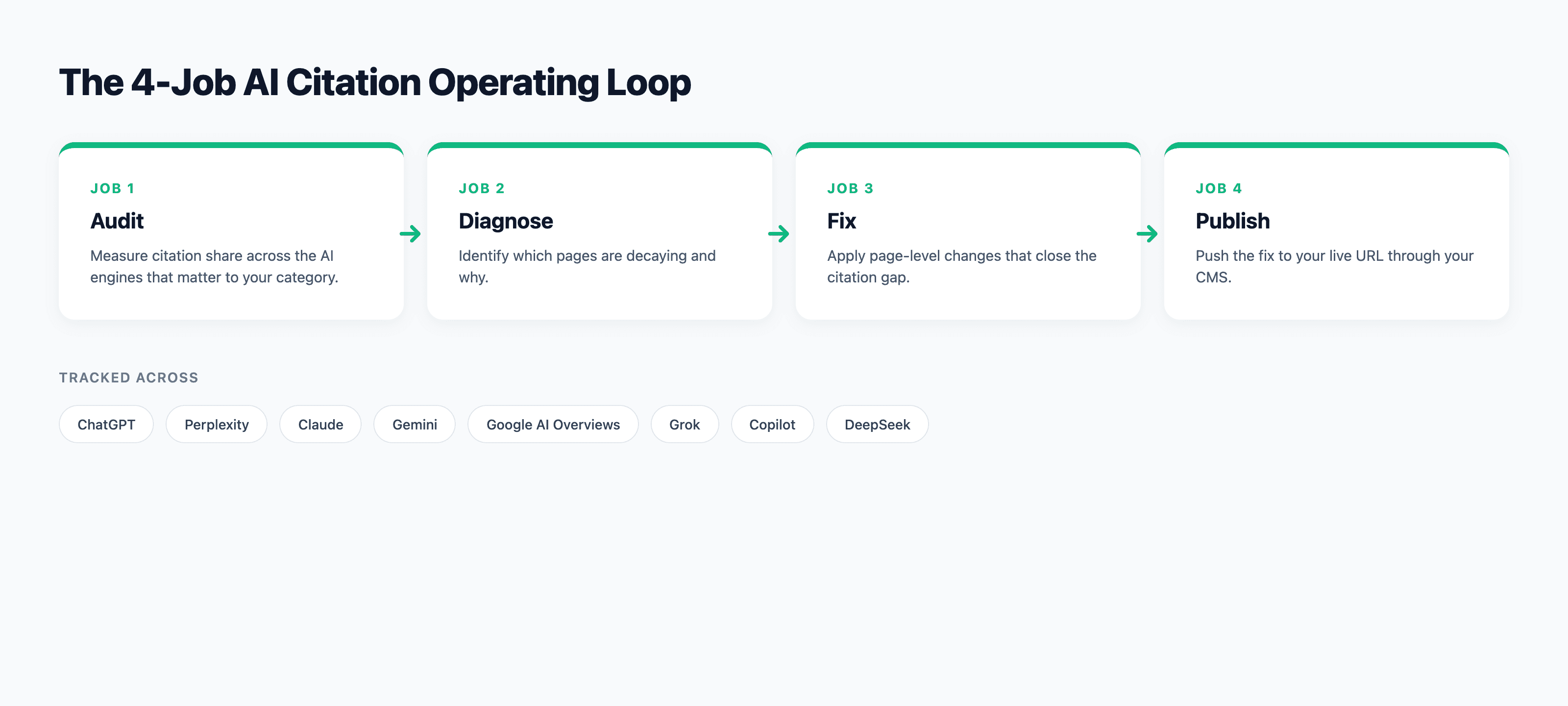
Frase is the agentic SEO and GEO platform built to close all four jobs in one workflow. The Auditor handles measurement. The GEO Content Optimization workflow handles diagnosis and fixes. Content Guard handles continuous monitoring and CMS publishing. The loop runs against your existing site without rebuilding your stack.
Job 1: Audit Your Citation Share Across AI Engines
Without measurement, you are guessing. Most teams know their Google rankings to the decimal and have zero visibility into ChatGPT or Perplexity. That is the first thing to fix.
A complete citation audit covers the major engines: ChatGPT, Perplexity, Claude, Gemini, Google AI Overviews, Grok, Copilot, and DeepSeek. Each one selects sources differently, and they differ in which sources each engine cites. Auditing one or two is the equivalent of measuring SEO on Bing alone.
How to run the audit
The audit is a structured rotation. Pick the prompts that matter to your category: the questions your customers ask AI assistants when evaluating your space. Run each prompt against each engine weekly. Record three signals per run.
- Citation presence. Did your domain appear in cited sources at all?
- Citation position. Where in the answer was your page surfaced?
- Competing citations. Which domains did the engine choose over yours?
Weekly is the right cadence. AI engines update their retrieval indices on rolling cycles, and a single snapshot can mislead. A page can be cited Monday, replaced Tuesday by a fresher competitor, and back in rotation Friday. You need the trend, not the spot check.
What the audit tells you
Three patterns emerge from a clean audit. Pages with consistent citation share are category anchors to protect. Pages trending down are decay candidates for Job 2. Prompts where you never appear belong in your content roadmap.
New to the concept? Start with our guide to AI visibility. Then see it in action: run a single domain through the AI Visibility Checker. The tool surfaces your ChatGPT citation result instantly, then layers in Perplexity and Gemini after a quick email confirmation. It is the entry point to the full workflow inside AI Visibility Tracking.
When evaluating a full AEO platform for the weekly loop, the 5-criteria framework in our Best AEO Tools 2026 guide maps every tool in the category against the four jobs above.
See where you stand right now. Start your 7-day free trial: track your AI citations. No credit card required.
Job 2: Diagnose Why Your Citations Decay
A page cited last month and skipped this month did not get worse. The competitive set got fresher, prompts shifted, or the engine rotated its source pool. Diagnosis tells you which.
Five signals tell you what changed. Pull them in this order:
- Citation half-life trend over the last 8 weeks
- Fresh-competitor publishing in the same prompt cluster
- AI Overview surface drift on the target queries
- Stale statistics on the page itself
- Any field-level change to the page's structure or schema since the last refresh
Citation half-life
Every page has a citation half-life, meaning the rolling window during which it stays in the AI engine's source pool. Some pages hold for months. Some decay in weeks. Tracking citation share over time reveals each page's natural half-life, which is the only honest baseline for deciding when to refresh.
Fresh-competitor publishing
AI engines weight recency aggressively. When a competitor publishes a thorough piece on a topic you own, the engine often pivots within days. The fix is to refresh your page with new entities, new examples, new statistics, and a fresher dateModified.
AIO surface drift
Google AI Overviews change which sources they cite as query intent shifts. A page cited for "best AI visibility tools" can lose its AIO slot when the query population skews toward "free AI visibility tools." Watching the AIO source list weekly catches this drift before traffic moves. A Google core update can move AI citations the same way, because AI Overviews lean on the same core ranking systems, so when a core update lands, re-audit citation share, not just rankings.
Stale-stat detection
A page anchored on a 2023 statistic loses citation share to a page anchored on a 2025 statistic, even when the underlying claim is unchanged. Stale stats are the most common reason pages decay quietly.
Each signal maps to a specific fix in Job 3. For a deeper treatment of the decay pattern itself, see our guide on content decay and automatic ranking-drop fixes.
Job 3: Fix the Page-Level Patterns AI Engines Miss
This is where most teams either get it right or stall. The fix is not "add more content." The fix is targeted changes that match the four mechanics AI engines use to pick sources.
Close entity coverage gaps
For each target prompt, list the entities a thorough answer would mention: products, frameworks, statistics, dates, named methods. Cross-check against your page. Any entity missing from your page is a citation leak. Add it with definition, attribute, and relationship to adjacent entities.
Tighten structure for extraction
AI engines extract from question-shaped headers and well-defined chunks faster than from prose. Rewrite section headers as questions when natural. Break sections longer than 400 words into smaller chunks. Add a labeled list whenever you have three or more parallel items.
Lead with answer-first paragraphs
Every section should open with a sentence that could be cited as a standalone answer. The rest of the section provides context and citations. This is featured-snippet optimization scaled across the page.
Raise citation density
A page with two cited statistics will lose to a page with eight. Audit your claims, add a source link to every factual statement that lacks one, and replace older citations when fresher equivalents exist. This is the highest-leverage move in the workflow.
Optimize both SEO and GEO together
Frase scores pages on both SEO content optimization and GEO content optimization in the same workflow. The two scores move together more often than they conflict. Tools that score only one half of the problem ship half-fixes.
The fix queue is the operational center of the loop. A team running this weekly keeps citation share trending up rather than reacting to drops after the fact. For the foundational structural pattern, our Answer Engine Optimization complete guide covers the citation-shaped structures in depth.
Run your first weekly loop this week. Start your 7-day free trial: track your AI citations. No credit card required. Plan limits and tiers live on the pricing page if you want the full plan view first.
Job 4: Publish the Fix Across Your CMS
The loop only closes when the fix lands on the live URL. A great fix sitting in a draft is invisible to every AI engine on Earth.
Publishing is where most content workflows break. The fix gets approved, then waits days for engineering to push it live. By then the diagnosis is stale and the next decay cycle has started.
Frase Content Guard closes this gap. The workflow scans your pages weekly, applies fixes per your policy, and republishes directly to your CMS without the developer round trip.
CMS providers Frase publishes to
Frase publishes directly to all five of the CMS platforms that cover the majority of marketing teams.
- WordPress. Direct publishing through Frase's WordPress integration.
- Sanity. Programmatic publishing via the Sanity content API.
- Webflow. Direct publishing through the Frase Webflow integration.
- Wix. Direct publishing through the Frase Wix integration.
- FraseCMS. Native publishing inside Frase for teams without a separate CMS.
Each integration handles field mapping, image upload, and schema markup. The page on your CMS picks up the updates Frase identified in Jobs 2 and 3. The loop runs end-to-end without an engineering ticket.
This is the agentic part of agentic SEO. Monitoring tools tell you a page is decaying. Frase fixes it and publishes the fix.
The Operating Loop Is the New Unit of Work
Top-10 rank is no longer enough. The 12% overlap between Google rankings and AI citations is not a temporary anomaly. It is the permanent shape of search going forward. The teams that build a weekly citation loop will compound their visibility across both surfaces and stay cited by AI as the index rotates. The teams that wait for AI search to "settle" will watch their best pages disappear from the new surfaces one quarter at a time.
The fix is operational, not technical. Audit your citation share. Diagnose decay before traffic drops. Apply the four-mechanic fix to your most cited pages. Publish through your CMS in the same workflow. Run the loop weekly.
Frase runs this loop end-to-end. AI Visibility Tracking handles Job 1. The GEO content optimization workflow handles Jobs 2 and 3. Content Guard and the Frase CMS integrations handle Job 4. One platform, four jobs, weekly cadence across the major AI engines.
Start your operating loop this week. Start your 7-day free trial: track your AI citations. No credit card required.
Frequently Asked Questions
Why does my page rank on Google but not get cited by ChatGPT?
Google ranking and AI citation use different selection signals. Only about 12% of URLs cited by ChatGPT, Gemini, and Copilot rank in Google's top 10 for the same prompt, per Ahrefs' 2025 analysis. AI engines weight freshness, entity coverage, structural clarity, and citability of specific claims more heavily than Google's algorithm. A page can rank #2 and still fail those tests.
What is AI citation decay?
AI citation decay is the gradual loss of citation share on AI engines as fresher competing pages publish, query intent shifts, and AI engines rotate their source pools. Pages have natural citation half-lives that vary by topic and competitive density. Without a weekly audit, decay is invisible until traffic drops.
How often should I audit AI citation share?
Weekly is the right cadence. AI engines update their retrieval indices on rolling cycles, and a single monthly snapshot misses the rotation pattern. A weekly audit catches decay early enough to fix the page before traffic moves and surfaces fresh-competitor publishing inside the same week it happens.
How many AI engines should I track?
The major engines: ChatGPT, Perplexity, Claude, Gemini, Google AI Overviews, Grok, Copilot, and DeepSeek. Each engine selects sources differently and serves a different audience slice. Tracking only one or two creates blind spots in the same way measuring SEO on Bing alone would.
Can I track AI citations without a paid tool?
You can spot-check a single domain on a single engine with a free tool like the Frase AI Visibility Checker. To run a weekly audit across the major AI engines with consistent prompts and historical tracking, a dedicated platform is required. The cost difference between guessing and measuring is usually less than one paid acquisition channel test.
What is the fastest fix for a page that ranks but is not cited?
Increase citation density. Add a source link to every factual claim that lacks one. Replace any citation older than 18 months with a fresher equivalent. Add three to five entity definitions to sections that mention concepts in passing. This is the single highest-leverage page-level move and usually takes under an hour per page.
Which CMS platforms does Frase publish to so pages get cited by AI faster?
Frase publishes directly to WordPress, Sanity, Webflow, Wix, and FraseCMS. Each integration handles field mapping, image upload, and schema markup automatically. Content Guard runs the full audit-diagnose-fix-publish loop without engineering involvement, so fixes land on the live URL the same week they are identified and the page stays cited by AI across the major engines we track.
About the author
Shegun Otulana
Founder & CEO
Shegun Otulana is CEO of Copysmith AI, parent company of Frase.io and Describely.ai. He's a serial entrepreneur with multiple exits and has been building companies at the intersection of search, marketing, SaaS, and artificial intelligence since 2013. Shegun writes about generative engine optimization, AI search, and the future of content marketing.
Related articles
See Frase run on your own content.
Research your market, draft in your voice, and track where you show up across Google and AI search. Start free.
Start free trial7-day free trial. No credit card.