Answer Engine Optimization Tools: What to Look For Before You Buy
Learn how to assess answer engine optimization tools by asking what happens after the alert and how the finding becomes a published page.
One question can guide your choice of an answer engine optimization tool: what happens after the alert. A report may show that ChatGPT stopped citing you, but your page still needs a specific correction. Frase's AI Visibility monitors citations across ChatGPT, Perplexity, Claude, Gemini and Google AI and alerts you when they change, while Content Guard watches Google ranking and traffic decay and drafts fixes from each page's research at the autonomy you set.
You decide whether Frase waits for your review or publishes the fix without you. You can change that setting whenever you want. The useful part starts when the alert becomes work that Frase can finish.
Want a reading before you compare options? Run the free AI Visibility Checker on your domain to see which AI engines name you now, with no card required. Ready to test the workflow on your pages? Start a 7-day free trial, no credit card. If you still need the basics, read what answer engine optimization is and return here.
Key takeaways
- Ask one question before you buy: what happens after the alert. A dashboard reports the lost citation, while a platform turns that finding into a corrected page on your live site.
- Use the same factors for each option: manual updates, SEO editing, data compliance readiness, support, customization, multilingual reach and audience-based analytics.
- Frase's AI Visibility monitors citations across ChatGPT, Perplexity, Claude, Gemini and Google AI and alerts you when they change. Content Guard watches Google ranking and traffic decay and drafts the fix at the autonomy you set.
- Frase is SOC 2 Type II and GDPR compliant, scores each draft for SEO and GEO in one editor, and publishes to WordPress, Sanity, Webflow, Wix or FraseCMS.
- Start with the AI Visibility Checker, then use the 7-day free trial with no credit card to test the full workflow.
What actually happens after the alert
You see the change on a Tuesday. ChatGPT no longer names you for a question that sends qualified buyers to your site, and another page now appears in the answer.
The alert leaves the next steps with you. Someone must find the affected page, compare its coverage with the cited source, prepare a brief, manage the draft and approval, and publish the correction. Someone must also check three weeks later to see whether the citation returned.
That work moves through several tools and calendars, so the page remains absent while your team coordinates each step, and a demo often ends at the dashboard because the vendor wants to show the finding. Ask what happens next. Find out how much of the remaining work the product handles for you. If you need more context first, read what AI visibility is.
Answer engine optimization (AEO) platforms: evaluation factors
Answer engine optimization platforms need to diagnose a visibility problem and help you correct the affected page, and Frase tracks citations across AI engines, drafts the correction and publishes the approved page. Use the factors below to see how much work each shortlisted product leaves with your team after it reports a change.
Each factor gives you a direct question for a vendor, so vague answers become easier to spot. Our best AEO tools roundup covers the field if you want a ranked view of the available choices.
Answer engine optimization software vs manual content updates
Answer engine optimization software reduces the time you spend finding and correcting pages that lose visibility, and Frase's AI Visibility monitors AI citations daily and alerts you when they move. Content Guard watches those pages for Google ranking and traffic decay, drafts each fix from the page's research and republishes it at the autonomy you set.
Several pages can slip in one month. Manual updates then become difficult. One correction can take about a week of someone's time, and the next page may decline before that work ends. Writing still matters, but someone also has to notice every change.
Ask whether the product finds decay without a manual check and whether your team must switch tools to publish the correction. Then ask who controls approval. Content Guard shows the type of workflow you should expect.
Answer engine optimization platform vs SEO content editor
An SEO content editor compares a draft with pages that rank on Google, while an answer engine optimization platform checks whether AI engines cite the live page. Frase handles both jobs in one editor with SEO scoring and GEO scoring, so you can prepare the draft for search results and AI answers in one pass.
GEO scoring shows how well a draft supports quotation in an AI answer. SEO scoring covers the Google results page.
The two surfaces have largely decoupled. A page can rank third on Google and receive no citation from ChatGPT or Perplexity because the systems reward different qualities. An editor without tracking leaves you unsure about AI visibility, while a tracker without editing leaves the correction with you. Ask a vendor to show both scores on one draft, and include any extra handoff in your cost review.
Data compliance readiness for answer engine optimization platforms
Data compliance readiness starts with clear answers about content access and publishing. Frase is SOC 2 Type II and GDPR compliant, and Frase publishes into the CMS you own so the live page stays on your infrastructure. Roles and permissions control access, while Enterprise adds SSO and SAML, two years of history and an SLA.
A late security review can delay a pilot after your team has already invested time in setup. Ask the compliance questions before the pilot begins, and keep the vendor's answers with your evaluation notes.
Request written answers about where published content lives, who can access the workspace, how long citation history remains available and whether you can export it.
Customer support and documentation for team adoption
Support matters after setup. Clear documentation helps your team use a new workflow without waiting for internal help, and Frase provides onboarding and training from the support team, a public help center, an SEO and GEO guide, a public API reference and agent-native documentation. Enterprise includes a dedicated account manager and an SLA.
Your team starts by connecting its CMS and naming the prompts and competitors it wants to track. Engineers can use Frase's MCP server, CLI, agent skills and the Frase API to run research, scoring and publishing from their existing tools.
You can inspect support material before you pay. Search the vendor's help center for a specific task, such as connecting a CMS, and check whether the result gives your new hire a usable answer. Clear documentation lets more people complete routine work without relying on one colleague.
Customization features that decide whether the tool fits your brand
Customization features determine whether generated work follows the standards your editors already use. Frase writes with the brand voice and terminology you set, applies tone and structure presets for each market, follows your templates and content rules, and tracks the prompts and competitors you choose. Enterprise adds custom seats, domains and limits.
Generic copy creates editing work on every page. Ask whether you can define your voice once, preserve the terms your company uses, apply your editorial rules and choose the prompts that matter to your buyers.
Multilingual support for the markets you actually sell in
Multilingual support should produce native drafts for the markets you serve instead of translating a finished English page. Frase drafts in 70+ languages with the tone and structure each market expects. Frase also targets each prompt to a country across 40+ countries, so you see the answers buyers receive in that market.
The same prompt can produce different shortlists in two countries. Check the markets you plan to serve before you commit, even when your current content uses one language.
Ask whether the product writes natively or translates from English, and confirm that you can assign a country to each tracked prompt. A combined global result cannot show the answer for a specific market.
Audience-based analytics: which buyers stop seeing you
Audience-based analytics show where your visibility changes as a buyer moves toward a decision. Frase classifies each tracked prompt as awareness, consideration or decision and scores visibility for each stage. You can see when AI names your brand during research but leaves it out when the buyer starts comparing options.
A mention on a broad educational question says little about purchase intent. Comparison and selection prompts sit closer to a decision, so aggregate coverage can hide a gap at the stage you care about.
Ask how the product classifies prompts and whether it keeps each buying stage separate. Then check whether the product compares your citation rate with your industry's median instead of showing change against your previous month alone.
Check your current position before you score another product. The free AI Visibility Checker reads your domain and shows which AI engines name you.
Answer engine optimization software for founders
Founders can start with one page. Answer engine optimization software should show its value there before you commit to a plan, and Frase checks your domain for free and shows which AI engines cite you today. You choose a page, and Frase turns its research into a draft in your voice and a published update.
You may need to recover one valuable question rather than build a separate AEO program. Run the check, choose the page you want to correct and let Frase handle the research, draft and publication. Frase keeps monitoring the result and alerts you when the citation changes.
That process keeps your attention on the published page instead of a report you may never revisit. A weekly digest cannot change the result by itself. The updated page gives the engines new material to assess.
The scoring checklist
Take this checklist into each vendor call and score the answers as you hear them. Strong diagnosis scores matter, but weak fix and publishing scores still leave your team with the work.
| Factor | The question to ask | What a yes looks like |
|---|---|---|
| Engine coverage | Which AI engines do you track? | ChatGPT, Perplexity, Claude, Gemini and Google AI, each reported separately |
| Citation share | Do you report share of voice, or mention counts? | Prompt-level share against competitors I name, not a raw mention tally |
| Buying-stage analytics | Can you split visibility by buying stage? | Every prompt classified awareness, consideration or decision, scored per stage |
| Industry benchmark | How do I know if my rate is any good? | My citation rate against my industry's median, per engine, with quartile placement |
| Decay detection | How do I learn a page is slipping? | Continuous monitoring tied to the specific gaps, not a generic traffic alert |
| Drafts the fix | Do you write the correction, or describe it? | A draft built from that page's own research, in my brand voice |
| Publishes to my CMS | Does the corrected page reach my live site? | Direct publishing to the CMS I already run, at an autonomy level I set |
| Customization | Can I encode my voice and my rules? | Brand voice, reusable templates and content rules I define once |
| Market coverage | Can it follow me into other markets? | Native drafting in my languages, per-prompt country targeting |
| Access and governance | Who can do what, and what is logged? | Roles and permissions, SSO and SAML where required, exportable history |
Where Frase fits
Frase tracks citations across ChatGPT, Perplexity, Claude, Gemini and Google AI, and compares your prompt-level share of voice with the competitors you name. AI visibility tracking classifies each prompt as awareness, consideration or decision. Weekly industry benchmarks compare your citation rate with your industry's median for each engine and show your quartile placement.
AI Visibility runs daily and alerts you when a citation changes. Frase then gives you a direct path from that finding to the affected content.
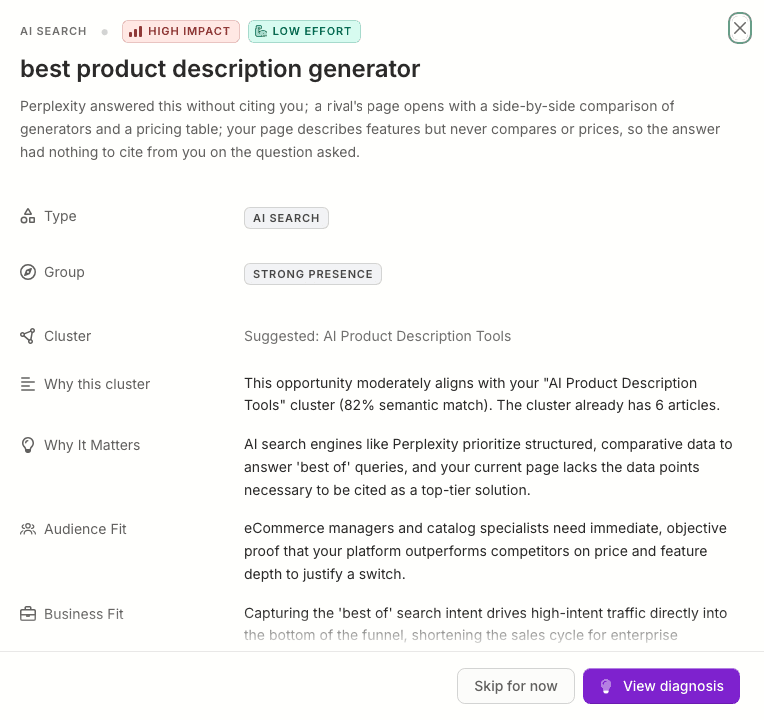
Content Guard watches published pages for Google ranking and traffic decay, then drafts corrections from each page's research. You choose whether Frase prepares a draft for review or publishes it without you. You can change the autonomy setting whenever you want.
Frase publishes approved updates to WordPress, Sanity, Webflow, Wix and FraseCMS, so the correction reaches the page your audience visits. The same editor gives every draft an SEO score and a GEO score.
Frase serves in-house teams, agencies and large organizations with support for one brand or several client sites. Scale includes up to ten domains, five seats with roles and client-ready reports. Enterprise includes white-label reports, a branded client portal, SSO and SAML, custom seats, domains and limits, two years of history, a dedicated account manager and an SLA. G2 reviewers rate Frase 4.8 out of 5, and thousands of teams use Frase from solo operations through large content organizations.
Plans run from Starter to Enterprise, scoped to your org. Each tier includes a 7-day free trial with no credit card. See pricing for the full breakdown. Recovering one citation on a page that attracts qualified buyers can cover a year of the subscription because the correction creates value where a report cannot.
Start your 7-day free trial. No credit card required.
What to buy at your size
Solo founder or one-person marketing team. Check your domain before you build a shortlist, then choose the page you most want cited again. Frase researches that page, drafts the correction in your voice and publishes it. The tracking shows you when the citation changes.
Content team of two to ten. Choose a workflow that turns an alert into a published correction without adding another manual process. Frase handles that sequence and keeps monitoring the page, so a small team can maintain its content without assigning each step to a different person.
Agency running client sites. Scale supports up to ten domains and five seats with roles, and Frase exports client-ready reports for each client. Per-prompt targeting across 40+ countries measures each client in its market. Frase publishes to WordPress, Sanity, Webflow, Wix and FraseCMS. Enterprise adds white-label reports and a branded client portal when your reports need your agency's identity.
Enterprise content org. Review publishing coverage and governance before you approve a rollout. Frase gives teams white-label reports, a branded client portal, SSO and SAML, custom seats, domains and limits, two years of history, a dedicated account manager and an SLA. Roles and permissions let analysts and writers work in the same system, while exportable reports keep the work visible.
Frequently Asked Questions
What should I look for in answer engine optimization tools?
Start with what happens after the product finds a problem. Engine coverage and citation share explain the change, while decay detection tells you which page needs attention. Frase tracks citations across ChatGPT, Perplexity, Claude, Gemini and Google AI, drafts the correction and publishes the approved page to your CMS.
Is answer engine optimization software better than updating content manually?
Software helps when you need to watch several pages and respond without checking each one yourself. Frase monitors citations daily, while Content Guard watches Google ranking and traffic decay. Content Guard drafts the correction from the page's research and republishes it at the autonomy level you choose, which reduces the manual work after an alert.
What is the difference between an answer engine optimization platform and an SEO content editor?
An SEO content editor compares your draft with pages that rank on Google. An answer engine optimization platform tracks whether AI engines cite the live page. Those results can differ, so a page may rank well and receive no AI citation. Frase scores each draft for SEO and GEO in the same editor.
What should I check about data and access before buying an answer engine optimization platform?
Ask where published content lives, who can access the workspace, how long the product retains history and whether you can export it. Frase is SOC 2 Type II and GDPR compliant. Frase publishes into your CMS and controls access with roles and permissions, while Enterprise adds SSO and SAML, two years of history and an SLA.
Do answer engine optimization platforms support multiple languages and markets?
Language and market coverage varies by product, so check both before you buy. Frase drafts natively in 70+ languages with the tone each market expects. Frase also assigns each tracked prompt to a country across 40+ countries, which lets you review the answers your buyers receive in each market.
Can an answer engine optimization platform publish the fix to my live site?
Ask the vendor to show the full publishing process during the demo. A recommendation still leaves your team to update the page. Frase publishes directly to WordPress, Sanity, Webflow, Wix and FraseCMS at the autonomy level you set, from a draft that waits for review through publication without your involvement.
What should founders and small teams look for in answer engine optimization software?
Choose a short path from checking a domain to publishing a corrected page. Start free, confirm that a visibility problem deserves your attention and select one page to update. Frase provides the check, research and draft in your voice, then publishes the approved work from the same place.
How do I know an answer engine optimization tool is actually working?
Choose one page and one prompt, publish the correction and watch whether the citation returns. The tracking gives you the result without waiting for a quarterly report. Frase keeps monitoring after the update, compares your citation rate with your industry's median and alerts you when the page starts slipping again.
See which AI engines cite you today
Start with the free AI Visibility Checker and get your own reading before you compare vendors. Then decide whether you want Frase to turn the finding into a published correction. The page needs to change before the answer can change.
About the author
Georgina D'Souza
Marketing Manager
Georgina D'Souza is a Marketing Manager at Frase and Copysmith AI, the company behind Frase.io and Describely.ai. She brings ten years of marketing experience — spanning early-stage startups to multinational enterprise — specializing in content marketing, SEO, and generative engine optimization, helping SaaS brands adapt their content strategies for AI-powered search. Georgina writes about generative engine optimization, AI search visibility, and content marketing for the AI era.
See Frase run on your own content.
Research your market, draft in your voice, and track where you show up across Google and AI search. Start free.
Start free trial7-day free trial. No credit card.