What Is an Agentic CMS? The Definition and the Five Criteria That Matter
An agentic CMS keeps the evidence behind every page and acts on it. The definition, the five criteria that separate it from AI features, and how to evaluate one.
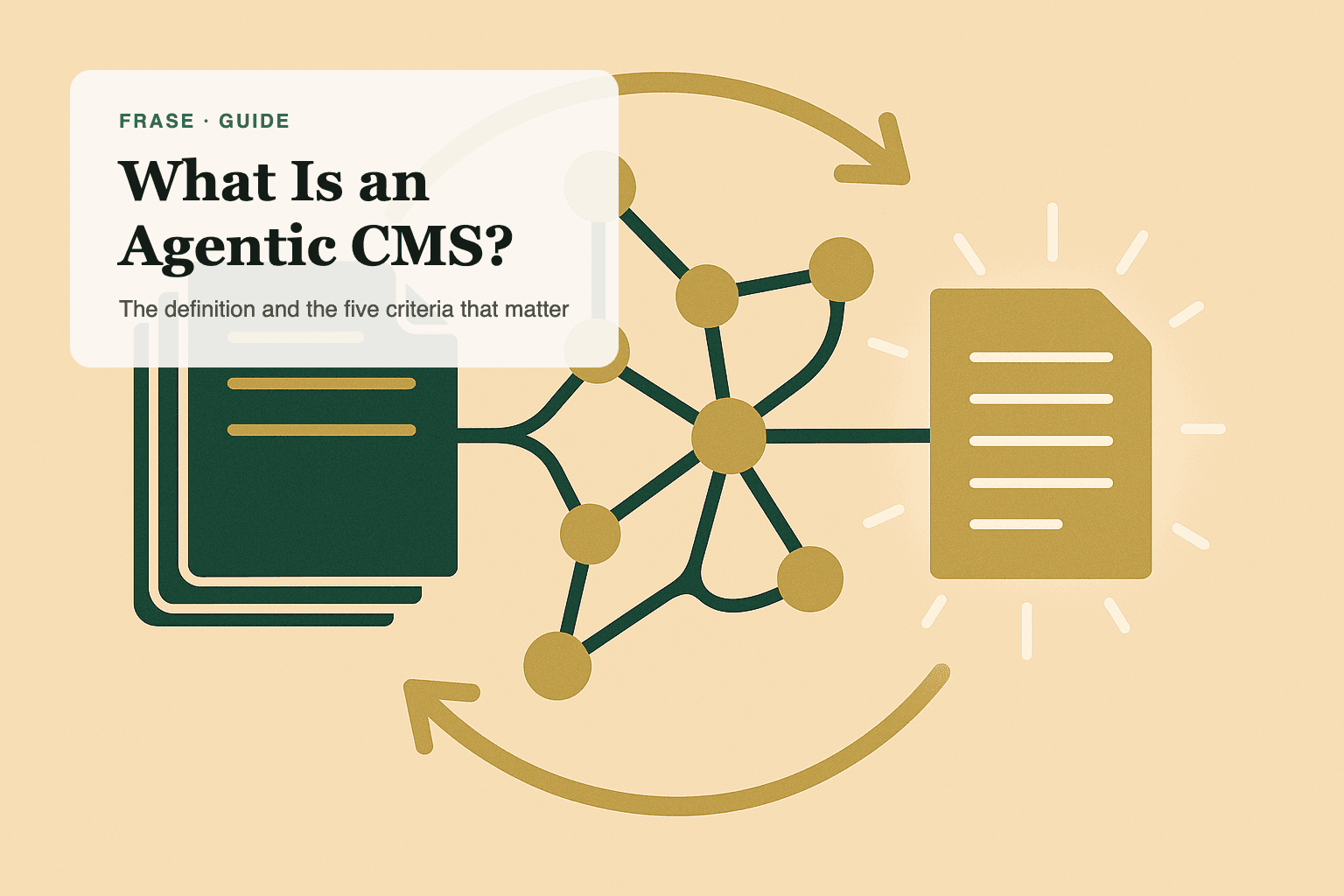
An agentic CMS is a content management system that keeps the evidence behind every page and acts on it. It stores the research a page was built from, publishes that page in a form machines can read, watches how the page performs after it goes live, and drafts its own revision from that original evidence when the page slips. It acts with exactly as much autonomy as you give it: every change behind your approval, applied automatically, or anywhere in between.
That is the whole definition. The rest of this guide unpacks why each clause is there, how an agentic CMS differs from a headless CMS and from a CMS with AI features bolted on, and how to evaluate one without taking any vendor's word for it, ours included.
The five criteria of an agentic CMS
The definition compresses into five testable criteria. A system that meets all five is agentic. A system that meets three is a good CMS with some AI features.
1. It remembers why each page exists. The brief, the sources, and the audience questions that shaped a page stay attached to it after publish. Ask any page why it says what it says, and the evidence is there. This is the criterion everything else depends on: a system that never saw the research cannot act on it later.
2. It publishes pages machines can read. Structured data is written on every render, and the same structured data is served through the delivery API when your own frontend pulls the page. AI search engines and agents read structure, not design. A page that only renders for human eyes is invisible to the machines reading it.
3. It notices when a page slips. Rankings and traffic are watched after publish, not just at draft time. A conventional CMS considers its job finished at the moment of publishing, which is exactly when the page's real life starts.
4. It moves at the speed you set. When a page slips, the system drafts the revision from that page's own research, not from a blank prompt. Whether that draft waits for your approval or ships automatically is your decision, per site and per workflow. The dial belongs to the user, and approval-first is the sensible default.
5. It speaks agent. The content, and the research behind it, is open to the agents you connect: readable through a delivery API, writable through the same management API and MCP tools the platform itself uses. An agentic CMS that only its own vendor's agents can operate is a walled garden with a fashionable name.
A content management system stores and serves. It never saw the research, so it has nothing to draft from and no reason to watch what happens next. That structural gap, not any single feature, is what the word agentic marks.
Agentic CMS vs. headless CMS
These answer different questions, and you can have both at once.
A headless CMS separates where content is stored from where it is displayed. Your frontend pulls content through an API and renders it however you like. That is an architecture choice, and a good one for many teams.
An agentic CMS is about what the system knows and does after the page is live. Does it hold the evidence? Does it watch the outcome? Can it draft the fix? Headless architecture says nothing about any of that. A headless CMS can be agentic if it meets the five criteria; most today do not, because they were designed as storage with an API, not as systems that act.
FraseCMS runs both ways: hosted on your domain, or headless with your own frontend pulling pages through the delivery API. The research stays attached, the watching continues, and the drafts keep coming in either mode.
Agentic CMS vs. a CMS with AI features
Most content systems now offer AI writing assistance inside the editor. That is drafting help, and it is useful. It is not what agentic means.
The test is what happens when nobody is in the editor. An AI writing feature waits for a person to open a document and prompt it. An agentic system is watching published pages on its own schedule, noticing the ones that slip, and preparing evidence-grounded revisions before anyone asked. The first is a faster pen. The second is a system with responsibilities.
The honest middle ground: many teams should start with the pen and grow into the responsibilities. That is why the autonomy dial matters more than the autonomy itself. A system that forces full automation on day one is as poorly designed as one that cannot automate at all.
How FraseCMS meets the bar
Frase built FraseCMS against these five criteria, and the platform is the reason the criteria exist in this form.
Every page published through Frase keeps its chain to the brief and the research session behind it, and the delivery API can return a post together with that research. Structured data is written on every hosted render and projected through the API for headless sites. Frase watches rankings and traffic on the pages you choose to monitor, up to your plan's limit, and when one slips, it drafts the revision from the page's own evidence. You decide how much runs on its own: keep every fix behind your approval, let Frase apply them automatically, or anywhere in between. And the content is open to the agents you already use: read through the delivery API, create and update through the same management API and MCP tools Frase itself runs on.
The pricing reflects the on-ramp philosophy: FraseCMS hosting is included free with any Frase plan at 100,000 page views a month, with paid tiers when you want your own domain and more volume. You can be publishing on it before your trial ends.
How to evaluate any agentic CMS
Whichever platform you are considering, the five criteria convert into questions a sales call cannot dodge:
- Show me the research behind a published page, from inside the CMS. If the answer involves another tool's tabs, criterion one has failed.
- Fetch a page through your API and show me its structured data. Not the rendered page, the machine-readable one.
- What does the system do, unprompted, when a page loses rankings for three weeks? "It can help you rewrite it" means a person noticed first, and the system did not.
- Show me the revision it drafts, and show me where I control whether that revision ships automatically or waits for me. A demo that cannot show the dial does not have one.
- Can an agent I run, not one you sell, read and write content through your API? Ask to see the authentication docs, not a slide.
Any platform that passes all five is a genuine agentic CMS, whoever makes it. Most will pass two or three. The gap between the demo and the criteria is where the next few years of this category will be decided. If you want to hold Frase to the same five questions, the FraseCMS page is where to start.
Frequently Asked Questions
What is an agentic CMS?
An agentic CMS is a content management system that keeps the evidence behind every page and acts on it. It stores the research a page was built from, publishes that page in a form machines can read, watches how the page performs after it goes live, and drafts its own revision from that original evidence when the page slips. It acts with exactly as much autonomy as you give it: every change behind your approval, applied automatically, or anywhere in between.
How is an agentic CMS different from a headless CMS?
A headless CMS is an architecture choice: content is stored in one place and displayed by your own frontend through an API. An agentic CMS is a capability bar: the system keeps the research, watches published pages, and drafts evidence-grounded revisions. The two are independent, and a platform can be both. FraseCMS runs hosted or headless, and the agentic capabilities work in either mode.
Does an agentic CMS change pages without permission?
Not a well-designed one. The autonomy belongs to the user as a dial, not to the vendor as a default: keep every change behind your approval, allow automatic fixes, or set anything in between. In FraseCMS, approval-first is the default and automatic application is something you deliberately turn on, for content it hosts.
Is an AI writing assistant inside a CMS the same thing?
No. Writing assistance is drafting help that activates when a person prompts it. An agentic CMS acts on its own schedule: watching published pages, noticing decay, and preparing revisions from the page's original research. The difference shows when nobody is logged in.
What does an agentic CMS cost?
FraseCMS is included free with any Frase plan, at 100,000 page views a month on a Frase subdomain. Paid tiers add your own domain and more volume. Frase plans themselves start at $39/mo billed yearly, with a 7-day free trial and no credit card required.
About the author
Shegun Otulana
Founder & CEO
Shegun Otulana is CEO of Copysmith AI, parent company of Frase.io and Describely.ai. He's a serial entrepreneur with multiple exits and has been building companies at the intersection of search, marketing, SaaS, and artificial intelligence since 2013. Shegun writes about generative engine optimization, AI search, and the future of content marketing.
See Frase run on your own content.
Research your market, draft in your voice, and track where you show up across Google and AI search. Start free.
Start free trial7-day free trial. No credit card.