Content Maps Are the Missing Link Between Strategy and AI Visibility: Full Breakdown

Stop using flat spreadsheets. Learn how to build a content map to connect your strategy to user needs and improve your brand's visibility in AI search results.
The Strategic Shift from Content Lists to Content Maps
A content map isn’t a spreadsheet of URLs, but a structural model of how every content asset connects to a user need, a buyer stage, and a search signal. It can also be the difference between brands that appear in AI search results and brands that don't.
Most marketing teams start with a list of titles, target keywords, and publish dates. That approach works perfectly fine until your content library grows past a few dozen pieces and the gaps get harder to spot.
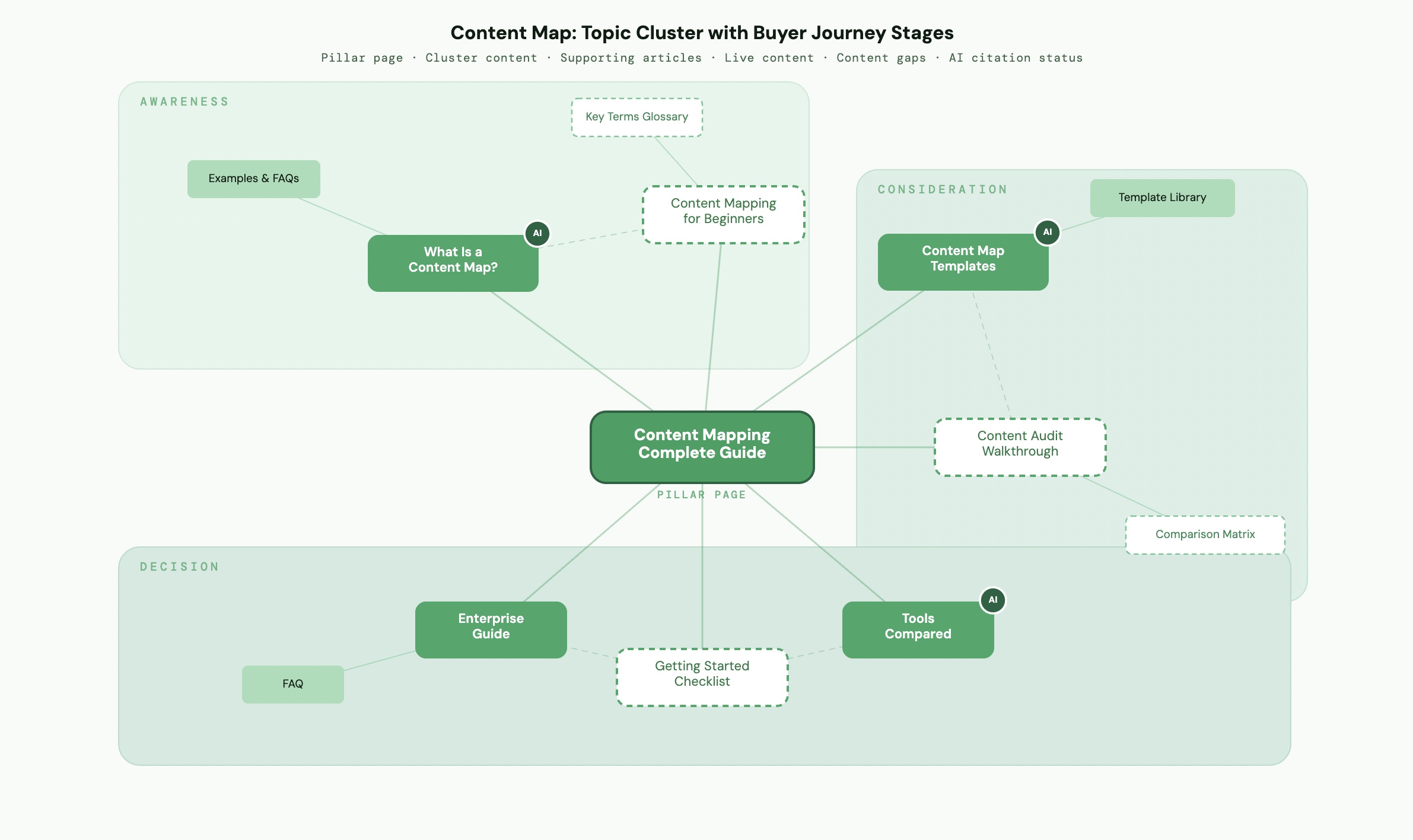
But there's a second problem the flat list can't solve: AI search engines like ChatGPT and Perplexity don't rank isolated pages. They surface sources that demonstrate clear topical authority across connected content. A structured content map reveals all of this, while a flat list signals none. It’s a living representation of relationships showing how a top-of-funnel awareness article feeds into a comparison page, which then leads to a conversion-focused case study.
A content map, built around interconnected topic clusters, communicates coverage and depth in a way that both Google and generative engines can easily parse and cite.
Where Your Buyer Journey Actually Breaks Down (And a Content Map is Needed)
A content map is only as valuable as the customer journey it reflects, and it’s easy to miss entire stages without realizing it.
The question to ask is: where do the gaps actually live? Content mapping guides always start with the awareness, consideration, and decision stages. Brands often flood the awareness stage with blog posts while leaving the consideration stage thin, no comparison content, no use-case breakdowns, no answers to the "is this right for me?" questions that move buyers forward.
Then you add personalization into the mix and the problem increases. 74% of marketers create content specifically for different stages of the customer journey, yet only 35% of companies successfully achieve personalization across all channels. That gap isn't a creative failure, it's a structural one. Without a map, you can't see where content needs to adapt to a segment, a geography, or a buyer signal.
Brands with regional audiences or physical locations, content must reflect where users are and not just what they're searching for. A mapped content strategy accounts for location-specific pages, localized intent signals, and how geo-targeted assets connect back to core topic clusters.
Dead-end content is another one of the most common structural failures mapping exposes. A high-traffic blog post that answers a question but offers no clear onward path leaks potential buyers out of the funnel. Mapping makes those exits visible and fixable. Building tightly grouped topic clusters is one practical way to ensure every asset connects to the next logical step.
A quick callout on the difference between content maps vs. topic cluster diagrams
A topic cluster diagram is a useful SEO architecture tool: one pillar page, connected to cluster pages, connected by internal links. A content map builds on that structure by adding what the cluster diagram leaves out, buyer journey stages, cross-cluster relationships, performance data, and increasingly, AI citation tracking. Think of the cluster as the skeleton. The map is what tells you whether that skeleton is actually serving the right people at the right stage.
The Architecture of Content Ecosystem Maps
A content ecosystem map goes beyond a list of pages to model the relationships between topics, audiences, channels, and the processes that keep content alive.
Most teams conflate three distinct mapping types, and that confusion costs them.
Site maps define URL structure and navigation hierarchy.
Journey maps trace how a buyer moves from awareness to decision.
Content ecosystem maps operate at a higher level: as Brain Traffic explains, they focus on the people, processes, and platforms that make content happen as well as the pages themselves.
Each serves a different strategic purpose, and a mature content operation needs all three working in concert.
Internal relationships are where ecosystem thinking becomes actionable. Topic clusters (a pillar page supported by tightly linked subtopic content) create the connective tissue that search engines and AI systems use to assess topical authority. If you're building those clusters from scratch, starting with structured keyword groupings gives you a clear foundation before you map the relationships between them. The map shows you which subtopics exist, which are missing, and where your internal linking strategy has gaps.
Content ecosystem maps do carry real limitations you shouldn't overlook though:
Over-complexity is the most common failure mode, when a map tries to capture every asset, channel, and workflow simultaneously, it becomes too unwieldy to maintain.
Maps also go stale quickly without a clear owner and a regular review cadence. The practical approach is to start with your highest-priority topic cluster, validate the structure, then expand.
"The most effective content ecosystem maps aren't exhaustive — they're intentional. They show what connects, what's missing, and what needs to be built next."
Mapping for the Generative Search Era
A content map built for AI visibility is more than just site index, it's a structured model of how your brand's expertise connects, and that structure is exactly what generative engines use to decide who gets cited.
The shift from keyword targeting to entity-based mapping changes how you approach SEO content research at a fundamental level. Traditional SEO asked: "Which keywords should this page target?" GEO asks a harder question: "Does our content model prove topical authority across connected ideas?" AI agents like ChatGPT and Perplexity don't retrieve pages in isolation, they interpret relationships between topics, entities, and the contextual signals that tie your content together into a coherent subject-matter footprint.
For GEO (Generative Engine Optimization), structuring content so it's not just findable by crawlers, but interpretable by AI inference engines is key. Where traditional SEO rewards keyword density and backlinks, GEO rewards completeness, covering the full conceptual surface of a topic so an AI model can confidently attribute expertise to your brand. A content map is the operational tool that makes this possible, because it surfaces where your topical coverage is solid and where it starts to breaks down.
And that breakdown can be costly. When your map has gaps, topics adjacent to your core subject that you haven't addressed, AI systems fill those gaps with competitor content. Tracking how your brand appears across AI engines is how you identify which gaps are actively hurting citation rates. And closing those gaps starts starts with knowing exactly where your map is incomplete.
How to Build a Map That Converts
Building a content map that drives both rankings and AI search visibility comes down to four repeatable steps — audit, align, gap-fill, and research.
Audit your existing assets. Before adding anything new, take stock of what you have and how it's performing. Pull traffic, engagement, and conversion data for every piece of content. You're looking for what's earning its place, what's underperforming, and what's quietly pulling the whole strategy off course.
Overlay buyer personas and journey stages. Map each asset to a specific audience segment and funnel stage, awareness, consideration, or decision. This step exposes whether your content is actually distributed across the full journey or quietly piling up at one end. Segmented messaging aligned to audience stages drives measurably stronger engagement — in the world of email marketing this is particularly clear, segmented emails built on pre-mapped conditions see an 85.53% higher open rate than unsegmented sends.
Identify where the journey breaks down. Look for the gaps, stages where prospects have no content guiding them forward, or where topics drop off before the reader reaches a decision. These are your highest-priority content opportunities.
Use AI-driven research to surface missing topics. Identify what your audience is searching for and what competitors are covering that you're not. Frase automates this layer of SERP and entity research, revealing the specific topics and questions your map needs to answer to earn citations in generative search results.
A map built this way is a strategic asset that keeps evolving.
The Bottom Line: Why Mapping is Non-Negotiable
Content mapping is the connective tissue between a high-level content strategy and the tactical execution that actually drives rankings, AI citations, and conversions.
Without a map, even well-resourced teams end up with content that's scattered across topics, misaligned with the buyer journey, and invisible to the AI engines increasingly shaping discovery. A map changes that by forcing intentional structure.
Here's what the evidence consistently shows:
Strategy-to-execution alignment. A map translates broad goals into specific content assets tied to real search demand — so every piece has a purpose and a measurable outcome.
AI citation coverage. Generative engines pull from sources that demonstrate comprehensive entity coverage. Mapping your topics systematically ensures your brand addresses the full scope of a subject, which is exactly what AI models look for when selecting citations.
Personalization at scale. Reaching the right audience with the right message is impossible without a clear map of the customer journey. A content map gives you the architecture to serve relevant content at every stage — awareness, consideration, and decision.
Continuous optimization. A map isn't a one-time deliverable. It's a living document that requires regular audits against both traditional SEO benchmarks and AI visibility signals as search behavior evolves.
The teams that treat content mapping as an ongoing discipline (not a one-time project), are the ones who stay visible as search shifts. And managing that discipline at scale is exactly where the right tooling becomes essential.
Future-Proofing Your Content Strategy with Frase
Content mapping stops being a strategic exercise the moment you can no longer see the gaps and that's exactly where manual approaches break down at scale.
The Frase full-loop covers SERP research, SEO/GEO optimization, AI visibility tracking, site audits, and a brand voice engine closes that gap systematically. Instead of auditing your content map by hand, Frase analyzes the SERP landscape to surface competitor coverage gaps, missing topic clusters, and structural weaknesses your existing content strategy hasn't addressed. You get a clear picture of what's absent, not just what exists, and these opportunities to fill content gaps are delivered to you every day.
If you're still look for content gaps manually, you're leaving both rankings and AI visibility on the table. Start your 7-day free trial of Frase, no credit card required, and move from static spreadsheets to an AI-assisted content operation that's built to perform in both search landscapes.
About the author
Georgina D'Souza
Marketing Manager
Georgina D'Souza is a Marketing Manager at Frase and Copysmith AI, the company behind Frase.io and Describely.ai. She brings ten years of marketing experience — spanning early-stage startups to multinational enterprise — specializing in content marketing, SEO, and generative engine optimization, helping SaaS brands adapt their content strategies for AI-powered search. Georgina writes about generative engine optimization, AI search visibility, and content marketing for the AI era.
Related articles
See Frase run on your own content.
Research your market, draft in your voice, and track where you show up across Google and AI search. Start free.
Start free trial7-day free trial. No credit card.