Anthropic Is Watermarking Claude Content. What Does That Mean for Yours?

Anthropic is watermarking Claude content. Learn what it actually proves, why it won't hurt your rankings, and how to use AI responsibly for SEO.
Anthropic Is Watermarking Claude Content. What Does That Mean for Yours?
Does Claude watermark AI-generated content? Key takeaway: yes, it does now. But don’t panic.
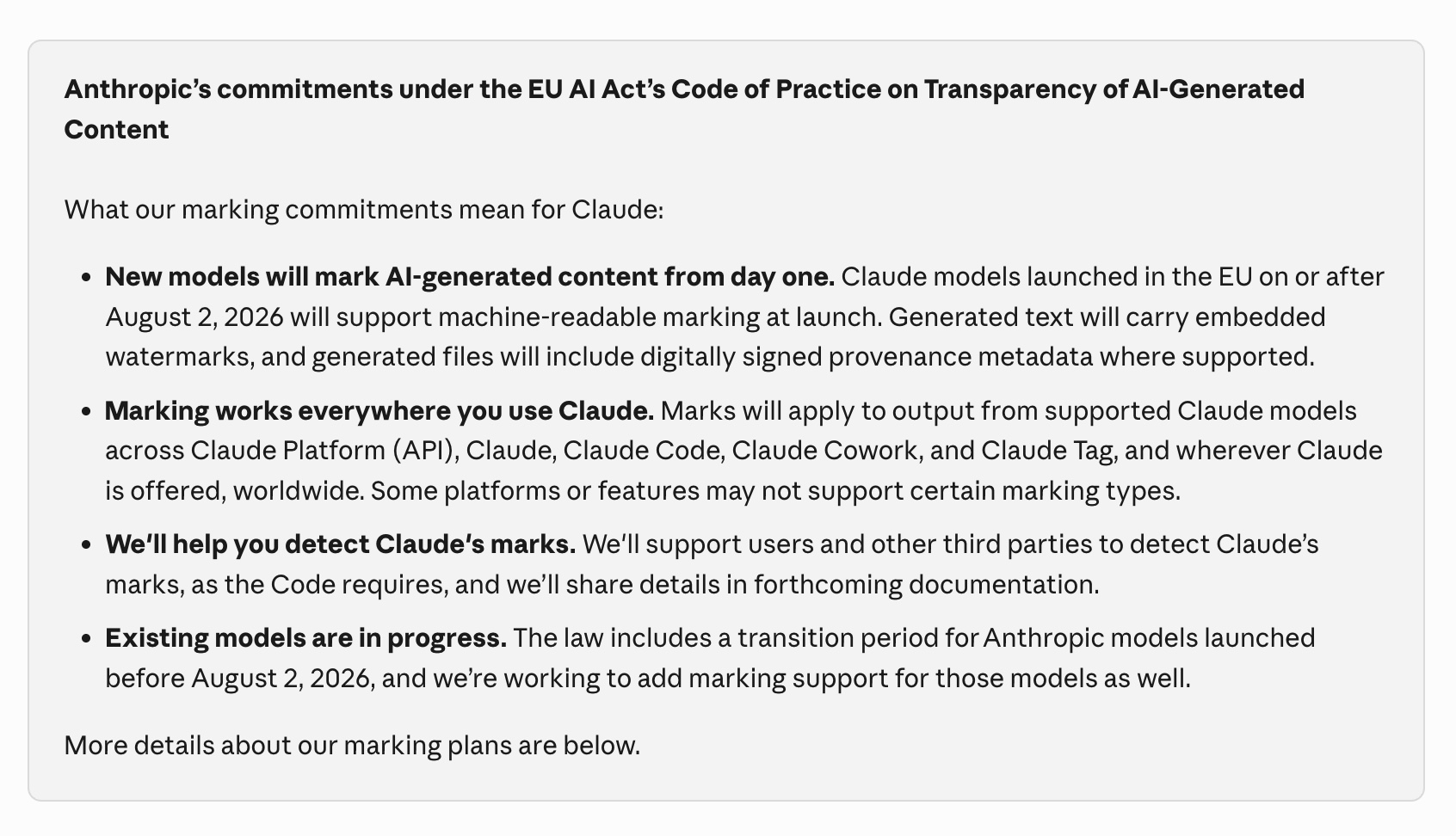
On 11 August Anthropic announced it would now watermark Claude generated content. Claude models launched on or after 2 August support marking at launch, and Anthropic says it’s working to add it to models released before that. It covers the API, the Claude apps, Claude Code, Claude Cowork and Claude Tag, plus Claude models running through AWS, Google Cloud and Microsoft Foundry. Image files generally get signed provenance metadata on top of that.
If you use AI anywhere in your content process, the worry is clear - is my content about to get flagged, and will that cause me to get penalised by traditional and AI search engines?
Read on for what’s confirmed, what isn’t, and what it changes.
What’s actually been confirmed
Less than you’d expect.
The watermark is woven into the text itself and travels with the text when it’s copied and pasted. Fuller technical documentation is pending. There’s no public detector yet, although an Anthropic engineer said publicly on 12 August that a text detection API you can call yourself is coming. Disclaimer: that’s what a person on the team has said though rather than the documentation itself.
The actual mechanism hasn’t been published, so most explanations about exactly how it works being given right now are at best an educated guess.
Here is what’s actually been said:
Why it’s happening now
The changes comes as a response to an EU ruling, Article 50 of the EU AI Act, which requires providers of generative AI to mark their outputs in a machine-readable format that’s detectable as artificially generated. Those obligations applied from 2 August 2026, which is the same date as the model cutoff.
Google has been running SynthID since 2023, and watermarking text with it since 2024, so none of this is new ground. Google has also signed the EU’s transparency code of practice, which tells you roughly where the rest of the model providers are heading.
What the mark actually proves
This comes straight from Anthropic’s own documentation.
A detected mark signals that content was processed by Claude. It doesn’t tell you Claude wrote it. Anthropic say so plainly: “Claude may not be the original author. People often use Claude to proofread, translate, summarize, or convert files.” All of which will now bear a watermark.
So you can write something entirely yourself, paste it in to fix your punctuation or turn it into a PDF, and come out the other side carrying a mark that a detector reads as AI.
So will a watermark hurt my rankings?
No. And we know this because Google actually emphasise that quality content is rewarded “however it is produced”. But it’s worth going through why properly.
Google has actually shipped quite a bit in this area. SynthID verification now sits inside Search surfaces like Lens, AI Mode and Circle to Search so you can check where an image came from, and there’s an AI Content Detection API on Google Cloud. The capability is there and has been for a while. What Google has never said, at any point, is that any of it feeds into ranking.
The policy has been pointing the other way for years, and the exact wording is important. Google’s guidance on automation says:
“If you use automation, including AI-generation, to produce content for the primary purpose of manipulating search rankings, that’s a violation of our spam policies.”
Read it to the end, because a lot of people might stop halfway and miss the critical bit. What breaks the rules is producing content for the primary purpose of manipulating search rankings. Not using AI to produce it. Google has never been concerned with the method of production, only the quality of the output.
What Google says it rewards is that same test in reverse: “helpful, reliable information that’s created to benefit people”, and “content that’s created primarily for people, and not to manipulate search engine rankings”.
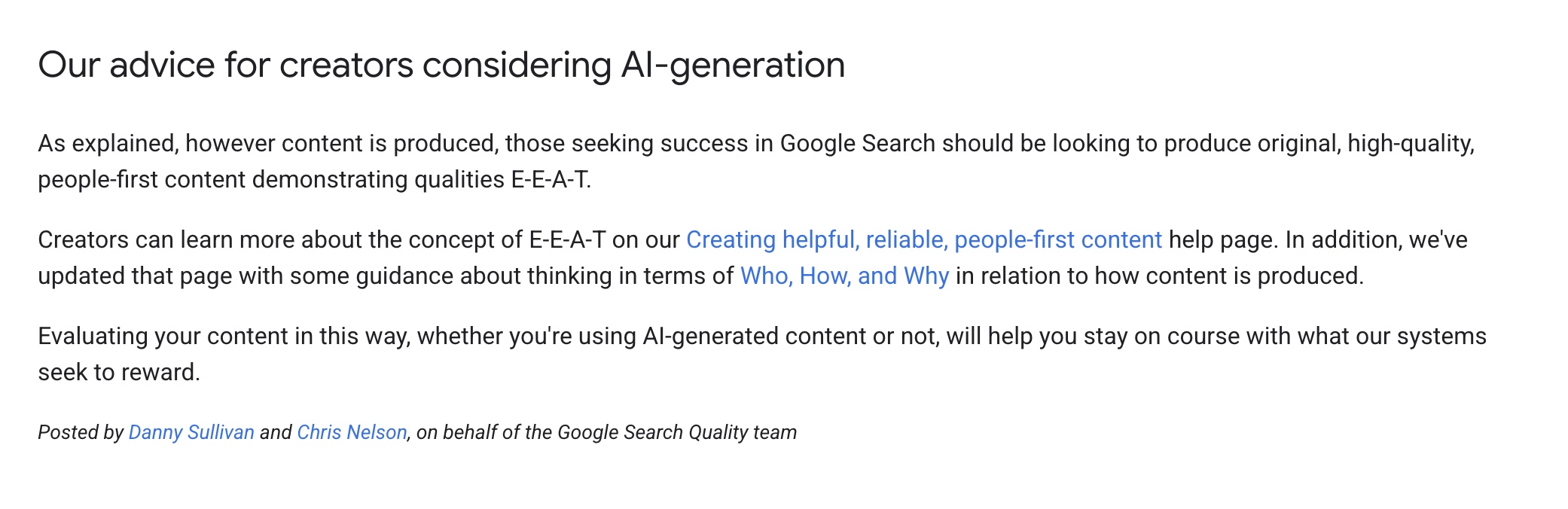
So a watermark tells someone a model was involved somewhere in the process. It says nothing whatsoever about which of those two things you were doing, and that’s the only question Google’s systems are actually asking. We went into this in more detail in a recent blog on does Google penalize AI content. Plus, you can check your E-E-A-T scores in Frase as you create content to make sure you’re demonstrating the qualities Google looks for.
It all comes down to using AI properly
If AI isn’t what gets punished, then hiding that you used it isn't particulraly important. The job is to use it in a way that produces "original, high quality, people-first content", which is Google’s own words on what content gets rewarded.
That means AI doing the research, the outlines, the drafts and the optimisation, with the direction and first-hand insights coming from you. It’s the difference between generating a page and actually having something to say on it.
That’s what Frase is designed around, and it’s why we score your content against E-E-A-T while you write it, so you can see whether you’ve cleared that bar rather than publishing and hoping. A watermark on a genuinely useful page costs you nothing. A page with nothing useful or original in it is never going to rank anyway, watermark or not.
Frequently asked questions
Does the watermark survive editing?
Partly. Anthropic say marks may not be detectable if text has been “heavily edited, paraphrased, translated, or mixed into other writing”. What nobody has defined anywhere yet is exactly what qualifies as "heavily".
Does content created in Frase carry a Claude watermark?
Possibly, depending on which model generated the text. Where a marked model has been involved, the mark can be there but Frase uses a mix of models which lessens the possibility.
What happens after that, nobody can say yet for certain. Content that’s been through more than one model, restructured and edited by you, is exactly the case Anthropic flag as unreliable for detection.
Should I run my content through a humanisation tool?
No. Those tools are AI themselves, so you’d be paying a marked model to launder the output of another marked model.
So what should I actually change?
Nothing, if you were already doing the work properly. Watermarking changes what can be detected about a page, it has no bearing on the quality of the output which is what actually matters to rank on Google.
Where we stand
Frase is built to be grounded in your brand’s voice and your own evidence rather than generating into thin air, with a human approval gate wherever you want one.
What gets you ranked on Google and cited by AI engines is still whether your page is the best answer to the question someone asked. That bar hasn't changed, Frase is still designed with this end goal in mind, and an anthropic watermark doesn’t affect that.
If you want to see how your pages score for E-E-A-T, log in to your Frase account or sign up for a free 7-day trial and check in seconds.
About the author
Georgina D'Souza
Marketing Manager
Georgina D'Souza is a Marketing Manager at Frase and Copysmith AI, the company behind Frase.io and Describely.ai. She brings ten years of marketing experience — spanning early-stage startups to multinational enterprise — specializing in content marketing, SEO, and generative engine optimization, helping SaaS brands adapt their content strategies for AI-powered search. Georgina writes about generative engine optimization, AI search visibility, and content marketing for the AI era.
Related articles


See Frase run on your own content.
Research your market, draft in your voice, and track where you show up across Google and AI search. Start free.
Start free trial7-day free trial. No credit card.