
The Conversational Front Door: Turning Your Content Into an Answer Engine
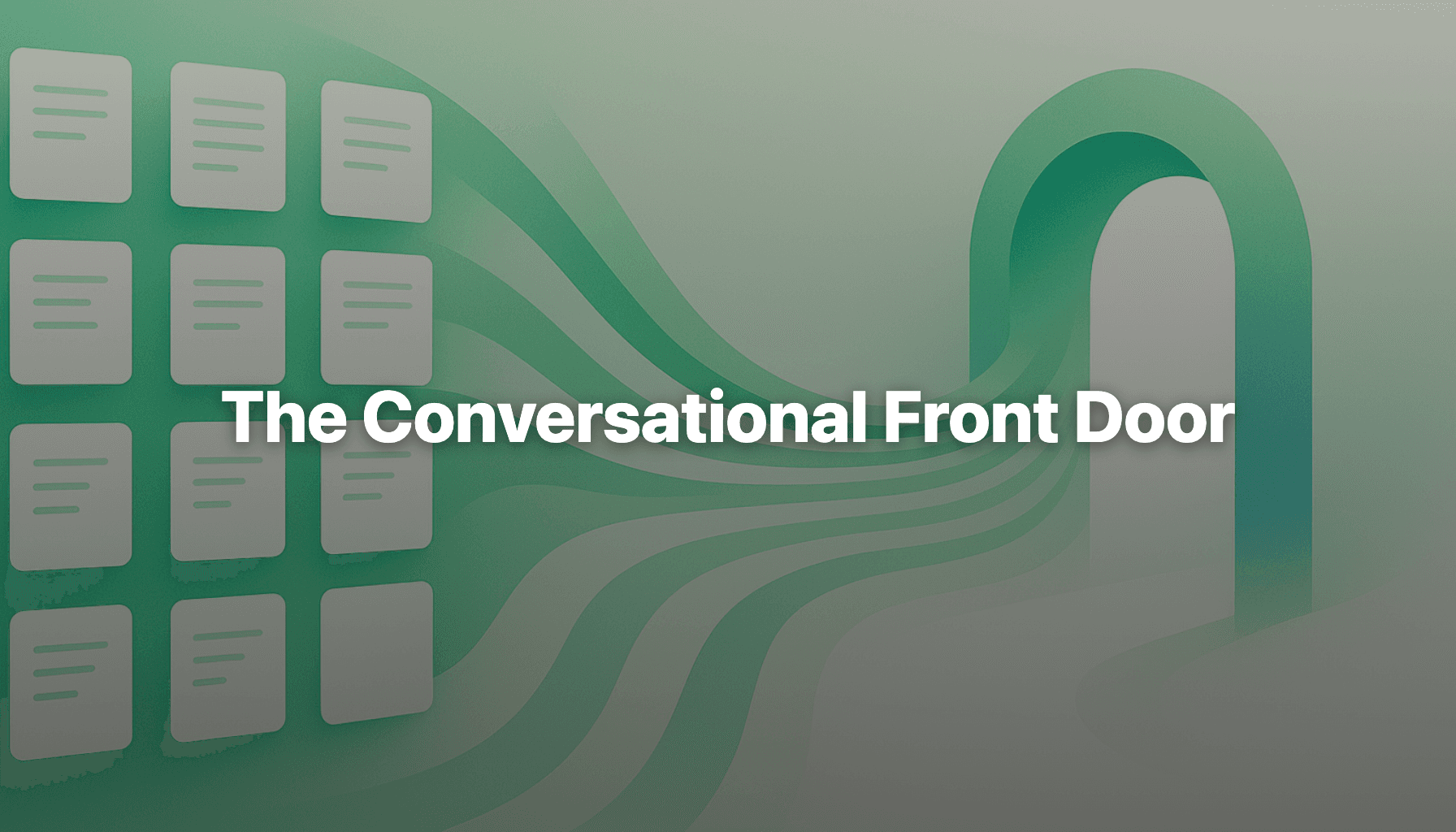
Most search now ends without a click. The fix isn't only getting cited in someone else's AI, it's becoming the answer engine on your own site, and a demand sensor for what to write next.
The link list is no longer the destination
Most searches now end without anyone clicking through to a website. Pew Research found that when Google shows an AI summary, users click a traditional result in just 8% of visits, versus 15% when there is no summary, and they click a link inside the AI summary only 1% of the time. Independent clickstream data tells the same story: SparkToro measured that 68% of US Google searches ended with no click at all in early 2026. Gartner has forecast that search engine volume is forecast to drop about 25% by 2026 as AI assistants absorb queries.
Read those together and the shift is clear. People increasingly want the answer, not a list of ten places that might contain it. The interface that gives the answer is the destination now. McKinsey describes AI search as "the new front door to the internet." The question for any brand is simple: when someone wants an answer, whose front door are they walking through?
The reflex everyone has, and its blind spot
Most teams have responded to this the same way: optimize to get cited inside the AI answers. That is answer engine optimization and generative engine optimization, and it is the right work. Getting your content surfaced in ChatGPT, Perplexity, Google AI Overviews, and the rest is how you stay visible as search changes. We write about it constantly, including which engines cite which sources and the broader discipline of AI visibility.
But there is a blind spot. AEO and GEO optimize for someone else's interface. You are competing to be one of a handful of sources another company's model chooses to quote, on a surface you do not control, where the user often never reaches your page. That work matters, and it is only half of the answer. The other half is the surface you do control: your own website.
The other half: an answer engine on your own site
A conversational front door is an answer engine that lives on your site. Instead of asking visitors to read, scan, and stitch together an answer from across your pages, it answers their question directly, in conversation, using your own content, with citations back to the source and an honest "I don't know" when your content can't support an answer.
This is not a new idea for support and documentation teams, who have used on-site answer layers to deflect tickets for years. What is new is treating it as a front door for your whole brand, and connecting it to the rest of your content operation. Because the same structured, answer-ready content that lets your own front door respond well is exactly what external AI engines reach for when they decide what to cite. Build the answer surface once and it serves both your visitors and the engines watching your site.
The part nobody connects: your front door is a demand sensor
Here is the move most teams miss. Every question a visitor types into your front door is a piece of first-party demand, in the person's own words, captured at the moment of intent. That is cleaner than a keyword tool's guess and more honest than scraping what AI engines say about you, because it is your actual audience asking your actual questions.
Cluster those questions into themes and track how often the front door cannot answer them, and you get a live map of exactly what your content is missing. The questions that come up often and go unanswered are your next briefs, ranked by real demand instead of intuition. Your website stops being a static library and starts telling you what to build next.
From sensor to system: closing the loop
A demand signal is only useful if something acts on it. This is where the front door connects to the rest of the loop: the gaps it surfaces become research, the research becomes content, the content gets optimized and published, and then it is monitored and, when it slips, fixed and republished. Every publish stays behind human approval. The front door senses what to write; the engine writes and maintains it; the new content makes the front door, and your AI search visibility, stronger. The work compounds instead of resetting every quarter.
That loop is the difference between a chatbot bolted onto a website and an answer surface wired into how content actually gets made.
What this looks like with Frase
Frase Answers is the conversational front door in this model. It puts an AI answer experience on the site you already have, responding to visitors from your own content, with citations and an honest fallback when the answer isn't there. The questions it receives are clustered into demand themes, and the gaps it can't answer flow into Frase's content loop as prioritized work, where research, writing, optimization, monitoring, and fixes run end to end with a human approving every publish. It works with the content you have, in your existing CMS or in FraseCMS, so adopting the front door doesn't mean moving your site.
The result is a single system doing what teams usually buy several disconnected tools for: answering your visitors, sensing what they want, and turning that into content that ranks and gets cited. If you want to see where you stand on the visibility half of that loop first, check your AI visibility across engines free, or dig into the real questions your audience is already asking.
Own the answer, don't just chase the click
The web is not getting less competitive; it is changing where the competition happens. The answer is now the destination, and you can either hope to be the one source in twenty that an external engine cites, or you can own the answer on the property you control and let what you learn there make everything else better. The future isn't more links. It's being the answer, on every surface, including your own.
Frequently asked questions
What is a conversational front door for a website?
A conversational front door is an AI answer layer on your own site that responds to visitors in natural language using your own content, with citations back to the source. Instead of making people read and stitch together an answer from multiple pages, it answers the question directly, and the same answer-ready content is what external AI engines reach for when they cite your site.
How is this different from AEO or GEO?
Answer engine optimization and generative engine optimization are about getting your content cited inside someone else's AI answer, like ChatGPT or Google's AI Overviews. A conversational front door is the inverse: being the answer engine on your own website. They are complementary, and the same answer-ready content powers both. Frase does both, and the front door feeds the AEO and GEO work.
Isn't this just a chatbot or site search?
It goes further than keyword site search and further than a scripted chatbot. It answers from your actual content with citations and an honest "I don't know" when the content can't support an answer, and it records every question as a demand signal. The point isn't only to answer; it's to learn what your audience wants and route that into your content.
How does an answer layer help my content strategy?
Every question a visitor asks is first-party demand captured in their own words. Cluster those questions into themes and track how often they go unanswered, and you get a ranked, evidence-based list of what to write and fix next, drawn from real audience intent rather than keyword-tool guesses.
Does an on-site answer engine help my AI search visibility too?
Yes. The structured, answer-ready content that lets your own front door respond well is the same content external AI engines reach for when they decide what to cite. The demand your front door captures also tells you where to focus your AI visibility work, so the two reinforce each other.
Do I have to move my content to use a conversational front door?
No. A good answer layer works with the content you already have, in your existing CMS such as WordPress, Sanity, Webflow, or Wix, or in FraseCMS. Adopting the front door does not require migrating your site.
About the author
Shegun Otulana
Founder & CEO
Shegun Otulana is CEO of Copysmith AI, parent company of Frase.io and Describely.ai. He's a serial entrepreneur with multiple exits and has been building companies at the intersection of search, marketing, SaaS, and artificial intelligence since 2013. Shegun writes about generative engine optimization, AI search, and the future of content marketing.
Related articles
See Frase run on your own content.
Research your market, draft in your voice, and track where you show up across Google and AI search. Start free.
Start free trial7-day free trial. No credit card.