
Master Programmatic SEO with Frase: A Complete Guide
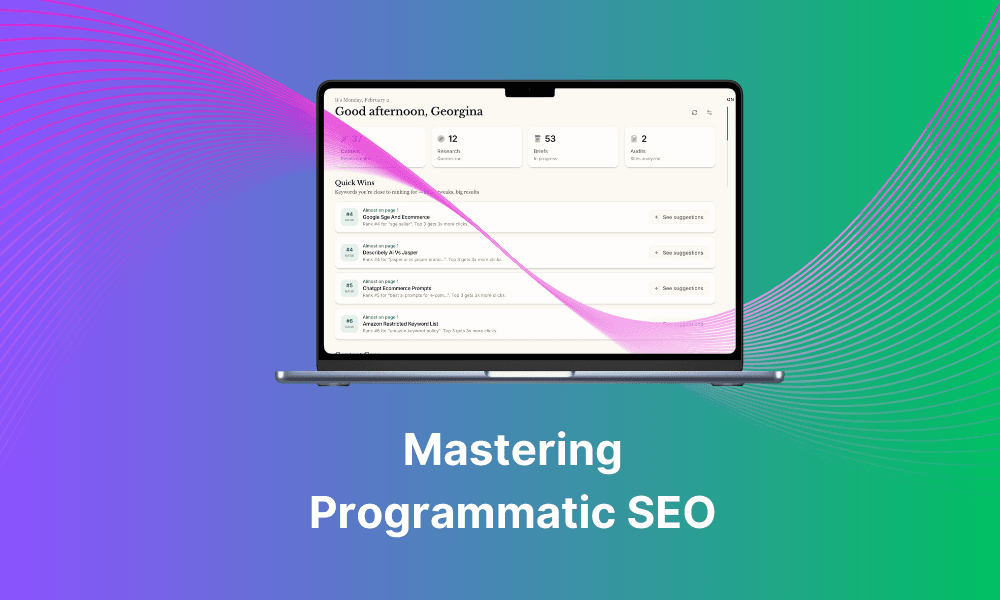
Master the art of scaling content at unprecedented speed. This comprehensive guide reveals the proven framework for programmatic SEO that helps companies achieve 300-500% organic traffic growth.
Understanding Programmatic SEO and Its Importance
Imagine generating hundreds of optimised web pages in hours rather than months, each targeting specific keywords and drawing qualified traffic to your site. Programmatic SEO transforms this dream into reality by automating the creation of large-scale, data-driven content that search engines love and users find valuable. And better yet, you can use Frase to automate the entire process taking it down further from hours to just minutes.
This guide will give you an understanding of the framework for implementing programmatic SEO, and demonstrate how you can use Frase to achieve your outcomes even faster. From surfacing the opportunities to you, to creating and optimizing each of the pages, Frase streamlines the entire programmatic SEO workflow.
A quick overview: What is Programmatic SEO and why does it work
Traditional SEO requires manually crafting individual pages, conducting keyword research one term at a time, and optimising content piece by piece. This approach works brilliantly for cornerstone content but becomes unsustainable when you need to target hundreds or thousands of related keywords. Programmatic SEO flips this model entirely, using templates, databases, and automation to create systematic content at unprecedented scale.
The power lies in identifying patterns within your target keywords and building scalable systems around them. Rather than writing separate pages for "best restaurants in London," "best restaurants in Manchester," and "best restaurants in Birmingham," you create one dynamic template that generates location-specific pages automatically. Companies using programmatic SEO report dramatic increases in organic traffic, often seeing 300-500% growth within six months.
This approach particularly excels for businesses with location-based services, product catalogues, or any scenario where similar content structures can address multiple search queries. E-commerce sites, travel platforms, and local service providers have leveraged programmatic SEO to capture long-tail traffic that competitors miss entirely.
The key to success lies in understanding both the technical implementation and strategic framework that makes programmatic SEO effective—which requires a structured approach to execution.
Core Framework for Implementing Programmatic SEO
Building successful programmatic SEO campaigns requires a systematic approach that balances automation with quality content creation. This comprehensive programmatic SEO guide outlines a proven framework that transforms your content strategy from manual, time-intensive processes into scalable, data-driven operations.
The foundation rests on four critical pillars: systematic keyword pattern identification, robust data infrastructure, template-driven content creation, and automated optimisation workflows. Each element must work in harmony to generate pages that satisfy both search engines and user intent at scale.
Data serves as the cornerstone of any effective programmatic approach. Without comprehensive datasets covering your target keywords, competitors, and user behaviour patterns, even the most sophisticated templates will fail to deliver meaningful results. Research indicates that successful programmatic campaigns typically begin with extensive data collection phases that map out thousands of keyword variations and their corresponding search volumes.
Template architecture forms the second crucial component, enabling consistent content structure whilst allowing for dynamic personalisation. These templates must accommodate various content types—from location-based pages to product comparisons—while maintaining quality standards across thousands of generated pages.
However, the framework's true power emerges through intelligent automation workflows that handle content generation, internal linking, and technical optimisation simultaneously. Modern tools can process vast datasets, apply SEO best practices, and generate publication-ready pages within hours rather than weeks.
The implementation process requires careful attention to quality control mechanisms, ensuring that scale doesn't compromise relevance or user experience. Each generated page must provide genuine value whilst targeting specific search queries with precision.
Now that we've established this foundational framework, let's examine how to identify the scalable keyword patterns that will fuel your entire programmatic strategy.
Step 1: Identifying Scalable Keyword Patterns
The foundation of successful automated SEO lies in discovering keyword patterns that can be systematically scaled across hundreds or thousands of pages. Rather than targeting random keywords, this approach focuses on identifying structured opportunities where similar search queries follow predictable patterns.
Location-based keywords represent one of the most effective scalable patterns. Consider how a property rental site might target "flats for rent in [city]" or "best neighbourhoods in [location]" across hundreds of US cities. Each variation follows the same template whilst addressing distinct local search intent, creating natural opportunities for programmatic expansion.
Product comparison keywords offer another lucrative pattern, particularly for SaaS, and e-commerce sites. Terms like "[tool A] vs [tool B]" or "[product] alternatives" can be systematically generated for comprehensive market coverage. Research indicates that comparison-focused searches often demonstrate high commercial intent, making them particularly valuable for conversion-focused campaigns. Feature-specific patterns work brilliantly for service-based businesses. A design agency might target "logo design for [industry]" across dozens of sectors, whilst a consultancy could focus on "[service] for [business type]" combinations. The key lies in identifying your core offering's natural variations.
To validate these patterns, examine search volume consistency across variations and ensure sufficient commercial intent exists. Successful keyword patterns maintain relevance whilst offering genuine scalability - the perfect foundation for creating optimised templates that convert visitors into customers.
How Frase can help: By connecting your Google Search Console to Frase, you can skip the manual work element of this stage entirely. Frase will pull in your data to analyse existing content and see where your programmatic opportunities are.
Step 2: Creating SEO-Optimised Templates
Once you've identified your keyword patterns, the next crucial step involves crafting templates that can efficiently generate hundreds of optimised pages whilst maintaining content quality. These templates serve as the backbone of your scalable SEO strategy, transforming raw data into search-engine-friendly content.
The most effective programmatic templates follow a structured approach that includes dynamic title tags, meta descriptions, and content sections that automatically populate based on your data variables. For instance, a location-based service might use templates like "Best [Service] in [City]" or "[Service] Near [Neighbourhood]" that systematically generate unique pages for each geographical variation. Template design should prioritise both user experience and search engine optimisation. This means incorporating schema markup placeholders, internal linking structures, and content sections that naturally weave in long-tail keyword variations. Programmatic SEO templates typically include header hierarchies (H1, H2, H3) with variable placeholders, and ensuring each generated page maintains proper SEO structure. However, there's a critical balance to strike between automation and authenticity. Templates that appear overly formulaic can trigger Google's quality filters, particularly if they lack substantial unique content. The key lies in creating templates with enough flexibility to produce genuinely valuable pages rather than thin, duplicate content.
Well-designed templates also include conditional logic for varying content based on data availability, ensuring pages remain comprehensive even when certain data points aren't available. This foundation sets the stage for leveraging advanced tools like Frase to further optimise your automated content creation process. How Frase can help: When you’ve approved the programmatic opportunities Frase surfaces for you, it will then create briefs for these pages with optimized template structures.
Step 3: Content Optimisation
With your templates structured and ready, the next step is writing the content across your programmatic pages. Whether you’re writing this manually or generating with AI,
Frase's optimization features really revolutionises SEO automation here by analysing your content against top-ranking competitors and providing specific optimisation recommendations. Rather than guessing which keywords to include or how to structure your content, the platform examines the SERP landscape for each target keyword, identifies the semantic terms, headings, and content elements that consistently appear in high-ranking pages. Frase will also fill out any missing semantic keywords and make structural enhancements that align with search intent. This process ensures each programmatically generated page doesn't just follow your template but actually competes effectively in search results.
With optimisation complete, the next crucial phase involves monitoring how these automated pages perform in real-world search results.
Step 4: Monitoring Performance and Making Adjustments
Once your programmatic SEO pages are live, the real work begins with continuous performance monitoring and optimisation. Unlike traditional SEO where you might track a handful of pages, programmatic SEO requires a systematic approach to monitor potentially hundreds of pages simultaneously.
Data-driven SEO becomes absolutely critical at this scale. Start by establishing key performance indicators (KPIs) across your entire programmatic page network. Focus on metrics like organic click-through rates, average position changes, and conversion rates by page template type. Frase's analytics and opportunities features can help automate much of this monitoring process, flagging pages that are underperforming or showing declining rankings. The most effective monitoring strategy involves segmenting your pages by template type and keyword difficulty. High-competition keywords may require more aggressive content updates and additional optimisation rounds, whilst long-tail variations might need minimal adjustments once they start ranking well. You can pull these pages directly into Frase at any time to update them based on Frase’s recommendations and optimization suggestions.
Pattern recognition becomes a great asset here. If you notice that pages targeting "X vs Y comparison" keywords consistently outperform "best X for Y" variations, you can adjust your template priorities accordingly. Similarly, if certain geographic modifiers or product categories show stronger performance, these insights inform your next wave of programmatic content creation.
Regular audits should include checking for technical issues like duplicate content across templates, broken internal links, and page load speed variations. These seemingly minor issues can compound quickly across hundreds of pages, making proactive monitoring essential for maintaining your programmatic SEO success.
Using Frase for Programmatic SEO
Now we’ve been through the full workflow and hinted at ways Frase can help speed up this process, here’s the Frase workflow to automate it entirely. And it takes just minutes. This AI-driven approach transforms what would traditionally be hours of manual SEO work into an automated process that maintains quality whilst dramatically reducing time investment. To set this up in Frase follow these steps: 1. Connect your Google Search Console to Frase in the integrations section of your account 2. Head to opportunities and on the right hand side filter to ‘Programmatic’ 3. Frase will then surface any programmatic opportunities to you that have already detected based on your current data. Frase will tell you why these opportunities have been highlighted, you can review the content brief, before telling it to start creating. 4. Then, you’ll be notified when your content is ready. You’ll find it under ‘Review’ in the content section of your account, ready to be reviewed and published directly to your CMS. It’s really that simple. If Frase hasn’t surfaced programmatic opportunities for you, or you have ideas for them yourself, just open Frase Agent. This is where it gets interesting. Enter commands like : “find programmatic opprtunities for me” “expand on the opportunities you’ve already found” “Create 50 programmatic seo pages for the following: compare [X] to [Y]” Frase Agent will instantly respond with suggestions, nail down a template structure, and then go ahead and create all of those pages for you directly in your account ready for you to review.
What makes Frase particularly powerful for programmatic SEO is the batch processing capability. Instead of optimising pages one by one, you can apply similar optimisation patterns across entire clusters of related pages. Frase's programmatic features enable you to maintain content quality standards whilst scaling to hundreds of pages efficiently.
The platform also provides content scoring, gap analysis, and highlighting exactly where your programmatic content might be falling short compared to competitors. This data-driven approach ensures your scaled content strategy isn't just about quantity—it's about creating pages that genuinely serve user intent and rank competitively.
Hypothetical Scenarios: Applying Programmatic SEO
Understanding programmatic SEO through practical scenarios helps illustrate how businesses can achieve SEO at scale whilst maintaining quality and relevance. These hypothetical examples demonstrate the strategic thinking behind successful implementations.
Example scenario: A property management company targeting local markets could create thousands of location-specific pages using templates like "Flats to Rent in [City] - [Property Type]". By combining data on rental prices, neighbourhood demographics, and local amenities, each page delivers genuine value whilst targeting long-tail keywords. The Frase integration ensures each page maintains optimal content-to-keyword ratios and semantic relevance.
Another practical approach involves e-commerce sites scaling product comparisons. A technology retailer might generate comparison pages for "[Product A] vs [Product B] - Complete Buyer's Guide", automatically pulling specifications, pricing, and review data. This creates comprehensive resources that naturally rank for commercial intent keywords whilst serving user needs.
The beauty of programmatic SEO lies in identifying patterns within your industry where structured data meets genuine search demand. A common pattern is financial services companies creating calculators and guides for different locations or scenarios—"Mortgage Calculator for [City]" or "Car Insurance Quotes in [Region]".
However, successful implementation requires careful consideration of user intent and content depth. What typically happens when businesses rush into programmatic SEO is they create shallow pages that Google devalues over time. The key is ensuring each generated page genuinely serves its intended audience.
As you develop these scenarios, you'll likely encounter several persistent myths about programmatic SEO that could derail your strategy.
Common Misconceptions About Programmatic SEO
Despite its growing popularity, programmatic SEO remains widely misunderstood, with several persistent myths that can derail well-intentioned campaigns before they even begin. The most prevalent misconception is that programmatic SEO simply means mass-producing low-quality pages stuffed with keywords—a notion that couldn't be further from the truth.
Many business owners assume that programmatic SEO involves creating thousands of thin, duplicate pages that offer little value to users. In reality, successful programmatic SEO focuses on generating unique, valuable content that addresses specific user needs whilst targeting long-tail keywords systematically. Each page should solve a genuine problem or answer a specific query, not merely exist to capture search traffic.
Another common fallacy is believing that programmatic SEO guarantees instant results. Some practitioners expect immediate rankings simply because they've published hundreds of pages simultaneously. However, search engines still evaluate each page individually, considering factors like content quality, user engagement, and topical authority. Perhaps the most dangerous misconception is that automation eliminates the need for human oversight. Whilst tools like Frase can streamline content creation, optimisation, successful programmatic SEO campaigns require careful planning, quality control, and ongoing refinement. The technology serves to scale human expertise, not replace it entirely. These misunderstandings often lead to penalties, wasted resources, and missed opportunities—highlighting the importance of understanding programmatic SEO's true potential and inherent limitations.
Limitations and Considerations
Whilst programmatic SEO offers tremendous scaling potential, it's crucial to understand its inherent limitations before launching large-scale campaigns. The most significant challenge is maintaining content quality at scale—some automated generation can produce thin, repetitive content that fails to satisfy user intent or search engine quality guidelines. That’s why incorporating a tool you can trust to deliver on quality really matters here.
Technical complexity represents another major hurdle. If you opt not to use Frase and go for a more manual approach, then building robust programmatic systems requires significant development resources, ongoing maintenance, and careful monitoring. According to SaaS implementation guides, companies often underestimate the time needed for proper setup and data management systems.
Data dependency poses substantial risks. Your entire programmatic strategy relies on consistent, high-quality data sources. When data becomes outdated, incomplete, or inaccurate, thousands of pages can simultaneously lose their value. This vulnerability requires constant vigilance and proper content monitoring.
Google's algorithm updates can disproportionately impact programmatic sites. Since these campaigns typically target similar patterns and structures, a single algorithmic shift can affect your entire portfolio of pages. The risk-reward ratio demands careful consideration of your overall SEO strategy.
Resource allocation often becomes problematic. Whilst initial automation reduces manual work, successful programmatic SEO requires ongoing optimisation, content audits, and performance monitoring. The "set it and forget it" mentality frequently leads to declining performance over time.
Key Takeaways
Programmatic SEO represents a transformative approach to content creation that can dramatically expand your organic search presence when executed thoughtfully. The combination of data-driven content generation and strategic automation enables businesses to scale their SEO efforts whilst maintaining quality and relevance.
The journey from concept to implementation traditionally requires careful planning across multiple phases. Starting with comprehensive keyword research and competitor analysis, you'll need to structure your data thoughtfully, design scalable templates, and establish robust quality assurance processes. Frase's programmatic capabilities provide the what you need here to drastically reduce the workload involved, whilst still providing a quality output. Quality must never be compromised for quantity. The most successful programmatic SEO campaigns balance automation with human oversight, ensuring each generated page provides genuine value to users.
The landscape of programmatic SEO continues evolving rapidly, with AI-powered tools making content generation more sophisticated whilst search engines refine their ability to assess content quality. However, the fundamental principles remain unchanged: understand your audience, solve real problems, and maintain unwavering focus on user experience.
Start small, test thoroughly, and scale gradually. Whether you're generating location-based landing pages or comprehensive product comparisons, the methodical approach outlined in this guide will help you harness programmatic SEO's full potential whilst avoiding common pitfalls that derail ambitious campaigns. If you’d like to test out using Frase to scale your programmatic SEO, sign up to a 7 day trial here.
About the author
Georgina D'Souza
Marketing Manager
Georgina D'Souza is a Marketing Manager at Frase and Copysmith AI, the company behind Frase.io and Describely.ai. She brings ten years of marketing experience — spanning early-stage startups to multinational enterprise — specializing in content marketing, SEO, and generative engine optimization, helping SaaS brands adapt their content strategies for AI-powered search. Georgina writes about generative engine optimization, AI search visibility, and content marketing for the AI era.
See Frase run on your own content.
Research your market, draft in your voice, and track where you show up across Google and AI search. Start free.
Start free trial7-day free trial. No credit card.